


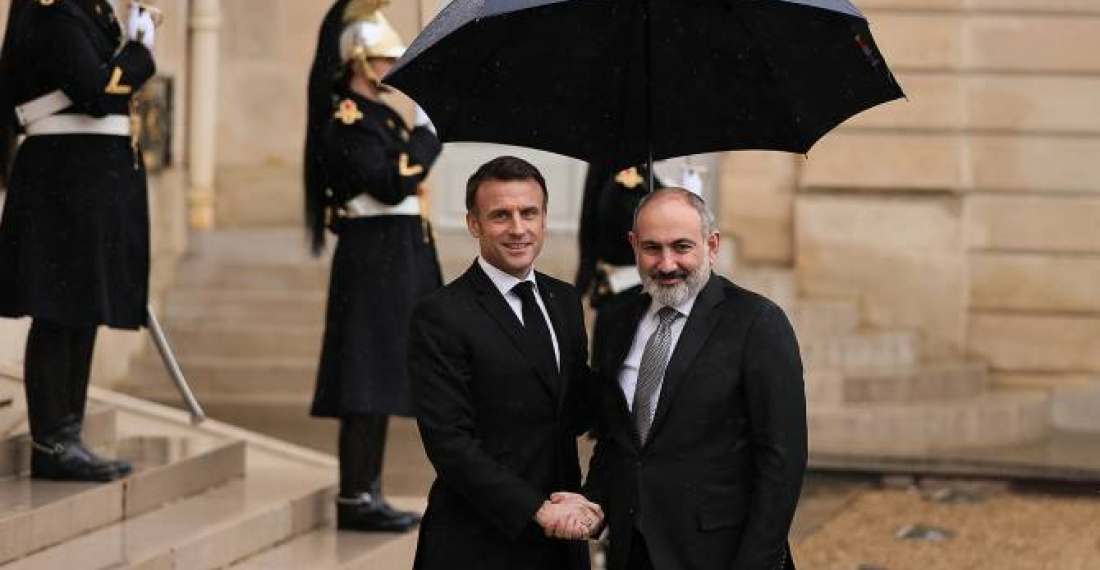
Pashinyan feted at the Elysee as Macron offers unconditional support

Armenian Prime Minister Nikol Pashinyan visited France on 21-22 February at the invitation of President Emmanuel Macron. The official reason for the visit was for Pashinyan to attend the ceremony of the re-burial of a WWII French partisan of Armenian descent Misak Manushyan and his wife, Meline Manushyan, in the pantheon of the greatest figures of France. But the visit was also an opportunity for Macron to re-iterate France's unqualified support for Armenia, its sovereignty, territorial integrity and democracy, under the leadership of Pashinyan. In a joint press conference at the Elysee Palace, Macron hailed Pashinyan’s “courage”:

“I once again want to tell you, to repeat, that you can count on France's support for Armenia, its independence, territorial integrity, democratic process and aspirations for peace.

I would also like to salute, dear Nicole, your personal courage and determination to move forward on this path. Armenia's membership in the International Criminal Court is also a shining example of this commitment. At this moment, as we commemorate Misak and Meline Manushyan, war crimes continue on the continent of Europe, and the fight for freedom, more than ever, requires a fight against impunity.”

In his remarks, Macron also reaffirmed France's support for the Armenia-Azerbaijan peace process, but went out of his way to highlight the issue of the displacement of the Armenian population of Karabakh:

"We also call for the implementation of the decision of the International Court of Justice of November 17, 2023. According to this decision, Azerbaijan must ensure that persons who have left Nagorno-Karabakh since September 19, 2023, and who wish to return can do so safely, unhindered and quickly.

We want the South Caucasus to be a region of peace, integration and cooperation, and it is necessary for communication channels to be factors of integration and not division. I have visited Central Asia and I want communication links between Central Asia, the South Caucasus and the European Union to develop. And I welcome your "Crossroads of Peace" initiative in this common ambition."

The remarks of the French president were criticised in a commentary posted on the website of the Azerbaijani foreign ministry: "As a country, which has never mentioned the rights of Azerbaijanis violated for nearly 30 years, displaced from their territories, and subjected to mass massacres, French side’s statement about the rights and security of Armenians left the territories of Azerbaijan at their own will and without any violence, is completely inappropriate", it said.

In a separate development, it was reported on Thursday that a batch of French military equipment will arrive in Armenia today. The French newspaper Le Figaro said the consignment includes three Thalès Ground Master (GM 200) radars, which will enable the detection of enemy aircraft at a distance of 250 kilometers, as well as night vision devices and binoculars.

It is also noted that the agreement signed between the parties on cooperation in the field of defense provides that the French army will organize 3 mountain combat training courses for Armenians this year.   

Armenia and France signed agreements on defense cooperation on October 23, 2023, during the visit of RA Defense Minister Suren Papikyan to France. 

French Defense Minister Sebastien Lecorne announced in an interview to RTL radio station that he will soon visit Armenia. The French news agency AFP agency reported that the Minister of Defense of France will visit Armenia on February 22 on a two-day visit. 

source: commonspace.eu with elysee.fr, Azerbaijan MFA and agencies
photo: French president Emanuel Macron welcoming Armenian prime minister Nikol Pashinyan at the Elysee Palace on 21 February 2024

Related articles

Editor's choice
News
Borrell tells the European Parliament that the situation in Afghanistan was critical, but the EU will remain engaged

Borrell tells the European Parliament that the situation in Afghanistan was critical, but the EU will remain engaged

Borrell underlined that the European Union will make every effort to support the peace process and to remain a committed partner to the Afghan people. "Of course, we will have to take into account the evolving situation, but disengagement is not an option.  We are clear on that: there is no alternative to a negotiated political settlement, through inclusive peace talks.
Editor's choice
News
NATO Chief says war is on Europe's doorstep, and warns against complacency

NATO Chief says war is on Europe's doorstep, and warns against complacency

Russia could attack a Nato country within the next five years, the Secretary General of NATO, Mark Rutte, said in a stark new warning. "Nato's own defences can hold for now," Rutte warned in Berlin, but conflict was "next door" to Europe and he feared "too many are quietly complacent, and too many don't feel the urgency, too many believe that time is on our side. "Russia is already escalating its covert campaign against our societies," Rutte said in a speech in Germany. "We must be prepared for the scale of war our grandparents or great-grandparents endured." Earlier this month, Russia's President Vladimir Putin said his country was not planning to go to war with Europe, but it was ready "right now" if Europe wanted to - or started a war. But similar reassurances were given by Moscow in 2022, just before 200,000 Russian troops crossed the border and invaded Ukraine. Putin has accused European countries of hindering US efforts to bring peace in Ukraine - a reference to the role Ukraine's European allies have recently played in trying to change a US peace plan to end the war, whose initial draft was seen as favouring Russia. But Putin was not sincere, Nato's secretary-general said in the German capital, Berlin. Supporting Ukraine, he added, was a guarantee for European security. "Just imagine if Putin got his way; Ukraine under the boot of Russian occupation, his forces pressing against a longer border with Nato, and the significantly increased risk of an armed attack against us." Russia's economy has been on a war footing for more than three years now - its factories churn out ever more supplies of drones, missiles and artillery shells. According to a recent report by the Kiel Institute for the World Economy, Russia has been producing each month around 150 tanks, 550 infantry fighting vehicles, 120 Lancet drones and more than 50 artillery pieces. The UK, and most of its Western allies, are simply not anywhere near this point. Analysts say it would take years for Western Europe's factories to come close to matching Russia's mass-production of weapons. "Allied defence spending and production must rise rapidly, our armed forces must have what they need to keep us safe," the Nato chief said.

Popular

Editor's choice
News
NATO Chief says war is on Europe's doorstep, and warns against complacency

NATO Chief says war is on Europe's doorstep, and warns against complacency

Russia could attack a Nato country within the next five years, the Secretary General of NATO, Mark Rutte, said in a stark new warning. "Nato's own defences can hold for now," Rutte warned in Berlin, but conflict was "next door" to Europe and he feared "too many are quietly complacent, and too many don't feel the urgency, too many believe that time is on our side. "Russia is already escalating its covert campaign against our societies," Rutte said in a speech in Germany. "We must be prepared for the scale of war our grandparents or great-grandparents endured." Earlier this month, Russia's President Vladimir Putin said his country was not planning to go to war with Europe, but it was ready "right now" if Europe wanted to - or started a war. But similar reassurances were given by Moscow in 2022, just before 200,000 Russian troops crossed the border and invaded Ukraine. Putin has accused European countries of hindering US efforts to bring peace in Ukraine - a reference to the role Ukraine's European allies have recently played in trying to change a US peace plan to end the war, whose initial draft was seen as favouring Russia. But Putin was not sincere, Nato's secretary-general said in the German capital, Berlin. Supporting Ukraine, he added, was a guarantee for European security. "Just imagine if Putin got his way; Ukraine under the boot of Russian occupation, his forces pressing against a longer border with Nato, and the significantly increased risk of an armed attack against us." Russia's economy has been on a war footing for more than three years now - its factories churn out ever more supplies of drones, missiles and artillery shells. According to a recent report by the Kiel Institute for the World Economy, Russia has been producing each month around 150 tanks, 550 infantry fighting vehicles, 120 Lancet drones and more than 50 artillery pieces. The UK, and most of its Western allies, are simply not anywhere near this point. Analysts say it would take years for Western Europe's factories to come close to matching Russia's mass-production of weapons. "Allied defence spending and production must rise rapidly, our armed forces must have what they need to keep us safe," the Nato chief said.


