


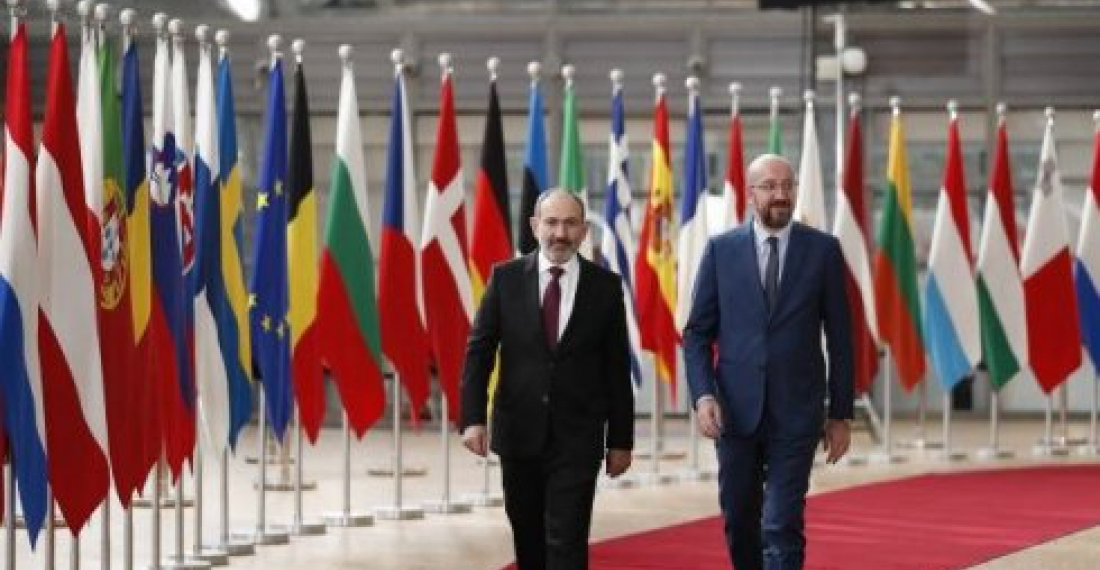
Armenian prime minister Nikol Pashinyan paid a one day visit to Brussels on Monday (9 March), during which he held meetings with senior EU officials.A statement from the European External Action Service said that EU High Representative Josep Borrell met with Armenian Prime Minister Pashinyan to discuss bilateral and regional issues.
"The High Representative and the Prime Minister discussed prospects for the resolution of the Nagorno-Karabakh conflict. The EU fully supports the efforts of the OSCE Minsk Group Co-Chairs for the peaceful resolution of the conflict. The High Representative and the Prime Minister stressed the role of the EU Special Representative for the South Caucasus in this context.
The High Representative welcomed the Prime Minister's commitment to reform and to the implementation of the EU-Armenia Comprehensive and Enhanced Partnership Agreement. The High Representative encouraged the further implementation of reform with EU support."
Sources close to the office of the Armenian prime minister told the media that the two sides highlighted the intensive development of Armenia-EU relations and discussed issues related to future assistance to the Armenian reform process. Josep Borrell reaffirmed the readiness of the EU to support the reform implementation in Armenia. He saluted the fight against corruption, the developments in judicial system and other spheres in Armenia, the sources said.
As an important component of Armenia-EU cooperation, Nikol Pashinyan and Josep Borrell emphasised the importance of the early ratification of the Comprehensive and Enhanced Partnership Agreement by the EU member states and its full realisation.The sides also referred to the possibilities of starting Armenia-EU visa liberalisation talks, according to the sources.
In Brussels Pashinyan also met with the President of the European Council, Charles Michel. Speaking after the meeting Pashinyan highlighted the assistance of the European Union to the reforms in Armenia and expressed confidence that Armenia-EU partnership will continue to develop. "The EU is our main partner in reform implementation process and we felt the helpful assistance of the EU in that process at every moment",Pashinyan was quoted by the semi official Armenpress news agency as saying. Pashinyan emphasized that Armenia will consistently move forward in the direction of developing and strengthening democracy, rule of law and protection of human rights.
During his visit to Brussels, Nikol Pashinyan also met with the president of the European people's Party, Donald Tusk.
source: commonspace.eu with the press service of the EEAS, Armenpress.am and agencies.
photo: European Council President Charles Michel welcoming Armenian prime minister Nikol Pashinyan in Brussels on Monday, 9 March 2020 (picture courtesy of the press service of the primeminister of Armenia.)



