


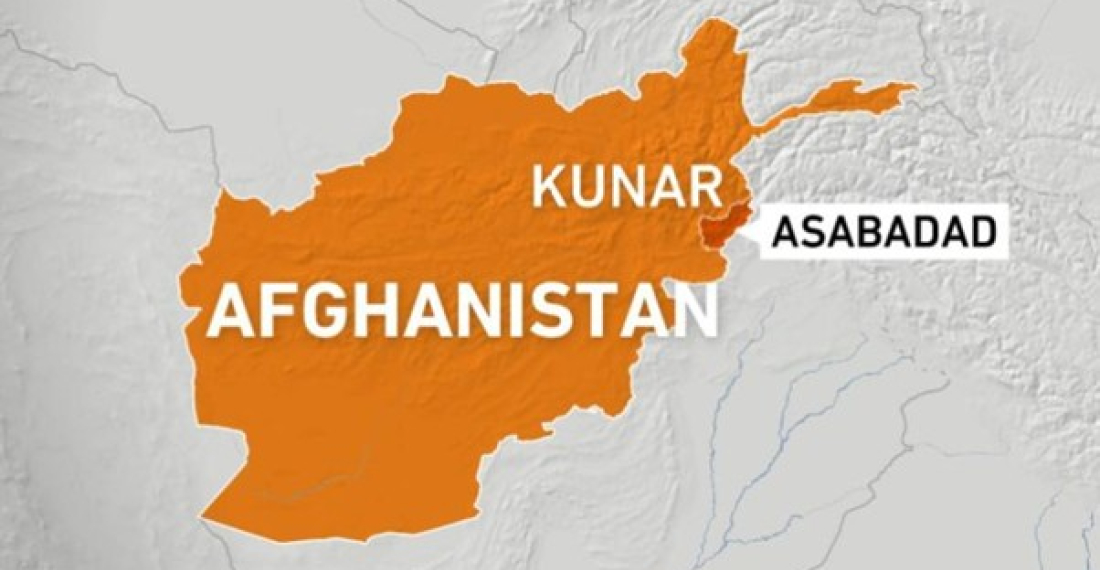
Pakistan bombs University in nearby Afghanistan

Pakistan has bombed a university in Afghanistan, amid an outbreak of new violence between the two neighbours. Pakistan and Afghanistan have accused one another of launching cross-border attacks.

Afghanistan’s Taliban authorities said on Monday (27 April) that four people were killed in attacks in the eastern Kunar province. Pakistani officials reported that at least three civilians were injured by gunfire in South Waziristan.

The resumption of violence threatens fragile peace talks between the neighbours. The two countries agreed on a fragile ceasefire in March that halted weeks of violence.

The Taliban’s Deputy Spokesperson, Hamdullah Fitrat, said that the Pakistani military had launched mortar and rocket attacks that wounded 45 people.

He said that students, women, and children were among those injured as homes and the Sayed Jamaluddin Afghani University in Kunar province’s capital, Asadabad, came under fire.

 A spokesman for Pakistan’s border forces described the incident in South Waziristan as the most serious clash since the ceasefire was declared.

The strikes marked the first major attack since the pair had agreed to halt the violence at peace talks last month, mediated by China.

Turkey, Qatar, the United Arab Emirates, and Saudi Arabia have also made efforts to halt the conflict, with relations between Pakistan and Afghanistan fraught since the Taliban took power for a second time in 2021.

Security issues have proved a sticking point, especially Pakistan’s demand that Afghanistan curb the Tehreek-e-Taliban Pakistan (TTP) armed group, which has conducted regular deadly attacks from its bases in Afghanistan.

Pakistan has witnessed a sharp rise in violence within the country in recent years, including suicide bombings and coordinated assaults targeting security forces.

Islamabad accuses the Taliban government of sheltering the TTP. However, Kabul rejects the charge, countering that it is Pakistan that harbours hostile groups and does not respect Afghanistan’s sovereignty.

The heaviest fighting in years was sparked in February after Afghanistan launched an operation against the Pakistani military along the 2,640km (1,640-mile) Durand Line, which separates the two nations.

Pakistan launched air strikes on Afghanistan’s capital, Kabul, and other cities, declaring that the two countries were at “open war”.

truce was agreed in March during the Muslim holiday of Eid al-Fitr after weeks of fighting.

Mediator China later said the warring sides had agreed to avoid escalation, but the Afghans have since reported sporadic violence.

The new spurt of violence is reportedly linked to the shooting of a child by Pakistani military forces on Sunday near the Afghan border city of Spin Boldak, according to sources quoted by Afghanistan’s TOLOnews. Taliban forces subsequently engaged Pakistani troops.

Source: commonspace.eu with Al Jazeera (Doha) and agencies

Related articles

Editor's choice
News
Women emerge favourite to lead United Nations from next year, after straw-poll of UN Security Council members

Women emerge favourite to lead United Nations from next year, after straw-poll of UN Security Council members

​ Two women have emerged as favourite to lead the United Nations as Secretary-General from 1 January 2027, when the term of the present incumbent, Antonio Gutteres, expires. A straw poll of the members of the UN Security Council, held on Thursday, 30 July showed that of the seven candidates, Rebecca Grynspan of Costa Rica and Carolyn Rodriguez-Birkett of Guyana received ten and nine positive endorsements respectively, by the 15 members UN Security Council Although the poll and its result are supposed to be secret, the result leaked within minutes, and was carried on world media outlets, such as Reuters. The result was as follows   Michelle Bachelet 6 encourage 5  discourage   4 no opinion María Fernanda Espinosa 5 2 8 Rafael Grossi 7 2 6 Rebeca Grynspan 10 1 4 Olara Otunnu 2 5 8 Carolyn Rodrigues-Birkett 9 2 4 Macky Sall 6 7 2   Article 97 of the UN Charter states that the “Secretary-General shall be appointed by the General Assembly upon the recommendation of the Security Council”. Straw polls are informal ballots used to determine the viability of Secretary-General candidates.  The seven current candidates are: Michelle Bachelet Jeria (Chile), who was nominated by Brazil, Chile, and Mexico on 2 February, with Chile withdrawing its nomination on 24 March; María Fernanda Espinosa Garcés (Ecuador), who was nominated by Antigua and Barbuda on 11 May; Rafael Mariano Grossi (Argentina), who was nominated by Argentina on 26 November 2025; Rebeca Grynspan Mayufis (Costa Rica), who was nominated by Costa Rica on 3 March; Olara Otunnu (Uganda), who was nominated by Uganda on 24 July; Carolyn Rodrigues Birkett (Guyana), who was nominated by Guyana on 15 June; and Macky Sall (Senegal), who was nominated by Burundi on 2 March. At Thursday's straw poll, there was no difference between the ballots presented to the five permanent members (P5) and the ten elected members (E10). Council members received one ballot per candidate, containing the candidate’s name followed by three options: “encouraged”, “discouraged”, and “no opinion expressed”.   It is ofcourse early days, and the straw poll is just an informal indication of the mood of the UN Security Council, but the strong showwing by the two womencandidates may be an indication that for the first time, the head of the UN can be a women. (click image to read more) ​

Popular

Editor's choice
Interview
Thursday Interview: Murad Muradov

Thursday Interview: Murad Muradov

Today, commonspace.eu starts a new regular weekly series. THURSDAY INTERVIEW, conducted by Lauri Nikulainen, will host  persons who are thinkers, opinion shapers, and implementors in their countries and spheres. We start the series with an interview with Murad Muradov, a leading person in Azerbaijan's think tank community. He is also the first co-chair of the Action Committee for a new Armenian-Azerbaijani Dialogue. Last September he made history by being the first Azerbaijani civil society activist to visit Armenia after the 44 day war, and the start of the peace process. Speaking about this visit Murad Muradov said: "My experience was largely positive. My negative expectations luckily didn’t play out. The discussions were respectful, the panel format bringing together experts from Armenia, Azerbaijan, and Turkey was particularly valuable during the NATO Rose-Roth Seminar in Yerevan, and media coverage, while varied in tone, remained largely constructive. Some media outlets though attempted to represent me as more of a government mouthpiece than an independent expert, which was totally misleading.  Overall, I see these initiatives as important steps in rebuilding trust and normalising professional engagement. The fact that soon a larger Azerbaijani civil society visits to Armenia followed, reinforces the sense that this process is moving in the right direction." (click the image to read the interview in full)


