Muslims throughout the Caucasus celebrate the Feast of the Sacrifice

Muslims throughout the Caucasus region on Monday join the Muslim ummah worldwide in celebrating Eid al Adha, the feast of the Sacrifice. In Azerbaijan, Turkey and other parts of the Turkic world, the festival is popularly known as Gurban Bayram. Traditionally sheep are slaughtered and ate in gatherings of family and friends.

Islam is the predominant religion in Azerbaijan and in the North Caucasus. There are also large Muslim communities in Georgia,

State leaders have issued messages on the occasion of the festival. In Azerbaijan, president Ilham Aliyev extended greetings to his countrymen on the occasion.

Azerbaijani first vice president Mehriban Aliyeva. in a message posted on her official Instagram page, stated: "Dear fellow countrymen, I heartily congratulate you on the occasion of Eid al-Adha. On this holy day, which is a symbol of humanism, kindness, sharing and compassion, I wish our people health, well-being, peace, and endless love. May Allah accept your prayers!"

Georgian Prime Minister Mamuka Bakhtadze sent good wishes to the country's Muslim citizens, saying "Georgia's wealth is in its diversity" and "over the course of centuries, our ancestors jointly built our homeland". It is our obligation to pass these traditions on to our future generations. Qurban Bayram is a holiday dedicated to hope, love and support of those in need", the prime minister added.

The festival is also very popular in Turkey, Turkish President Recep Tayyip Erdogan on Sunday spoke to several world leaders over the phone to extend greetings with them on the occasion.

Turkey's Directorate of Communications said in a statement that Erdogan had phone calls with Qatari Amir Sheikh Tamim bin Hamad Al Thani, Uzbek President Shavkat Mirziyoyev, Iranian President Hassan Rouhani, Azerbaijani President Ilham Aliyev, Pakistani Prime Minister Imran Khan, Saudi King Salman bin Abdulaziz al Saud and Kuwaiti Amir Sheikh Sabah al-Ahmad al-Jaber al-Sabah.

Erdogan and the leaders exchanged greetings for the Eid al-Adha, it added.

Millions of Russian muslims in the North caucasus and other parts of the Russian Federation are also marking the holiday. Russian President Vladimir Putin has congratulated the Muslims of Russia on the Eid al-Adha Islamic holiday, wishing them peace, happiness and prosperity, according to a telegram published on the Kremlin's website on Sunday.

"This holiday, which is one of the main and the most respected ones by the Muslims, marks the end of the pilgrimage to the holy places and serves to unite people, strengthen the eternal values of love, kindness and mercy. It is pleasant that Russian Muslims cherish the rich cultural and spiritual heritage of their fathers and grandfathers, educate the younger generation to respect history, traditions and customs of their ancestors," Putin said.

According to Putin, life of the Muslim community is filled with good deeds and undertakings, and great attention is paid to fulfilling social and educational initiatives.

The Russian president highlighted the great contribution of Muslim organizations in developing fruitful cooperation with state and public institutions and maintaining dialogue between ethnic groups and religions.

The editorial team of commonspace.eu extend our best wishes on the occasion of Eid al Adha to our readers and subscribers in the Caucasus region and world wide. Eid Mubarak!

source: commonspace.eu with agencies.

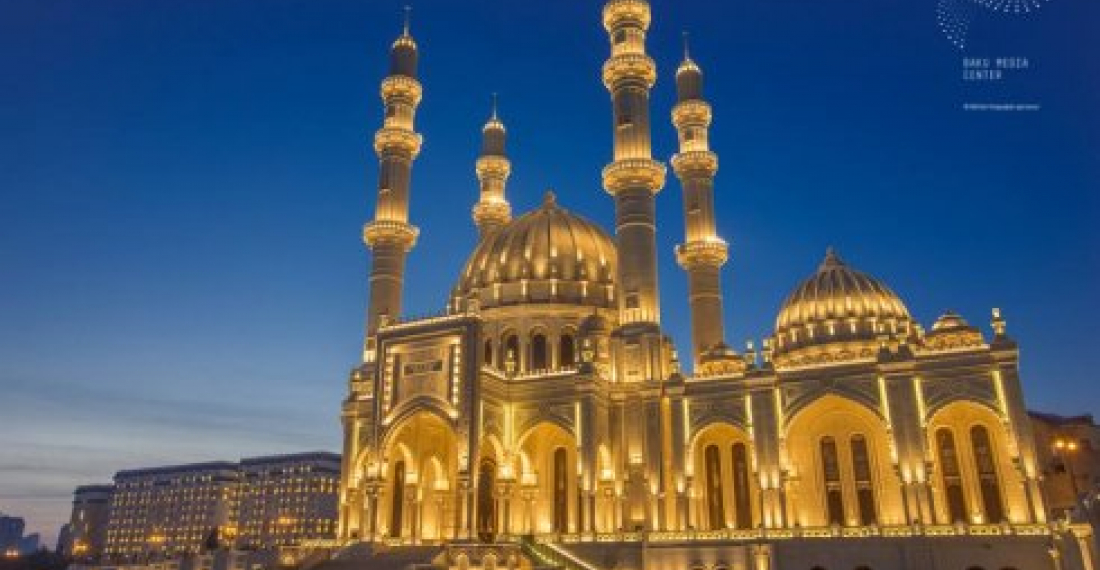
photo: The Heydar Mosque in Baku, the largest mosque in the Caucasus, covers a total area of 12,000 square meters, and has four 95m-height minarets. (picture courtesy of the Baku Media Centre).


Related articles

Editor's choice
News
Council of Europe launches new International Claims Commission for Ukraine

Council of Europe launches new International Claims Commission for Ukraine

Thirty-four countries and the European Union have signed a new convention establishing an International Claims Commission for Ukraine at a diplomatic conference co-hosted by the 46-nation Council of Europe and the Netherlands in the Hague. The diplomatic conference was attended by leaders and high-level representatives from over 50 states, including the President of Ukraine, Volodymyr Zelenskyy, the President of the Republic of Moldova, Maia Sandu, and the Prime Minister of the Netherlands, Dick Schoof.  “Today marks a major step forward in ensuring accountability for Ukraine. The International Claims Commission represents justice and hope for tens of thousands of victims—our determination that those who have suffered will not be forgotten. I call for quick ratifications so we can get the commission rapidly up and running for the people of Ukraine,” said Council of Europe Secretary General Alain Berset. Ukrainian President Volodymyr Zelenskyy said: “We expect that every mechanism for compensation from the Register of Damage and Claims Commission to the actual payments – will start working and receive strong and sufficient international support, so that people can truly feel that any kind of damage caused by the war can be compensated. This war, and Russia’s responsibility for it, MUST become a clear example – so that others learn not to choose aggression.” “Accountability is about creating the conditions for peace that endures. And therefore, accountability is a condition of security – today and for the future. But accountability is not only about Ukraine. And it is not only about one aggressor and one victim. Accountability is about Europe. About every country in Europe. It is about whether Europe, as a whole, is willing to defend its peace,” said Maia Sandu, President of the Republic of Moldova, which currently holds the Presidency of the Council of Europe’s Committee of Ministers. The Prime Minister of the Netherlands, Dick Schoof, said: “Every day Russia is deliberately bombarding homes, destroying businesses and damaging infrastructure in Ukraine. Russia must compensate Ukraine for the damage caused. That is why we have launched the International Claims Commission for Ukraine and we are honoured to host it.” The International Claims Commission will be the second part of a comprehensive compensation mechanism related to Russia’s war of aggression, building on the existing Register of Damage for Ukraine. The claims commission will be established within the framework of the Council of Europe and will also be open to other countries. The Register of Damage for Ukraine, created in 2023, collects and records compensation claims submitted by individuals, organisations and public bodies in Ukraine. Forty-four states and the European Union have so far joined the Register, which has already received 86,000 claims. The International Claims Commission will review, assess and decide upon claims submitted to the Register of Damage for Ukraine and determine the amount of compensation, if any, which is due in each case. The convention establishing the commission will enter into force once it has been ratified by 25 signatories, as long as sufficient funds have been secured to support its initial work.

Popular

Editor's choice
News
Council of Europe launches new International Claims Commission for Ukraine

Council of Europe launches new International Claims Commission for Ukraine

Thirty-four countries and the European Union have signed a new convention establishing an International Claims Commission for Ukraine at a diplomatic conference co-hosted by the 46-nation Council of Europe and the Netherlands in the Hague. The diplomatic conference was attended by leaders and high-level representatives from over 50 states, including the President of Ukraine, Volodymyr Zelenskyy, the President of the Republic of Moldova, Maia Sandu, and the Prime Minister of the Netherlands, Dick Schoof.  “Today marks a major step forward in ensuring accountability for Ukraine. The International Claims Commission represents justice and hope for tens of thousands of victims—our determination that those who have suffered will not be forgotten. I call for quick ratifications so we can get the commission rapidly up and running for the people of Ukraine,” said Council of Europe Secretary General Alain Berset. Ukrainian President Volodymyr Zelenskyy said: “We expect that every mechanism for compensation from the Register of Damage and Claims Commission to the actual payments – will start working and receive strong and sufficient international support, so that people can truly feel that any kind of damage caused by the war can be compensated. This war, and Russia’s responsibility for it, MUST become a clear example – so that others learn not to choose aggression.” “Accountability is about creating the conditions for peace that endures. And therefore, accountability is a condition of security – today and for the future. But accountability is not only about Ukraine. And it is not only about one aggressor and one victim. Accountability is about Europe. About every country in Europe. It is about whether Europe, as a whole, is willing to defend its peace,” said Maia Sandu, President of the Republic of Moldova, which currently holds the Presidency of the Council of Europe’s Committee of Ministers. The Prime Minister of the Netherlands, Dick Schoof, said: “Every day Russia is deliberately bombarding homes, destroying businesses and damaging infrastructure in Ukraine. Russia must compensate Ukraine for the damage caused. That is why we have launched the International Claims Commission for Ukraine and we are honoured to host it.” The International Claims Commission will be the second part of a comprehensive compensation mechanism related to Russia’s war of aggression, building on the existing Register of Damage for Ukraine. The claims commission will be established within the framework of the Council of Europe and will also be open to other countries. The Register of Damage for Ukraine, created in 2023, collects and records compensation claims submitted by individuals, organisations and public bodies in Ukraine. Forty-four states and the European Union have so far joined the Register, which has already received 86,000 claims. The International Claims Commission will review, assess and decide upon claims submitted to the Register of Damage for Ukraine and determine the amount of compensation, if any, which is due in each case. The convention establishing the commission will enter into force once it has been ratified by 25 signatories, as long as sufficient funds have been secured to support its initial work.