


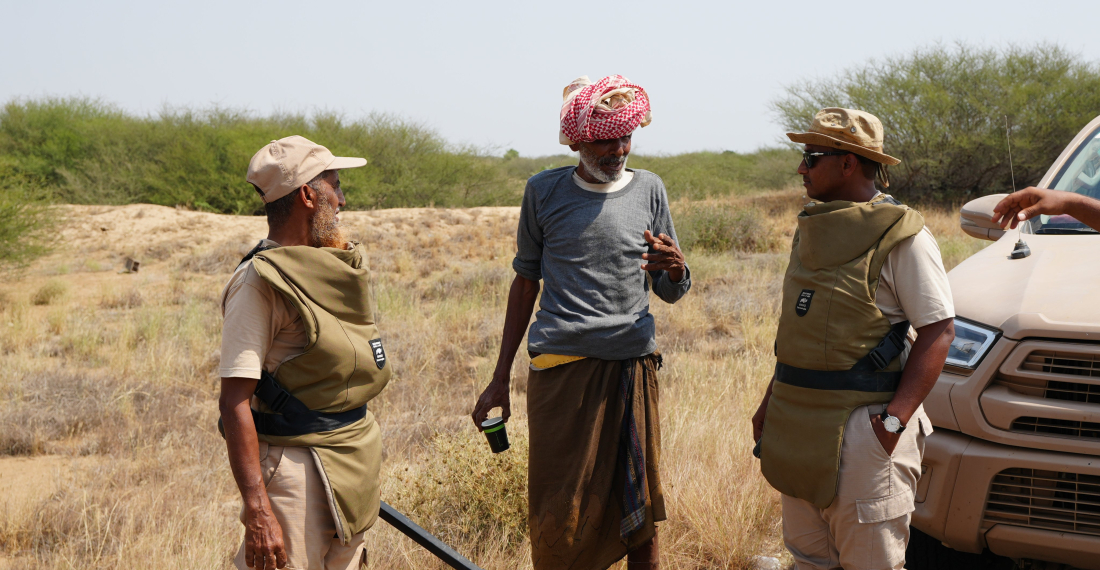
Masam landmine clearance project discovers an anti-tank minefield in northern Hajjah province, Yemen

On Thursday (16 October), Al-Sahwah reported that the Masam landmine clearance project, launched by the King Salman Humanitarian Aid and Relief Centre, had discovered a new anti-tank minefield in the Midi district of the northern Hajjah province in Yemen. The minefield was cordoned off and classified as hazardous due to its proximity to a residential area.

At the same time, the Masam project continued its awareness and advocacy campaigns in western coastal schools in Yemen, where over 230 students had the opportunity to learn about remnants of war and how to protect themselves and their families from them.

The International Committee of the Red Cross has long declared Yemen one of the most heavily mined countries in the world after decades of conflict. The highest level of contamination in Yemen is around the west coast, near the ports of Hodeida, and the governorates of Taiz, Marib, Mokha and Al Hudaydah. According to the 2025 Humanitarian Needs and Response Plan (HNRP), an estimated 5.2 million people in Yemen need mine action interventions, which include awareness campaigns. 

In Yemen, landmines have had a devastating impact on civilians. Since March 2015, more than 9,500 people, predominantly women and children, have been killed or injured, according to the Yemen Executive Mine Action Center (YEMAC) in Sana’a. Women and children are particularly vulnerable, as they tend to be involved in activities such as collecting wood or tending to the livestock. 

Landmines affect the post-war reconstruction in these areas as they obstruct the free movement of goods and people and cut off access to essential services such as infrastructure, employment, education, and other aspects of life.


Source: commonspace.eu with Al-Sahwah and other agencies

Related articles

Popular

Editor's choice
Interview
Thursday Interview: Murad Muradov

Thursday Interview: Murad Muradov

Today, commonspace.eu starts a new regular weekly series. THURSDAY INTERVIEW, conducted by Lauri Nikulainen, will host  persons who are thinkers, opinion shapers, and implementors in their countries and spheres. We start the series with an interview with Murad Muradov, a leading person in Azerbaijan's think tank community. He is also the first co-chair of the Action Committee for a new Armenian-Azerbaijani Dialogue. Last September he made history by being the first Azerbaijani civil society activist to visit Armenia after the 44 day war, and the start of the peace process. Speaking about this visit Murad Muradov said: "My experience was largely positive. My negative expectations luckily didn’t play out. The discussions were respectful, the panel format bringing together experts from Armenia, Azerbaijan, and Turkey was particularly valuable during the NATO Rose-Roth Seminar in Yerevan, and media coverage, while varied in tone, remained largely constructive. Some media outlets though attempted to represent me as more of a government mouthpiece than an independent expert, which was totally misleading.  Overall, I see these initiatives as important steps in rebuilding trust and normalising professional engagement. The fact that soon a larger Azerbaijani civil society visits to Armenia followed, reinforces the sense that this process is moving in the right direction." (click the image to read the interview in full)

