


For many, the worst is yet to come

Will Murray looks at the march of coronavirus and with the worst yet to come for many says that it now more important than ever to follow the advice of the medical authorities.

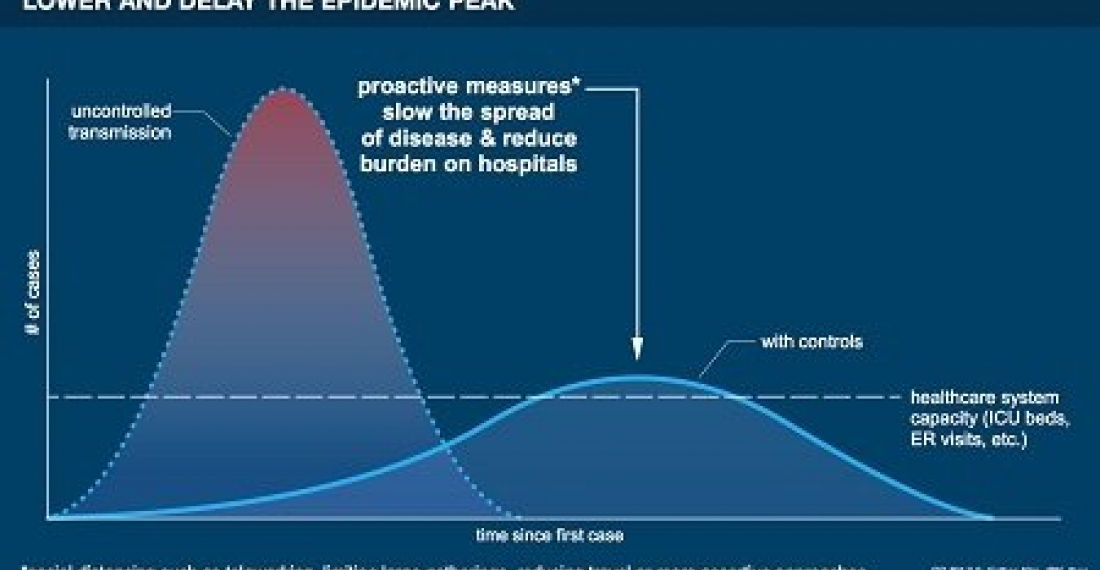
By now, you may be familiar with the widely-circulated graph with the number of coronavirus cases over time, alongside healthcare system capacity and two arched curves - a sharp peak and a shallow peak (see above). The lines visually represent the trajectory of coronavirus cases with and without precautionary measures, such as handwashing and social distancing. Whilst in the first curve where the virus runs its natural course, the demand for hospital treatment is significantly higher than the healthcare system can handle; the second curve, whilst taking more time, is significantly more manageable. As we have seen in Italy, the greatest number of people die from the virus when beds in intensive care units fill up [1]. This graph highlights just how essential preventative measures are helping to 'flatten the curve', mitigating the deaths likely to occur.

So, with the currently implemented lock downs and preventionary measures, when is the virus likely to peak across countries in Europe and beyond?

In Western Europe, the UK expects the height of the virus in two-three weeks [2]; the French peak is likely sometime around the 5th of April [3]; and swamped medical teams in Spain and Italy are hoping for it by the end of this month [4][5]. In the Netherlands, Jaap van Dissel, Director of the Public Health Institute RIVM, has suggested the peak occurring at some time in the end of May [6]


In Eastern Europe, Poland expects its peak in the middle of April [7], with Romanian and Czech Ministries of Health, amongst others, saying that projections of the virus will depend on the effectiveness of the measures currently being put in place [8][9].

In the South Caucasus, it is still too early to predict exactly how the virus will develop, but cases continue to rise in Armenia, Azerbaijan and Georgia.

Although these are just a few of the countries on the continent, it is quite clear that for most of us, the worst is yet to come. It's now more important than ever that we continue to follow guidelines set out by the World Health Organization and our local medical authorities to 'flatten the curve', preventing our medical services from becoming overwhelmed.

References:

[1] NY Times - Dip in Italy's Cases Does Not Come Fast Enough for Swamped Hospitals

https://www.nytimes.com/2020/03/23/world/europe/italy-coronavirus-hospitals.html?auth=login-google

[2] The Scotsman - 'When will coronavirus peak in the UK? Predictions based on infection curve, Italy and government guidance'

https://www.scotsman.com/health/coronavirus/when-will-coronavirus-peak-uk-predictions-based-infection-curve-italy-and-government-guidance-2519753

[3] Le Journal des Femmes - 'Coronavirus : carte en France, cas par région, décès, courbe, pic'

https://sante.journaldesfemmes.fr/maladies/2605417-coronavirus-carte-france-cas-deces-courbe-pic-italie-symptome-monde-chine-italie-espagne-etats-unis/

[4] EU Observer - Spain prays to reach peak of pandemic this week

https://euobserver.com/coronavirus/147850

[5] Huffington Post - 'Silvio Brusaferro (Iss): "Dal 19-20 marzo curva contagi sembra attenuarsi"'

[6] NLTimes.nl - 'Dutch Coronavirus Infection Rate Declining: Health Officials; ICU Peak Expected in May'

https://nltimes.nl/2020/03/25/dutch-coronavirus-infection-rate-declining-health-officials-icu-peak-expected-may

[7] ExMetric - '9 tys. Zakażeń i wyraźne zahamowanie w okolicy 15 kwietnia. Prognoza przebiegu epidemii koronawirusa w polsce - model exmetrix'

http://www.exmetrix.com/pl/uncategorized/9-tys-zakazen-i-wyrazne-zahamowanie-w-okolicy-15-kwietnia-prognoza-przebiegu-epidemii-koronawirusa-w-polsce-model-exmetrix/

[8] Czech Republic Ministry of Health - 'Datová a informační základna pro management pandemie COVID-19'

[9] Romania Insider - 'Romania considers home treatment for mild Covid-19 patients if total number of cases goes over 4,000'

https://www.romania-insider.com/home-treatment-coronavirus-romania

source: This article prepared by Will Murray is published as a public service announcement by commonspace.eu


 

Related articles

Editor's choice
News
Thousands join Pope on his last day in Cameroon, his second stop on his African tour

Thousands join Pope on his last day in Cameroon, his second stop on his African tour

More than 120,000 people joined Pope Leo XIV in Cameroon for an open-air Mass on Friday (17 April), the biggest crowd so far during his 11-day Africa tour. Arriving in the economic city of Douala on Friday, the Pope reiterated his message of peace after visiting the country's Anglophone region hit by a decade-long rebellion the day before. He later warned of the dangers of artificial intelligence (AI), which he said was leading to the spread of "polarisation, conflict, fear and violence". Jubliant crowds welcomed the Pope as he arrived at the Japoma Stadium. Standing in his vehicle - known as the Popemobile - the pontiff waved at the droves of people waiting for his entrance. Some worshippers camped outside the premises on Thursday night in a bid to get a prime spot for the pontiff's address, with some having been there for more than 24 hours By Friday, tens of thousands of people of all ages, including several from the priesthood, braved the heat to participate in the occasion. “Do not give in to distrust and discouragement,” he said. “Reject every form of abuse or violence, which deceives by promising easy gains but hardens the heart and makes it insensitive. Do not forget that your people are even richer than this land, for your treasure lies in your values: faith, family, hospitality, and work.” Pope Leo invited African youth to follow the vocation that God sets out for them, so that they may be protagonists of their own future. “Do not let yourselves be corrupted by temptations that waste your energies and do not serve the progress of society,” he said.
Editor's choice
News
Russian attacks on Kyiv and other Ukrainian cities highlights need of strengthening European resolve

Russian attacks on Kyiv and other Ukrainian cities highlights need of strengthening European resolve

Ukrainian President Volodymyr Zelensky condemned the attack, writing on X that it proved that US and European sanctions against Russia should not be weakened. Russia launched more than 700 drones and missiles at Ukraine in multiple waves overnight from Wednesday to Thursday, killing at least 18 people in what local officials said was the deadliest attack in months. Ukraine's air force said on Thursday morning that Russia had launched 659 drones and 44 cruise and ballistic missiles in the prior 24 hours. It said that 636 drones and 31 missiles had been shot down - but there had been direct hits in 26 locations. (click picture to read more)

Popular

Editor's choice
Interview
Thursday Interview: Murad Muradov

Thursday Interview: Murad Muradov

Today, commonspace.eu starts a new regular weekly series. THURSDAY INTERVIEW, conducted by Lauri Nikulainen, will host  persons who are thinkers, opinion shapers, and implementors in their countries and spheres. We start the series with an interview with Murad Muradov, a leading person in Azerbaijan's think tank community. He is also the first co-chair of the Action Committee for a new Armenian-Azerbaijani Dialogue. Last September he made history by being the first Azerbaijani civil society activist to visit Armenia after the 44 day war, and the start of the peace process. Speaking about this visit Murad Muradov said: "My experience was largely positive. My negative expectations luckily didn’t play out. The discussions were respectful, the panel format bringing together experts from Armenia, Azerbaijan, and Turkey was particularly valuable during the NATO Rose-Roth Seminar in Yerevan, and media coverage, while varied in tone, remained largely constructive. Some media outlets though attempted to represent me as more of a government mouthpiece than an independent expert, which was totally misleading.  Overall, I see these initiatives as important steps in rebuilding trust and normalising professional engagement. The fact that soon a larger Azerbaijani civil society visits to Armenia followed, reinforces the sense that this process is moving in the right direction." (click the image to read the interview in full)

