Kazakh yurt appears in Slovak capital Bratislava to mark Nauryz

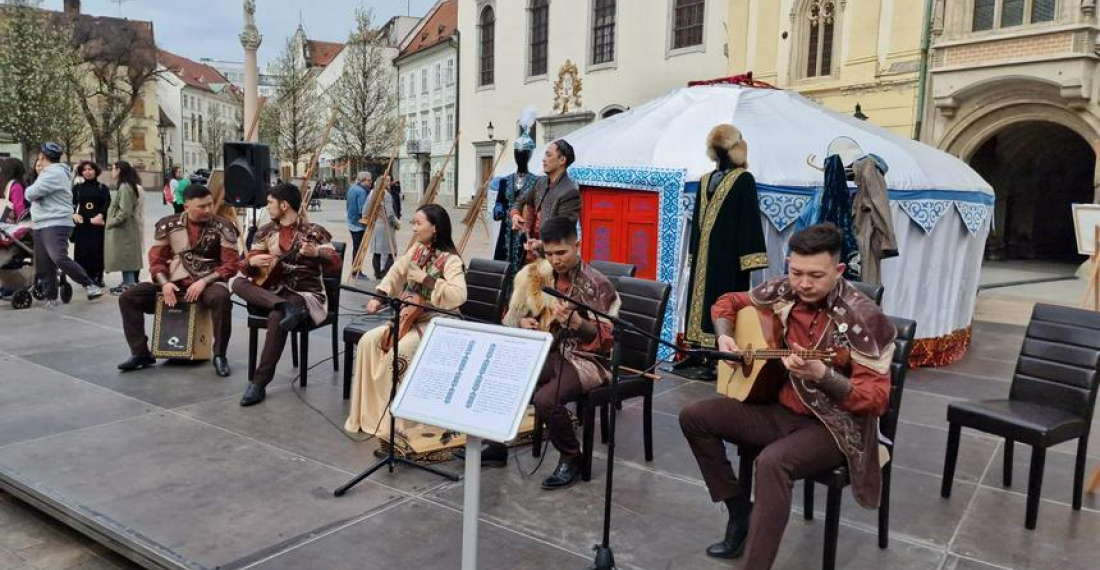
A traditional Kazakh yurt has been erected in the Slovak capital of Bratislava to celebrate the springtime festival of Nauryz. The installation was organised by the Embassy of Kazakhstan and supported by city authorities, reports Kazinform.

The traditional dwelling of Kazakhs and a national symbol of Kazakhstan, the yurt has recently become increasingly associated with peace, harmony, and solidarity after a number of "Yurts of Invincibility" were installed across Ukraine.

In Bratislava, the interior of the yurt was decorated with Kazakh national costumes, painted leather panels, carpets, ribbons, musical instruments, nomadic armor and a traditional Kazakh whip called a "kamcha".

Opening the exhibition, the Kazakh Ambassador to Slovakia Tolezhan Barlybayev spoke about the importance of the yurt, which is a symbol of the hearth and the continuation of the family.

The cultural event on Bratislava's main square also included an art workshop with students from the Ladon Bratislava School of Arts, the works from which will form the basis of the permanent exhibition "Kazakhstan through the eyes of Slovak children".

This year will see the ethnographic exhibition travel around various regions of Slovakia.

source: commonspace.eu with Kazinform
photo: Kazinform
 

Related articles

Editor's choice
News
Donald Tusk: "One for all, and all for one! Otherwise we are finished."

Donald Tusk: "One for all, and all for one! Otherwise we are finished."

Europe is rattled by events in Venezuela, and there are serious concerns that US disregard for international law may have consequences close to home.  The BBC diplomatic correspondent, James Landale, said, the question is how Europe may respond in the longer term to America's military operation in Venezuela. Will it provide a catalyst for the continent to take greater responsibility for its own security in the face of so much instability from what many see as an unreliable ally? Polish prime minister, Donald Tusk, appears to have answered the question, saying on social media: "No-one will take seriously a weak and divided Europe: neither enemy nor ally. It is already clear now. "We must finally believe in our own strength, we must continue to arm ourselves, we must stay united like never before. One for all, and all for one. Otherwise, we are finished." The US seizing of Venezuela's leader has faced strong criticism from both America's friends and foes at an emergency meeting of the United Nations Security Council, held on Monday, 5 January. Many member states agreed with the US that Nicolás Maduro had been an illegitimate and repressive leader. But many also condemned the US military action as a breach of international law and the UN Charter, and they demanded a democratic transition that reflected the will of the Venezuelan people. (click the image to read the full article).

Popular

Editor's choice
News
Donald Tusk: "One for all, and all for one! Otherwise we are finished."

Donald Tusk: "One for all, and all for one! Otherwise we are finished."

Europe is rattled by events in Venezuela, and there are serious concerns that US disregard for international law may have consequences close to home.  The BBC diplomatic correspondent, James Landale, said, the question is how Europe may respond in the longer term to America's military operation in Venezuela. Will it provide a catalyst for the continent to take greater responsibility for its own security in the face of so much instability from what many see as an unreliable ally? Polish prime minister, Donald Tusk, appears to have answered the question, saying on social media: "No-one will take seriously a weak and divided Europe: neither enemy nor ally. It is already clear now. "We must finally believe in our own strength, we must continue to arm ourselves, we must stay united like never before. One for all, and all for one. Otherwise, we are finished." The US seizing of Venezuela's leader has faced strong criticism from both America's friends and foes at an emergency meeting of the United Nations Security Council, held on Monday, 5 January. Many member states agreed with the US that Nicolás Maduro had been an illegitimate and repressive leader. But many also condemned the US military action as a breach of international law and the UN Charter, and they demanded a democratic transition that reflected the will of the Venezuelan people. (click the image to read the full article).