


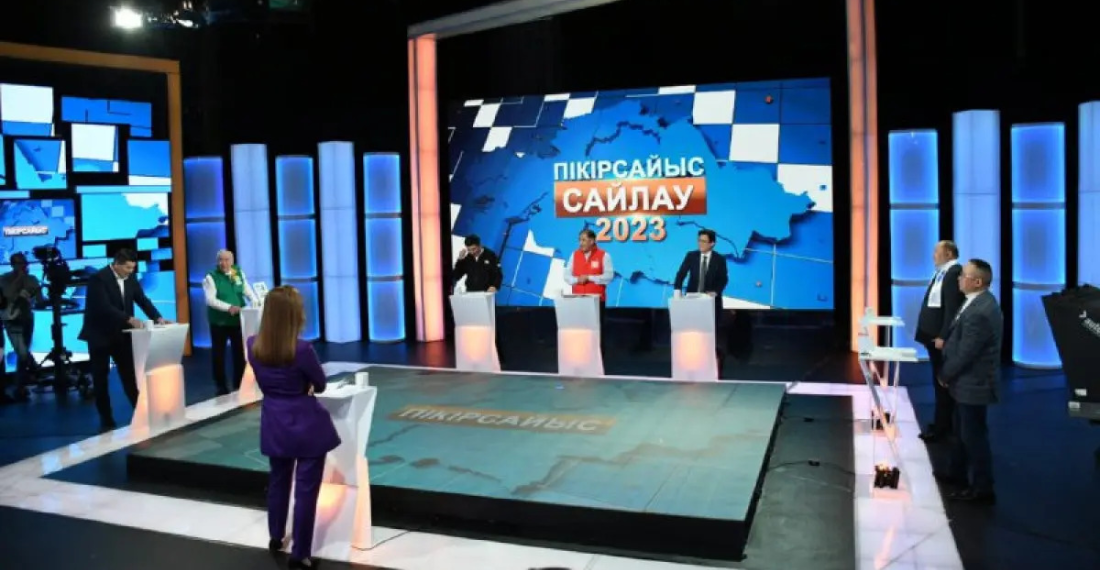
Kazakh parties outline priorities in TV debate ahead of 19 March election

Representatives of seven political parties in Kazakhstan debated live on TV on Wednesday (1 March) ahead of the country's 19 March elections to the lower house of parliament, the Mazhilis.

Participants included Berik Dyusembinov, Deputy Chair of the Aq Jol Democratic party; Yelnur Beisenbayev, Executive Secretary of the Amanat party, the party of current President Kassym-Jomart Tokayev; Zhiguli Dairabayev, Deputy Chair of the Auyl People’s Democratic Patriotic party; Azamatkhan Amirtai, Chair of the Baytaq Green party; Askhat Assylbekov, Deputy Chair of the People’s party of Kazakhstan; Nurlan Auesbayev, Chair of the Astana branch of the National Social Democratic party (NSDP); and Syrymbek Tau, Co-Chair of the Respublica party.

The debate lasted 70 minutes and consisted of four rounds. The first round focused on the main priorities of the parties’ election programmes. In the second round, participants asked and responded to each other’s questions. In the third round, debate moderator Armangul Toktamurat challenged the participants to identify three issues they would try to resolve first if elected to the Mazhilis. And finally, in the fourth round, each party leader made a personal address to the audience.

Below is a summary of each party's priorities and pledges, according to the 1 March debate.

Aq Jol Democratic Party

  • Returning to free market conditions, producing tangible economic results.
  • Minimising government participation, but the parliament should have a say in approving and controlling the state budget.
  • The majority party should form the government to increase its accountability before the parliament.
  • Improving the judiciary system. 
  • Accountability of tax authorities that harm businesses. 

Amanat Party

  • Eliminating injustice, oligopolies and corruption.
  • Raising income, decreasing the age limit for retirees, boosting social help, and supporting the interests of children and youth.
  • Prioritising social equality, rule of law, the revival of villages and the agro-industrial industry.
  • Promoting the Kazakh language to consolidate society.

Auyl Party

  • Improving the country's agricultural sector.
  • Changing the tax regime for agrarian workers, and elevating the status of working people who "provide food for the country".
  • Improving infrastructure in villages by ensuring good roads, water, gas, and internet.
  • Adopting a law on food safety and stable management of the country’s agricultural sector with strict monitoring.

Baytaq Green Party

  • Protection of the environment and human health, concentrating on local self-government.
  • Accountability of enterprises and officials for environmental pollution.
  • Revision of the Environmental Code.
  • Restoration of environmental science in Kazakhstan.
  • Eradication of social inequality by assisting vulnerable citizens.

People's Party

  • Prioritising forming a solid middle class and promoting justice.
  • Popular elections for district courts.
  • Adopting new laws to combat poverty, tax reform, increased social assistance for minors, a minimum wage, female retirement at 58, temporary residence for newlyweds, and mortgage rates not exceeding 3%.
  • Providing a land plot for every citizen, as well as free education and medical care.
  • Repossessing oligarchs’ property and return illegally privatised enterprises to the state.
  • Improving youth policy by providing housing and increasing student stipends.

National Social Democratic Party

  • Eradicating corruption and addressing medical care, housing, pensions, and wages.
  • Focusing on helping the poorest citizens first.
  • Eliminating the oligarchic system.
  • Ensuring control over the country’s resources by returning all illegally obtained assets to the people.

Respublica Party

  • Tackling disparity in education and medium-sized entrepreneurship between cities and the countryside.
  • Develop good living standards for rural residents.
  • Youth support in villages and cities, creating competitive conditions for qualified young people.
  • Providing decent wages to encourage young people not to leave abroad for work.

Elections in Kazakhstan are still deeply flawed despite ongoing reforms

The election will take place on 19 March 2023, with seven political parties and candidates in single-member districts competing for 98 seats in the Mazhilis, and for 3,415 seats in local representative bodies, known as maslikhats.

Kazakhstan's last major election took place on 20 November 2022, when incumbent President Kassym-Jomart Tokayev was re-elected, winning 81.3% of the votes.

According to the OSCE election monitoring mission, the 20 November presidential election took place in a "political environment lacking competitiveness and, while efficiently prepared, the election underlined the need for further reforms". The OSCE added that President Tokayev was "not meaningfully challenged", and the "ability of citizens to participate fully in political life remains significantly constrained".

After the election, Urszula Gacek, the Head of the ODIHR election observation mission, commented, "with the anticipated parliamentary elections coming soon, there is an opportunity to address the issues identified in today’s statement, including with regard to counting and tabulation procedures to safeguard the transparency and integrity of the vote."
source: commonspace.eu with The Astana Times and OSCE
photo: The Astana Times

Related articles

Editor's choice
News
Russia adds pressure on Armenia ahead of key elections; recalls Ambassador in Yerevan for consultations

Russia adds pressure on Armenia ahead of key elections; recalls Ambassador in Yerevan for consultations

Ahead of key parliamentary elections,scheduled to be held in Armenia on Sunday, 7 June, Russia continues to attempt to put pressure on the Armenian Government led by prime minister Nikol Pashinyan. On 30 May, Russia recalled its Ambassador to Yerevan for consultations. A terse statement, published on the website of the Russian Foreign Ministry, said, "The Ambassador of the Russian Federation to the Republic of Armenia , S.P. Kopyrkin, has been summoned to Moscow for consultations in connection with the steps taken by the Armenian leadership to move closer to the European Union, which are detrimental to cooperation within the EAEU." This followed a statement issued the day before, by the leaders of the Eurasian Economic Union (EAEU) that challenges the Armenian trajectory towards approximating to the European Union. Vladimir Putin is undertood to have personally pushed the other four EAEU leaders to issue the statement, which said: "Taking into account the significant risks to the economic security of the member states of the Eurasian Economic Union (hereinafter referred to as the Union) arising in connection with the preparation of the Republic of Armenia for accession to the European Union, as well as the need to prevent the associated damage to the member states of the Union: decided that the members of the Eurasian Intergovernmental Council from the Republic of Belarus, the Republic of Kazakhstan, the Kyrgyz Republic and the Russian Federation will report at the next meeting of the Supreme Eurasian Economic Council in December 2026 on the possible consequences of the suspension of the Treaty on the Eurasian Economic Union with respect to the Republic of Armenia. We share the position on the need to hold a national referendum in the Republic of Armenia as soon as possible on joining the European Union or continuing to be part of the Eurasian Economic Union."
Editor's choice
News
The leaders of the states of the Eurasian Economic Union issued a tough statement warning fellow-member state Armenia of the consequences of its desire to join the European Union.

The leaders of the states of the Eurasian Economic Union issued a tough statement warning fellow-member state Armenia of the consequences of its desire to join the European Union.

The leaders of the states of the Eurasian Economic Union (EEAS) issued a tough statement warning fellow-member state Armenia of the consequences of its desire to join the European Union. The stark, sharply worded,  warning, comes days before crucial parliamentary elections in Armenia, scheduled for 7 June. The full statement said, “We, the Presidents of the Republic of Belarus, the Republic of Kazakhstan, the Kyrgyz Republic and the Russian Federation, Taking into account the actions of the Republic of Armenia aimed at joining the European Union, including the approval in 2025 by the National Assembly of the Republic of Armenia and the signing by the President of the Republic of Armenia of the Law of the Republic of Armenia "On the Start of the Process of Accession of the Republic of Armenia to the European Union", as well as the confirmation by the European Union of the European aspirations of the Government of the Republic of Armenia, expressed in the joint declaration following the first Armenia-European Union summit, adopted on 5 May 2026, Taking into account the significant risks to the economic security of the member states of the Eurasian Economic Union (hereinafter referred to as the Union) arising in connection with the preparation of the Republic of Armenia for accession to the European Union, as well as the need to prevent the associated damage to the member states of the Union: decided that the members of the Eurasian Intergovernmental Council from the Republic of Belarus, the Republic of Kazakhstan, the Kyrgyz Republic and the Russian Federation will report at the next meeting of the Supreme Eurasian Economic Council in December 2026 on the possible consequences of the suspension of the Treaty on the Eurasian Economic Union with respect to the Republic of Armenia. We share the position on the need to hold a national referendum in the Republic of Armenia as soon as possible on joining the European Union or continuing to be part of the Eurasian Economic Union. Astana, May 29, 2026” A meeting of the Supreme Eurasian Economic Council was held in Astana, Kazakhstan, on May 29, 2026. The meeting of the Supreme Eurasian Economic Council in a restricted format was attended by Russian President Vladimir Putin, Belarusian President Alexander Lukashenko , Kazakh President Kassym-Jomart Tokayev , Kyrgyz President Sadyr Japarov , Armenian Deputy Prime Minister Mher Grigoryan, and Chairman of the Board of the Eurasian Economic Commission Bakytzhan Sagintayev. From the Russian side, the meeting was also attended by Deputy Prime Minister and member of the Council of the Eurasian Economic Commission Alexey Overchuk and Presidential Aide Yury Ushakov . The heads of delegations from EAEU observer states, including President of Uzbekistan Shavkat Mirziyoyev , Vice President of Cuba Salvador Valdés Mesa, Minister of Industry, Mines, and Trade of Iran Mohammad Atabak, and CIS Secretary General Sergei Lebedev, joined the expanded meeting . Following the meeting of the Supreme Eurasian Economic Council, a number of documents were signed .

Popular

Editor's choice
Interview
Thursday Interview: Murad Muradov

Thursday Interview: Murad Muradov

Today, commonspace.eu starts a new regular weekly series. THURSDAY INTERVIEW, conducted by Lauri Nikulainen, will host  persons who are thinkers, opinion shapers, and implementors in their countries and spheres. We start the series with an interview with Murad Muradov, a leading person in Azerbaijan's think tank community. He is also the first co-chair of the Action Committee for a new Armenian-Azerbaijani Dialogue. Last September he made history by being the first Azerbaijani civil society activist to visit Armenia after the 44 day war, and the start of the peace process. Speaking about this visit Murad Muradov said: "My experience was largely positive. My negative expectations luckily didn’t play out. The discussions were respectful, the panel format bringing together experts from Armenia, Azerbaijan, and Turkey was particularly valuable during the NATO Rose-Roth Seminar in Yerevan, and media coverage, while varied in tone, remained largely constructive. Some media outlets though attempted to represent me as more of a government mouthpiece than an independent expert, which was totally misleading.  Overall, I see these initiatives as important steps in rebuilding trust and normalising professional engagement. The fact that soon a larger Azerbaijani civil society visits to Armenia followed, reinforces the sense that this process is moving in the right direction." (click the image to read the interview in full)

