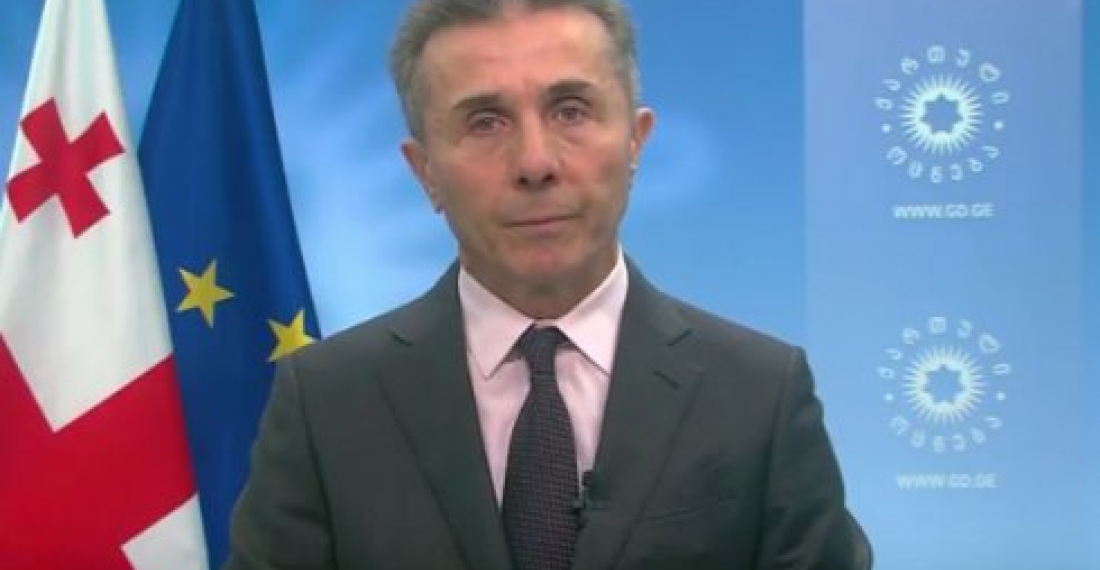
Ivanishvili makes impassioned appeal to Georgians

In an impassionde video appeal to the Georgian people, released on Monday morning (5 November), the leader of Georgian Dream (GD) party, Bidhzina Ivanishvili, called on the Georgian people not to lose the gains achieved in the last six years, but also promised that henceforth he will himself play a more direct role in the governing of the country.

"I am taking the responsibility, that in one year all errors of governance will be restored and I will use all resources available to me, so that the development of the country becomes irreversible. The most important thing is, that being angry at the government and at some officials, wishing to punish the government, we do not punish our future and our country, and not throw into the abyss everything we invested our lives into in 2012.I am confident, that we will make a choice for our people's well-being, liberty, dignity and we will succeed in building a modern Georgia..", Ivanishvili said.

In 2012 Bidhzina Ivanishili led a landslide victory in Georgia's parliamentary elections, sweeping away the government that had been led by Mikheil Saakishvili for the previous nine years. But Ivanishvili resigned as prime minister a year later, leaving others to manage the affairs of party and government alike. In May of this year Ivanishvili returned to mainstream politics after being elected Chairman of the Georgian Dream once more. Many political observers feel that his absence had led to a situation where the GD party became ineffective. On 28 October the candidate supported by Georgian Dream, Salome Zurabishvili, managed to come first in presidential elections, but only with the tiniest of margins. Opposition candidates, particularly Grigol Vashadze representing the United National Movement (UNM), performed much better than expected. The UNM remains in the shadow of Mikheil Saakashvili, despite the fact that he now lives in exile in the Netherlands. A second round is now due shortly, most likely on 2 December.

Commonspace.eu political editor said in a comment that the Georgian electorate remains by and large conservative, and expects to be led by 'a man on a white horse'.

"Ivanishvili is that kind of person, and many Georgians still have trust in him. By moving front line in the current election campaign Ivanishvili is in fact turning the election into a referendum of trust in himself. Given that the numbers in the 28 October poll were very disheartening for the GD this is for him a risky preposition. He needs to encourage those of his supporters who stayed away from the poll in the first round to turn up in the second round. And he needs to lure back the protest vote, who supported the opposition candidate Grigol Vashadze because they were unsatisfied with the GD government. This task will not be easy, but is doable. The opposition in the meantime needs to keep its cool if it wants to maintain its vote. Many of those voting for Vashadze on 28 October were voting against something and not for something. Such electorate is often ficklish. One thing is certain though, what started off as a staid and boring presidential election campaign for a largely ceremonial post, has now turned into yet another defining moment for Georgia, and the election is open for either side to win".

source: commonspace.eu

Related articles

Editor's choice
News
Borrell tells the European Parliament that the situation in Afghanistan was critical, but the EU will remain engaged

Borrell tells the European Parliament that the situation in Afghanistan was critical, but the EU will remain engaged

Borrell underlined that the European Union will make every effort to support the peace process and to remain a committed partner to the Afghan people. "Of course, we will have to take into account the evolving situation, but disengagement is not an option.  We are clear on that: there is no alternative to a negotiated political settlement, through inclusive peace talks.
Editor's choice
News
Germany accuses Russia of cyberattacks and disinformation campaign

Germany accuses Russia of cyberattacks and disinformation campaign

The German government holds Russia responsible for a cyberattack on German air traffic control, and for targeted disinformation campaigns before the last federal election. According to the German Foreign Office in Berlin, the incidents could be clearly attributed to the Russian military intelligence service, the GRU. In response, the Russian ambassador to Berlin was summoned to the Foreign Ministry. "We have been observing a massive increase in threatening hybrid activities by Russia for some time now," a spokesperson for the Foreign Ministry stated. These range from disinformation campaigns and espionage to cyberattacks and sabotage attempts. The aim is to divide society, sow distrust, and undermine confidence in democratic institutions. The spokesperson added that with these actions, Russia is "very concretely threatening our security, not only through its war of aggression against Ukraine, but also here in Germany."  The Foreign Ministry spokesperson explained that the cyberattack on air traffic control in August 2024 was clearly attributed to the hacker collective "APT28," known as "Fancy Bear," and to the responsibility of the Russian military intelligence service, the GRU. Furthermore, it could now be "conclusively stated" that Russia had attempted "to influence and destabilize both the last Federal election and the ongoing internal affairs of the Federal Republic of Germany." There was "absolutely irrefutable evidence" for this". The so-called "Storm 1516" campaign, which has been running since 2024, is allegedly backed by "reliable information" that the Moscow-based think tank "Center for Geopolitical Expertise" is behind it. The Center is also said to be supported by Russian military intelligence. Its primary aim is to influence democratic elections in the West. (Click the image to read more).

Popular

Editor's choice
News
Germany accuses Russia of cyberattacks and disinformation campaign

Germany accuses Russia of cyberattacks and disinformation campaign

The German government holds Russia responsible for a cyberattack on German air traffic control, and for targeted disinformation campaigns before the last federal election. According to the German Foreign Office in Berlin, the incidents could be clearly attributed to the Russian military intelligence service, the GRU. In response, the Russian ambassador to Berlin was summoned to the Foreign Ministry. "We have been observing a massive increase in threatening hybrid activities by Russia for some time now," a spokesperson for the Foreign Ministry stated. These range from disinformation campaigns and espionage to cyberattacks and sabotage attempts. The aim is to divide society, sow distrust, and undermine confidence in democratic institutions. The spokesperson added that with these actions, Russia is "very concretely threatening our security, not only through its war of aggression against Ukraine, but also here in Germany."  The Foreign Ministry spokesperson explained that the cyberattack on air traffic control in August 2024 was clearly attributed to the hacker collective "APT28," known as "Fancy Bear," and to the responsibility of the Russian military intelligence service, the GRU. Furthermore, it could now be "conclusively stated" that Russia had attempted "to influence and destabilize both the last Federal election and the ongoing internal affairs of the Federal Republic of Germany." There was "absolutely irrefutable evidence" for this". The so-called "Storm 1516" campaign, which has been running since 2024, is allegedly backed by "reliable information" that the Moscow-based think tank "Center for Geopolitical Expertise" is behind it. The Center is also said to be supported by Russian military intelligence. Its primary aim is to influence democratic elections in the West. (Click the image to read more).