


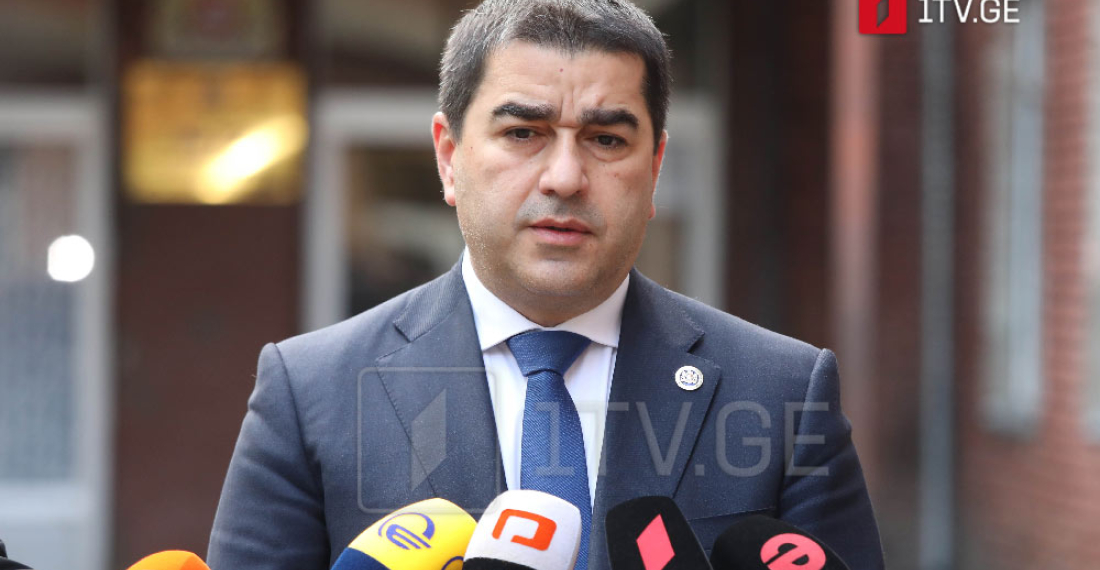
Georgian Parliament Speaker says EU Funding is Promoting ‘Hatred, Violence, and Propaganda’ in Georgia

Georgian Parliament Speaker Shalva Papuashvili has severely criticised how funding from the European Union is being implemented in Georgia saying that ministers from European Union Member States and EU Commissioners are making unjustified critical statements about Georgia while hatred, violence, and propaganda are being encouraged in the country with EU funding. According to the Georgian Public Broadcaster, Papuashvili said he was troubled by the narrative heard from various ministers from EU Member States before the meeting of the Foreign Affairs Council held on 23rd June claiming that “disinformation is being spread about some alleged democratic backsliding or walking the wrong path”.

He said this was disinformation, “which EU representatives from various structures should, by rule, be fighting against and not, conversely, be engaged in spreading disinformation”.  The Parliament Speaker added that he has expectations that relevant EU structures will finally realise what European values truly are: “Today, we see that hatred, propaganda, and violence in Georgia are financed by sources stemming from the EU budget. I have repeatedly addressed the EU Embassy to distance itself from the hatred campaign, violence, and propaganda originating from people it finances. Everyone observes that some EU country ambassadors, or the EU Ambassador himself, speak a lot, yet never, I emphasise, never, have they condemned the incitement of hatred, violence, and propaganda by people they finance”.

The Public Broadcaster also quoted Papuashvili saying that there is a motivation to encourage through their own silence and non-condemnation the hatred and propaganda campaign that is today financed with money stemming from the EU budget.

“We know that the U.S. analysed the harmful practices that USAID or other funds were engaged in, including financing hatred, violence, and propaganda, cancelled all this funding, and exposed U.S.-budget-funded organisations in hatred and propaganda campaigns”, he said.

“Today, essentially, only money coming from the EU or member countries remains, with which exactly this hatred and propaganda are being financed. Once again, I ask everyone to pay attention that in none of his statements has the EU Ambassador condemned, distanced himself from, or even criticised the hatred campaign, violence, and propaganda originating from people he finances, which, of course, accordingly represents encouragement of hatred, violence, and propaganda” Papuashvili said.
Source: commonspace.eu with Georgian Public Broadcaster and agencies. Photo: Georgian Public Broadcaster

Related articles

Editor's choice
News
Borrell tells the European Parliament that the situation in Afghanistan was critical, but the EU will remain engaged

Borrell tells the European Parliament that the situation in Afghanistan was critical, but the EU will remain engaged

Borrell underlined that the European Union will make every effort to support the peace process and to remain a committed partner to the Afghan people. "Of course, we will have to take into account the evolving situation, but disengagement is not an option.  We are clear on that: there is no alternative to a negotiated political settlement, through inclusive peace talks.
Editor's choice
News
UN General Assembly demands that Russia returns Ukrainian children

UN General Assembly demands that Russia returns Ukrainian children

The UN General Assembly, in a vote on Wednesday (3 December) overwhelmingly voted in favour of a resolution demanding that Russia returns Ukrainian children kidnapped since the start of the Russian invasion in February 2022. 91 countries voted in favour of the resolution, 12 voted against, and 57 countries abstained or were not present. Russia and Belarus were joined by ten countries in voting against the resolution, namely, Iran, Cuba, Nicaragua, Burundi, Burkina Faso, Niger, Mali, Democratic Republic of Congo, Sudan, and Eritrea. From the South Caucasus, Georgia voted in favour of the resolution, but Armenia and Azerbaijan abstained, as did Turkiye and the five Central Asian republics. Also abstaining were the six Gulf monarchies and most Arab countries. The resolution calls for the immediate return of Ukrainian children who were deported to Russia. The Ukrainian government says more than 19,000 children have been taken away from Russian-occupied areas and elsewhere since Moscow's invasion began in February of 2022. The draft resolution submitted on Wednesday demands that Russia "ensure the immediate, safe and unconditional return" of the children. (Read more by clicking the image)

Popular

Editor's choice
News
UN General Assembly demands that Russia returns Ukrainian children

UN General Assembly demands that Russia returns Ukrainian children

The UN General Assembly, in a vote on Wednesday (3 December) overwhelmingly voted in favour of a resolution demanding that Russia returns Ukrainian children kidnapped since the start of the Russian invasion in February 2022. 91 countries voted in favour of the resolution, 12 voted against, and 57 countries abstained or were not present. Russia and Belarus were joined by ten countries in voting against the resolution, namely, Iran, Cuba, Nicaragua, Burundi, Burkina Faso, Niger, Mali, Democratic Republic of Congo, Sudan, and Eritrea. From the South Caucasus, Georgia voted in favour of the resolution, but Armenia and Azerbaijan abstained, as did Turkiye and the five Central Asian republics. Also abstaining were the six Gulf monarchies and most Arab countries. The resolution calls for the immediate return of Ukrainian children who were deported to Russia. The Ukrainian government says more than 19,000 children have been taken away from Russian-occupied areas and elsewhere since Moscow's invasion began in February of 2022. The draft resolution submitted on Wednesday demands that Russia "ensure the immediate, safe and unconditional return" of the children. (Read more by clicking the image)

