


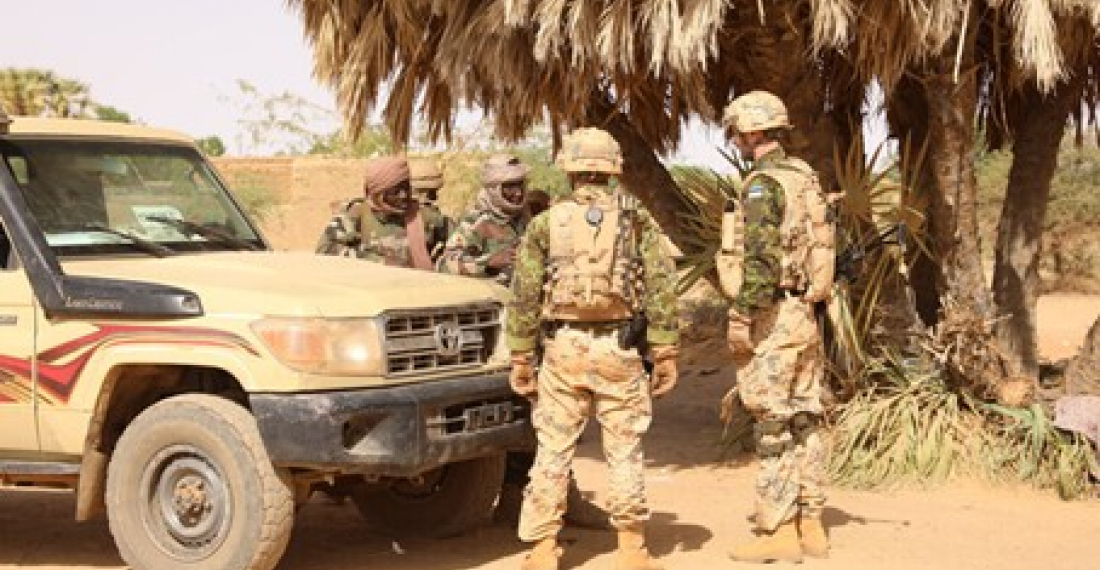
French government says troops in Mali will re-deploy to other parts of the Sahel

On Monday 14 February, only hours after a meeting between European foreign ministers, Jean-Yves le Drian announced that French President Emmanuel Macron had ordered the redeployment of French troops in the region. This redeployment would not imply a departure, but would require cooperation "with the other countries of the Sahel who are very much in favour", explained the French Foreign Minister.

The conditions no longer exist for military cooperation between Mali and France. The continued rule of the Malian military junta, which does not want to hold elections for another five years, and the arrival of 1,000 Russian mercenaries from the Wagner group finally led to the end of the French commitment in Mali.

This diplomatic crisis with Mali represents an additional obstacle to the struggle against the spread of the Islamist insurgency that France currently spearheads in the region. Indeed, over the past year, a dozen European countries and their respective special forces have been mobilised in the Task Force Takuba in this anti-terrorist war. The announcement of a withdrawal from Mali therefore also puts an end to a unique European experience in joined up military action.

Jean-Yves le Drian implied last night that the other Sahel countries were keen to take part in the redeployment of French troops. But where?

Mauritania has maintained a neutral position on the Malian situation until now. Niger, even though it has been hosting a command post of the Barkhane operation - the name of the French military operation in the Sahel - for four months now, is not very attracted by the idea of allowing redeployment on to its territory.

As for Burkina Faso, even if the French military continues to flirt with the Burkinabe junta including by lauding Burkina Faso's recent military successes, supported by Barkhane, the junta has not commented on the situation yet.

France has already reduced its troops in the Sahel, hoping to halve the number of soldiers by 2023 from the current 5000, half of which are currently based in Mali.

Frightened by the advance of the jihadists southwards, Paris hopes to convince its Sahelian and European allies to support the countries of the Gulf of Guinea, such as the Ivory Coast, Togo, Benin or Ghana, where the Islamist insurrection could spread.

 
Sources: CommonSpace.eu with Le Monde, RFI, Reuters and other media outlets
Picture: Members of the Takuba forces on patrol in Mali; Twitter: @EyeonMali


Related articles

Editor's choice
News
Borrell tells the European Parliament that the situation in Afghanistan was critical, but the EU will remain engaged

Borrell tells the European Parliament that the situation in Afghanistan was critical, but the EU will remain engaged

Borrell underlined that the European Union will make every effort to support the peace process and to remain a committed partner to the Afghan people. "Of course, we will have to take into account the evolving situation, but disengagement is not an option.  We are clear on that: there is no alternative to a negotiated political settlement, through inclusive peace talks.
Editor's choice
News
Germany accuses Russia of cyberattacks and disinformation campaign

Germany accuses Russia of cyberattacks and disinformation campaign

The German government holds Russia responsible for a cyberattack on German air traffic control, and for targeted disinformation campaigns before the last federal election. According to the German Foreign Office in Berlin, the incidents could be clearly attributed to the Russian military intelligence service, the GRU. In response, the Russian ambassador to Berlin was summoned to the Foreign Ministry. "We have been observing a massive increase in threatening hybrid activities by Russia for some time now," a spokesperson for the Foreign Ministry stated. These range from disinformation campaigns and espionage to cyberattacks and sabotage attempts. The aim is to divide society, sow distrust, and undermine confidence in democratic institutions. The spokesperson added that with these actions, Russia is "very concretely threatening our security, not only through its war of aggression against Ukraine, but also here in Germany."  The Foreign Ministry spokesperson explained that the cyberattack on air traffic control in August 2024 was clearly attributed to the hacker collective "APT28," known as "Fancy Bear," and to the responsibility of the Russian military intelligence service, the GRU. Furthermore, it could now be "conclusively stated" that Russia had attempted "to influence and destabilize both the last Federal election and the ongoing internal affairs of the Federal Republic of Germany." There was "absolutely irrefutable evidence" for this". The so-called "Storm 1516" campaign, which has been running since 2024, is allegedly backed by "reliable information" that the Moscow-based think tank "Center for Geopolitical Expertise" is behind it. The Center is also said to be supported by Russian military intelligence. Its primary aim is to influence democratic elections in the West. (Click the image to read more).

Popular

Editor's choice
News
Germany accuses Russia of cyberattacks and disinformation campaign

Germany accuses Russia of cyberattacks and disinformation campaign

The German government holds Russia responsible for a cyberattack on German air traffic control, and for targeted disinformation campaigns before the last federal election. According to the German Foreign Office in Berlin, the incidents could be clearly attributed to the Russian military intelligence service, the GRU. In response, the Russian ambassador to Berlin was summoned to the Foreign Ministry. "We have been observing a massive increase in threatening hybrid activities by Russia for some time now," a spokesperson for the Foreign Ministry stated. These range from disinformation campaigns and espionage to cyberattacks and sabotage attempts. The aim is to divide society, sow distrust, and undermine confidence in democratic institutions. The spokesperson added that with these actions, Russia is "very concretely threatening our security, not only through its war of aggression against Ukraine, but also here in Germany."  The Foreign Ministry spokesperson explained that the cyberattack on air traffic control in August 2024 was clearly attributed to the hacker collective "APT28," known as "Fancy Bear," and to the responsibility of the Russian military intelligence service, the GRU. Furthermore, it could now be "conclusively stated" that Russia had attempted "to influence and destabilize both the last Federal election and the ongoing internal affairs of the Federal Republic of Germany." There was "absolutely irrefutable evidence" for this". The so-called "Storm 1516" campaign, which has been running since 2024, is allegedly backed by "reliable information" that the Moscow-based think tank "Center for Geopolitical Expertise" is behind it. The Center is also said to be supported by Russian military intelligence. Its primary aim is to influence democratic elections in the West. (Click the image to read more).

