


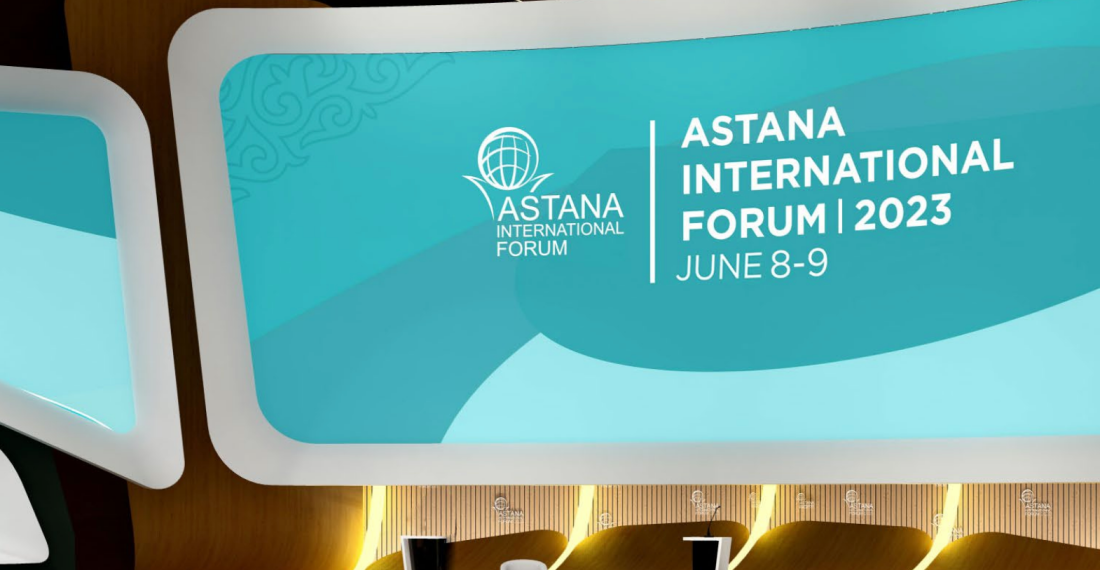
First Astana International Forum taking place in Kazakhstan on 8-9 June

The first Astana International Forum (AIF) is taking place in Kazakhstan on Thursday and Friday (8-9 June).

An initiative of the Kazakh President Kassym-Jomart Tokayev, the Astana International Forum writes that it will "serve as a platform for high-level delegates from foreign governments, international organizations, businesses and academic circles to engage in dialogue and seek solutions to problems such as climate change, food shortages and energy security".

Discussions over the two days will focus on four key areas: foreign policy and international security, international development and sustainability, energy and climate change, and economy and finance.

Over 1,000 people will participate in the conference, which is running under the theme "Tackling Challenges Through Dialogue: Towards Cooperation, Development & Progress". There will be several keynote speeches and over 40 panel sessions, discussions, and side events. The full agenda of the Astana International Forum can be accessed here.

Kazakh President, Kyrgyz President, and Emir of Qatar take centre stage at plenary session

In his address at the opening plenary session of the AIF, President Tokayev described the current era as "a period of unprecedented geopolitical tensions" characterised by the "process of destroying the very foundation of the world order that has been built since the founding of the United Nations."

He added that the AIF is "unique because it offers a platform for global middle powers to discuss their views and positions on the issues of today and to put forward their own solutions to these issues."

President Tokayev was joined on stage at the plenary session of the AIF by Emir of Qatar Sheikh Tamim Bin Hamad Al Thani, as well as Kyrgyz President Sadyr Japarov, Chairwoman of the Presidency of Bosnia and Herzegovina Željka Cvijanović, Director-General of the World Trade Organization, Ngozi Okonjo-Iweala, Managing Director of the International Monetary Fund, Kristalina Georgieva.

Meanwhile, it was also announced on the sidelines of the AIF that Kazakhstan is ready to increase exports to Qatar in about 60 types of products worth $250 million. The Astana Times reports that, in a meeting of the two countries' leaders, they discussed "the prospects for implementing joint projects in the oil and gas, mining and metallurgical, agricultural industries, medicine, and the financial sector with investors", as well as reviewing "mutually beneficial cooperation through international organizations".

Record foreign direct investment in Kazakhstan

The decline of Russia in Central Asia as a result of its ongoing full-scale invasion of Ukraine has propelled the region into a new geopolitical reality. Especially on trade, difficulties trading via Russia as a result of sanctions have given Central Asia a renewed, critical position in facilitating east-west trade. To that end, Central Asian connectivity is also high on the agenda at the AIF.

International interest in the region is rapidly growing, especially from Europe, China, and the Middle East. Yesterday, at a US-Kazakhstan investment roundtable, Kazakh Minister of National Economy Alibek Kuantyrov said that last year Kazakhstan attracted a record amount of foreign direct investment, at $28 billion.


source: commonspace.eu with Astana International Forum, The Astana Times
photo: Astana International Forum

Related articles

Editor's choice
News
Council of Europe launches new International Claims Commission for Ukraine

Council of Europe launches new International Claims Commission for Ukraine

Thirty-four countries and the European Union have signed a new convention establishing an International Claims Commission for Ukraine at a diplomatic conference co-hosted by the 46-nation Council of Europe and the Netherlands in the Hague. The diplomatic conference was attended by leaders and high-level representatives from over 50 states, including the President of Ukraine, Volodymyr Zelenskyy, the President of the Republic of Moldova, Maia Sandu, and the Prime Minister of the Netherlands, Dick Schoof.  “Today marks a major step forward in ensuring accountability for Ukraine. The International Claims Commission represents justice and hope for tens of thousands of victims—our determination that those who have suffered will not be forgotten. I call for quick ratifications so we can get the commission rapidly up and running for the people of Ukraine,” said Council of Europe Secretary General Alain Berset. Ukrainian President Volodymyr Zelenskyy said: “We expect that every mechanism for compensation from the Register of Damage and Claims Commission to the actual payments – will start working and receive strong and sufficient international support, so that people can truly feel that any kind of damage caused by the war can be compensated. This war, and Russia’s responsibility for it, MUST become a clear example – so that others learn not to choose aggression.” “Accountability is about creating the conditions for peace that endures. And therefore, accountability is a condition of security – today and for the future. But accountability is not only about Ukraine. And it is not only about one aggressor and one victim. Accountability is about Europe. About every country in Europe. It is about whether Europe, as a whole, is willing to defend its peace,” said Maia Sandu, President of the Republic of Moldova, which currently holds the Presidency of the Council of Europe’s Committee of Ministers. The Prime Minister of the Netherlands, Dick Schoof, said: “Every day Russia is deliberately bombarding homes, destroying businesses and damaging infrastructure in Ukraine. Russia must compensate Ukraine for the damage caused. That is why we have launched the International Claims Commission for Ukraine and we are honoured to host it.” The International Claims Commission will be the second part of a comprehensive compensation mechanism related to Russia’s war of aggression, building on the existing Register of Damage for Ukraine. The claims commission will be established within the framework of the Council of Europe and will also be open to other countries. The Register of Damage for Ukraine, created in 2023, collects and records compensation claims submitted by individuals, organisations and public bodies in Ukraine. Forty-four states and the European Union have so far joined the Register, which has already received 86,000 claims. The International Claims Commission will review, assess and decide upon claims submitted to the Register of Damage for Ukraine and determine the amount of compensation, if any, which is due in each case. The convention establishing the commission will enter into force once it has been ratified by 25 signatories, as long as sufficient funds have been secured to support its initial work.

Popular

Editor's choice
News
Council of Europe launches new International Claims Commission for Ukraine

Council of Europe launches new International Claims Commission for Ukraine

Thirty-four countries and the European Union have signed a new convention establishing an International Claims Commission for Ukraine at a diplomatic conference co-hosted by the 46-nation Council of Europe and the Netherlands in the Hague. The diplomatic conference was attended by leaders and high-level representatives from over 50 states, including the President of Ukraine, Volodymyr Zelenskyy, the President of the Republic of Moldova, Maia Sandu, and the Prime Minister of the Netherlands, Dick Schoof.  “Today marks a major step forward in ensuring accountability for Ukraine. The International Claims Commission represents justice and hope for tens of thousands of victims—our determination that those who have suffered will not be forgotten. I call for quick ratifications so we can get the commission rapidly up and running for the people of Ukraine,” said Council of Europe Secretary General Alain Berset. Ukrainian President Volodymyr Zelenskyy said: “We expect that every mechanism for compensation from the Register of Damage and Claims Commission to the actual payments – will start working and receive strong and sufficient international support, so that people can truly feel that any kind of damage caused by the war can be compensated. This war, and Russia’s responsibility for it, MUST become a clear example – so that others learn not to choose aggression.” “Accountability is about creating the conditions for peace that endures. And therefore, accountability is a condition of security – today and for the future. But accountability is not only about Ukraine. And it is not only about one aggressor and one victim. Accountability is about Europe. About every country in Europe. It is about whether Europe, as a whole, is willing to defend its peace,” said Maia Sandu, President of the Republic of Moldova, which currently holds the Presidency of the Council of Europe’s Committee of Ministers. The Prime Minister of the Netherlands, Dick Schoof, said: “Every day Russia is deliberately bombarding homes, destroying businesses and damaging infrastructure in Ukraine. Russia must compensate Ukraine for the damage caused. That is why we have launched the International Claims Commission for Ukraine and we are honoured to host it.” The International Claims Commission will be the second part of a comprehensive compensation mechanism related to Russia’s war of aggression, building on the existing Register of Damage for Ukraine. The claims commission will be established within the framework of the Council of Europe and will also be open to other countries. The Register of Damage for Ukraine, created in 2023, collects and records compensation claims submitted by individuals, organisations and public bodies in Ukraine. Forty-four states and the European Union have so far joined the Register, which has already received 86,000 claims. The International Claims Commission will review, assess and decide upon claims submitted to the Register of Damage for Ukraine and determine the amount of compensation, if any, which is due in each case. The convention establishing the commission will enter into force once it has been ratified by 25 signatories, as long as sufficient funds have been secured to support its initial work.

