


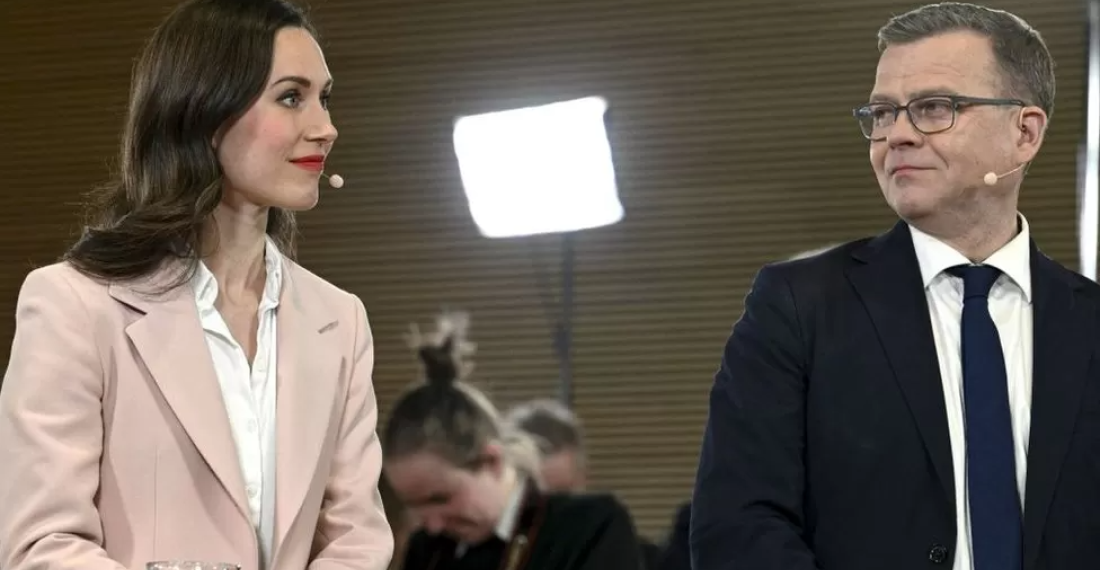
Finnish conservatives defeat incumbent PM Sanna Marin in parliamentary elections

The Finnish conservative National Coalition Party has won a tight three-way parliamentary election on Sunday (2 April), defeating the incumbent Prime Minister Sanna Marin's centre-left Social Democrats.

The National Coalition Party, led by Petteri Orpo, won 20.8% of the vote, ahead of the right-wing populist Finns Party led by Riikka Purra, who won a record 20.1%. Sanna Marin's Social Democrats came in at a very tight third place, winning 19.9% of the vote.

"We got the biggest mandate," said Petteri Orpo after the results came in. "I think Finnish people want change. They want change and now I will start negotiations, open negotiations with all parties."

Shortly after Orpo claimed victory, Marin conceded defeat.

"Congratulations to the winner of the elections, congratulations to the National Coalition Party, congratulations to the Finns Party. Democracy has spoken," said Marin.

Meanwhile, Riikka Purra was delighted with the best result in her party's history, saying, "we're still challenging to be number one, but seven more seats is an excellent result."

NATO membership

The Finnish parliamentary elections came only days after Turkey became the final current NATO member to approve Finland's membership in the alliance. However, despite this, the election was largely fought on Finland's economy and public debt as all the mainstream parties backed NATO membership.

Many Finns see incumbent Prime Minister Sanna Marin as a polarising figure. Last year, Marin was criticised when a video emerged of her singing, dancing and drinking at a party. Her supporters argued that the controversy over the video was steeped in sexism, and women across Finland and the nordic states subsequently posted videos of themselves dancing on social media in soliarity.

Petteri Orpo, on the other hand, is a career politician, and has been described, and indeed sometimes criticised, as being "stable", "calm", and "dull".

To form a government, Orpo's National Coalition Party will have to form a coalition of over 100 seats to control the 200-seat parliament.


source: commonspace.eu with BBC
photo: BBC/AFP 

Related articles

Editor's choice
News
Borrell tells the European Parliament that the situation in Afghanistan was critical, but the EU will remain engaged

Borrell tells the European Parliament that the situation in Afghanistan was critical, but the EU will remain engaged

Borrell underlined that the European Union will make every effort to support the peace process and to remain a committed partner to the Afghan people. "Of course, we will have to take into account the evolving situation, but disengagement is not an option.  We are clear on that: there is no alternative to a negotiated political settlement, through inclusive peace talks.
Editor's choice
News
Germany accuses Russia of cyberattacks and disinformation campaign

Germany accuses Russia of cyberattacks and disinformation campaign

The German government holds Russia responsible for a cyberattack on German air traffic control, and for targeted disinformation campaigns before the last federal election. According to the German Foreign Office in Berlin, the incidents could be clearly attributed to the Russian military intelligence service, the GRU. In response, the Russian ambassador to Berlin was summoned to the Foreign Ministry. "We have been observing a massive increase in threatening hybrid activities by Russia for some time now," a spokesperson for the Foreign Ministry stated. These range from disinformation campaigns and espionage to cyberattacks and sabotage attempts. The aim is to divide society, sow distrust, and undermine confidence in democratic institutions. The spokesperson added that with these actions, Russia is "very concretely threatening our security, not only through its war of aggression against Ukraine, but also here in Germany."  The Foreign Ministry spokesperson explained that the cyberattack on air traffic control in August 2024 was clearly attributed to the hacker collective "APT28," known as "Fancy Bear," and to the responsibility of the Russian military intelligence service, the GRU. Furthermore, it could now be "conclusively stated" that Russia had attempted "to influence and destabilize both the last Federal election and the ongoing internal affairs of the Federal Republic of Germany." There was "absolutely irrefutable evidence" for this". The so-called "Storm 1516" campaign, which has been running since 2024, is allegedly backed by "reliable information" that the Moscow-based think tank "Center for Geopolitical Expertise" is behind it. The Center is also said to be supported by Russian military intelligence. Its primary aim is to influence democratic elections in the West. (Click the image to read more).

Popular

Editor's choice
News
Germany accuses Russia of cyberattacks and disinformation campaign

Germany accuses Russia of cyberattacks and disinformation campaign

The German government holds Russia responsible for a cyberattack on German air traffic control, and for targeted disinformation campaigns before the last federal election. According to the German Foreign Office in Berlin, the incidents could be clearly attributed to the Russian military intelligence service, the GRU. In response, the Russian ambassador to Berlin was summoned to the Foreign Ministry. "We have been observing a massive increase in threatening hybrid activities by Russia for some time now," a spokesperson for the Foreign Ministry stated. These range from disinformation campaigns and espionage to cyberattacks and sabotage attempts. The aim is to divide society, sow distrust, and undermine confidence in democratic institutions. The spokesperson added that with these actions, Russia is "very concretely threatening our security, not only through its war of aggression against Ukraine, but also here in Germany."  The Foreign Ministry spokesperson explained that the cyberattack on air traffic control in August 2024 was clearly attributed to the hacker collective "APT28," known as "Fancy Bear," and to the responsibility of the Russian military intelligence service, the GRU. Furthermore, it could now be "conclusively stated" that Russia had attempted "to influence and destabilize both the last Federal election and the ongoing internal affairs of the Federal Republic of Germany." There was "absolutely irrefutable evidence" for this". The so-called "Storm 1516" campaign, which has been running since 2024, is allegedly backed by "reliable information" that the Moscow-based think tank "Center for Geopolitical Expertise" is behind it. The Center is also said to be supported by Russian military intelligence. Its primary aim is to influence democratic elections in the West. (Click the image to read more).

