


Far-right vigilantes tear down and burn the European flag in front of the Georgian parliament

Far right protestors tore down the European flag from in front of the Georgian parliament and burnt it on Tuesday night (6 July) amid ongoing tensions in Tbilisi as vigilantes attempted to violently disrupt Pride Week activities.

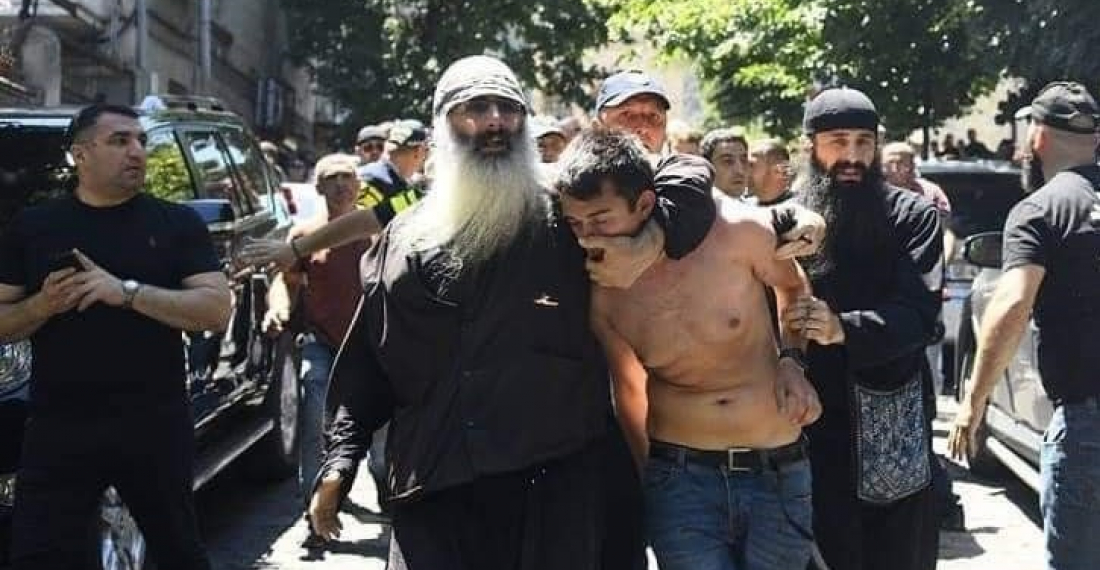
On Monday, a planned rally on the occasion of Pride Week which was supposed to highlight the demands for dignity, and non discrimination against Georgia' embattled gay and lesbian community, had to be cancelled after far right protestors, some instigated by Orthodox clergy, threatened to violently prevent it. The offices of the local LGBT organisation were ransacked, and dozens of journalists were attacked as they tried to cover events on Monday, with many suffering injuries and needing hospitalisation.

The incidents have caused outrage among civil society groups in Georgia and the international community. Those supporting the right of gay groups to march on Tuesday evening organised their own silent protest in front of the the Georgian parliament. But the gathering once more was subject to attempts by far right vigilante groups to disrupt it.  Vigilantes at some point succeeded to reach the European flag which has flown next to the Georgian flag in front of the Georgian Parliament for nearly two decades, and they tore it down and burned it.

The incident has caused further disquiet amongst pro liberal circles in Georgia who accuse the government of not doing enough to control the far right groups that have been violently disrupting public order.

The Georgian police, who appeared to be passive during the incidents on Monday took a tougher line on Tuesday, with dozens of right wing demonstrators arrested as they tried to break through police line.


source: commonspace.eu
photo: Orthodox priests appeared to be playing a leading role in an eruption homophobic protests in Tbilisi this week (picture courtesy of IPN, Tbilisi)


 

Related articles

Editor's choice
News
Georgian Patriarch buried amid scenes of nation-wide grief

Georgian Patriarch buried amid scenes of nation-wide grief

Catholicos-Patriarch of All Georgia, Ilia II, was was buried in Tbilisi on Sunday (22 March) amid expressions and scenes of nation-wide grief. Crowds filled the Holy Trinity Cathedral, and the route to the Sioni Cathedral where he will be buried, many shouting "We love you, Patriarch".  The service was led by Ecumenical Patriarch, His Holiness Bartholomew I, together with Metropolitan Shio and members of the Holy Synod of the Georgian Church. Soldiers lined the route from Trinity Cathedral to Sion Cathedral, but tens of thousands of people were also present Ilia II died on March 17. Since March 18, his body has been laying in state in the Trinity Cathedral where thousands of citizens paid tribute. During these days, the flow of people who wanted to say goodbye to the Patriarch flowed to the cathedral continuously, 24 hours a day. Citizens often had to stand in a queue for several hours to enter the cathedral.   Read the Obituary of Ilia II,  written by Dennis Sammut at  Read the Obituary of Ilia II,  written by Dennis Sammut here  Read the Obituary of Ilia II,  written by Dennis Sammut here   https://www.commonspace.eu/node/13740

Popular

Editor's choice
Interview
Thursday Interview: Murad Muradov

Thursday Interview: Murad Muradov

Today, commonspace.eu starts a new regular weekly series. THURSDAY INTERVIEW, conducted by Lauri Nikulainen, will host  persons who are thinkers, opinion shapers, and implementors in their countries and spheres. We start the series with an interview with Murad Muradov, a leading person in Azerbaijan's think tank community. He is also the first co-chair of the Action Committee for a new Armenian-Azerbaijani Dialogue. Last September he made history by being the first Azerbaijani civil society activist to visit Armenia after the 44 day war, and the start of the peace process. Speaking about this visit Murad Muradov said: "My experience was largely positive. My negative expectations luckily didn’t play out. The discussions were respectful, the panel format bringing together experts from Armenia, Azerbaijan, and Turkey was particularly valuable during the NATO Rose-Roth Seminar in Yerevan, and media coverage, while varied in tone, remained largely constructive. Some media outlets though attempted to represent me as more of a government mouthpiece than an independent expert, which was totally misleading.  Overall, I see these initiatives as important steps in rebuilding trust and normalising professional engagement. The fact that soon a larger Azerbaijani civil society visits to Armenia followed, reinforces the sense that this process is moving in the right direction." (click the image to read the interview in full)

