


European Court of Human Rights orders Russia to compensate Georgia for violations committed after 2008 war

The European Court of Human Rights (ECHR) has ordered Russia to pay Georgia over €250 million for violations committed after the brief war between the two countries in 2008. Russia has stated that it will not comply with the decision of the ECHR. The Court decided on Tuesday 14th October that Russia had stopped people from crossing freely into Abkhazia and South Ossetia, Georgian regions that Moscow recognised as independent after the 16-day war. According to the Court, Russia committed violations including excessive use of force, ill-treatment, unlawful detention and unlawful restrictions on day-to-day movement across the administrative boundary line between Georgian-controlled territory and the Russian-backed breakaway regions.

The Strasbourg-based court linked to the Council of Europe, ordered Moscow to pay just over €253 million for the harm suffered by more than 29,000 victims. The court said it was up to the Georgian government to set up an "effective mechanism" to distribute the sums awarded to the individual victims within 18 months of payment by Russia.

Russia invaded Georgia in August 2008 after Tbilisi launched a surprise offensive against pro-Moscow separatist forces that it said were shelling Georgian villages. Since then, it has occupied areas of northern and western Georgia comprising almost one-fifth of the country and supported friendly governments that have prevented the return of ethnic Georgian citizens, according to Tbilisi. It has also blocked the teaching of Georgian in schools, Georgia says.

Moscow left the the Council of Europe, of which the ECHR is part, in 2022 in the wake of its invasion of Ukraine but the court says it remains liable for violations committed before then. The country has repeatedly defied ECHR rulings, including ones given while it was still a member of the Council of Europe.

Only a few nations followed Russia's lead in recognising South Ossetia and Abkhazia. The wider international community and Georgia still regard them as Georgian territory. The Georgian authorities said that people have been killed while trying to enter or exit Abkhazia or South Ossetia, while others have been arrested, detained and ill-treated for "illegally crossing" the boundary lines.

Children had been forced to choose between learning Russian or making long and perilous journeys to Georgian-controlled territory to attend school, it said.

In an initial 2024 judgment, the court already found "that the incidents alleged were not isolated and were sufficiently numerous and interconnected to amount to a pattern or system of violations."


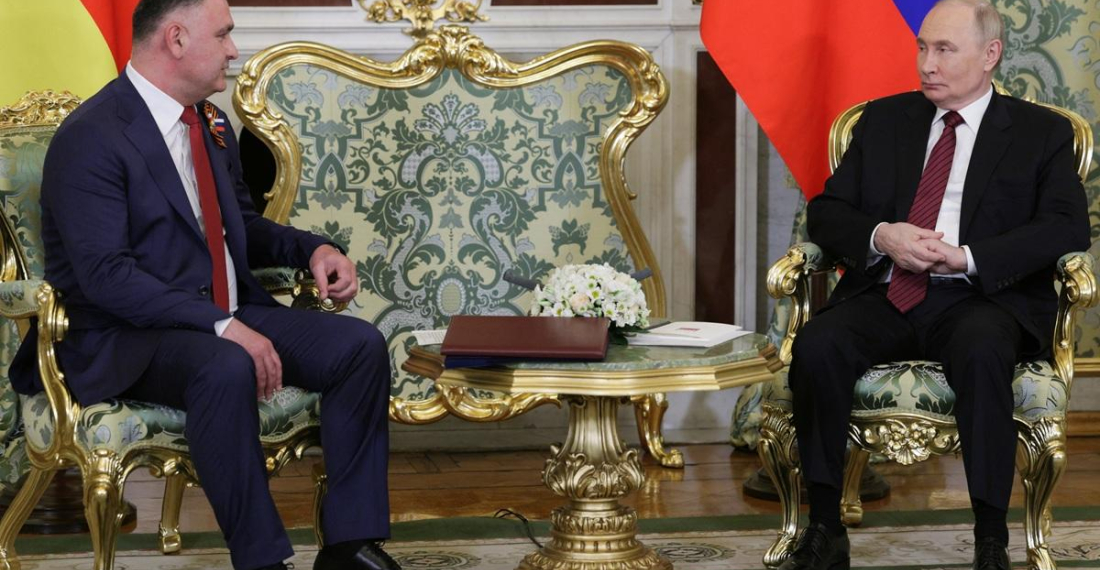
Source: commonspace.eu with AFP, Le Monde and agencies. Photo: Russia's President Vladimir Putin (R) attends a meeting with the leader of the breakaway Georgian region of South Ossetia Alan Gagloev (L) in Moscow on May 10, 2025/AFP

Related articles

Editor's choice
News
European leaders set out their plan for Ukraine

European leaders set out their plan for Ukraine

The leaders of Germany, Denmark, Finland, France, Italy, Netherlands, Norway, Poland, Sweden, and United Kingdom, together with the President of the European Council, and the President of the European Commission, o  Monday (15 December) issued a statement, outlining their plan for Ukraine. In their statement, Chancellor Merz, Prime Minister Frederiksen, President Stubb, President Macron, Prime Minister Meloni, Prime Minister Schoof, Prime Minister Støre, Prime Minister Tusk, Prime Minister Kristersson, Prime Minister Starmer, as well as President Costa and President von der Leyen spoke about "Peace for Ukraine". The Leaders welcomed significant progress on President Trump’s efforts to secure a just and lasting peace in Ukraine. They also welcomed the close work between President Zelenskyy’s and President Trump’s teams as well as European teams over the recent days and weeks. They agreed to work together with President Trump and President Zelenskyy to get to a lasting peace which preserves Ukrainian sovereignty and European security. Leaders appreciated the strong convergence between the United States, Ukraine and Europe. Leaders agreed that ensuring the security, sovereignty, and prosperity of Ukraine was integral for wider Euro-Atlantic security. They were clear that Ukraine and its people deserved a prosperous, independent, and sovereign future, free from fear of future Russian aggression. Both the US and European leaders committed to work together to provide robust security guarantees and economic recovery support measures for Ukraine in the context of an agreement on ending the war. This would include commitments to: Provide sustained and significant support to Ukraine to build its armed forces, which should remain at a peacetime level of 800,000 to be able to deter conflict and defend Ukraine’s territory. A European-led ‘multinational force Ukraine’ made up from contributions from willing nations within the framework of the Coalition of the Willing and supported by the US. It will assist in the regeneration of Ukraine’s forces, in securing Ukraine’s skies, and in supporting safer seas, including through operating inside Ukraine. (Click the image to read the statement in full).

Popular

