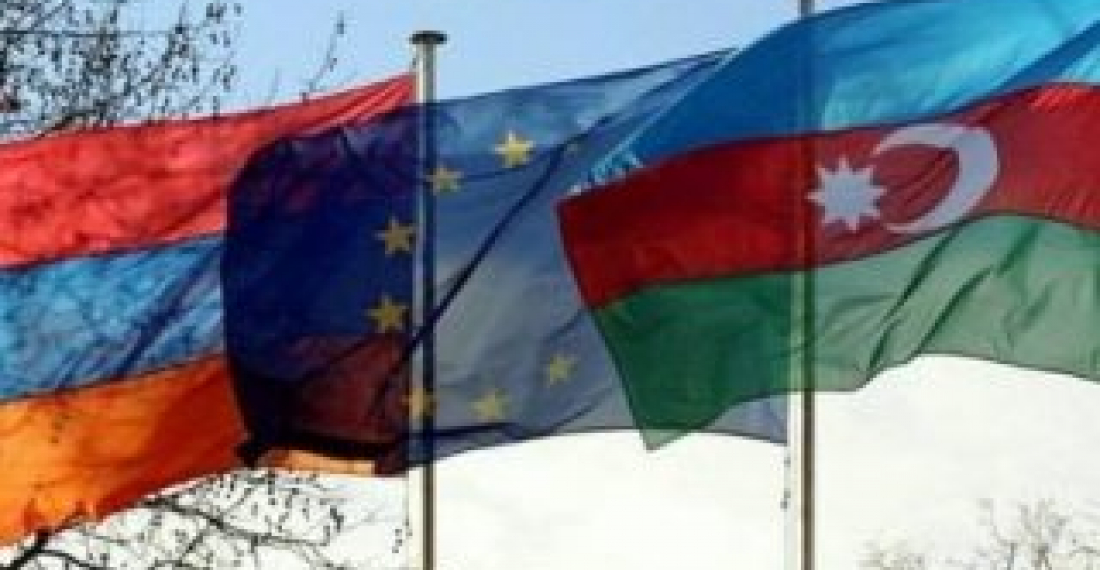
The European Union and Azerbaijan met in Brussels on Friday (18 December) in the framework of the Partnership Council. High Representative Josep Borrell led the EU side, whilst Foreign Minister Jeyhun Bayramov led the Azerbaijani delegation.
In a read-out of the meeting posted on the website of the European External Action Service it was stated that the Cooperation Council reviewed the implementation of the jointly agreed EU-Azerbaijan Partnership Priorities, Azerbaijan’s reform agenda, prospects for a new EU-Azerbaijan bilateral agreement, the coronavirus pandemic and its impact, and the situation following the recent large-scale hostilities in and around Nagorno-Karabakh.
"The EU wants to conclude an ambitious new comprehensive agreement with Azerbaijan, based on democracy, human rights and fundamental freedoms. This would contribute to the diversification of Azerbaijan’s economy, enhance our trading relationship, and extend our cooperation more broadly,” said the High Representative, Josep Borrell. “The EU stands ready to assume a role in supporting and shaping a durable settlement to the Nagorno Karabakh conflict, in close complementarity with the Minsk Group Co-Chairs. We are ready to use our peacebuilding and reconstruction tools to support this.”
Commissioner for Neighbourhood and Enlargement, Olivér Várhelyi, said: “The EU is a key partner of Azerbaijan in energy, trade, investment and connectivity. Building on the important progress made this year in finalising the Southern Gas Corridor, we are keen on exploring its possible extension to the Western Balkans. We will also continue to work with Azerbaijan on the country’s socio-economic recovery in the context of COVID-19 pandemic, including through our support to the country’s economic diversification and strengthening its health resilience. We are ready to contribute €10 million to further humanitarian assistance and to work towards more comprehensive conflict transformation and longer-term socio-economic development.”
In reviewing the implementation of the Partnership Priorities, the EU and Azerbaijan took note of very good cooperation in the energy sector. The first dispatching of gas from Azerbaijan through the Southern Gas Corridor is expected before the end of 2020. The Council also addressed challenges to democracy, the rule of law and human rights and fundamental freedoms, in particular the freedom of association and freedom of expression and of media in Azerbaijan. The Council discussed the state of play of negotiations of the new comprehensive agreement and of the Common Aviation Area Agreement.
The Council also addressed the challenges posed by the COVID-19 pandemic, underlining the EU’s support to Azerbaijan’s efforts protect lives and livelihoods, and to reopen societies and the economy.
The EU and Azerbaijan exchanged views on the situation in and around Nagorno-Karabakh following the cessation of hostilities on 10 November 2020, the EU's role in supporting recovery and reconciliation, as well as regional issues. The EU-Azerbaijan Cooperation Council took place one day after the EU-Armenia Partnership Council. These meetings reiterate the importance of the EU’s partnership with the countries in the region and the EU’s support to its recovery and to sustainable peace, the EEAS readout from the meeting stated.
Earlier, speaking ahead of the meeting High Representative Joseph Borrell said that he had wanted to hold a trilateral meeting involving the EU, Armenia and Azerbaijan.
"We had the same meeting yesterday with Armenia. Today it is Azerbaijan. Unhappily, the difficult situation between the two countries made it impossible to have any kind of common [trilateral] contact", he said.
Borrell reminded that the European Union is the first trading partner and the largest foreign investor in Azerbaijan. But we are also a key partner in the efforts to push for reforms in this country, to modernise its economy, and to strengthen its governing institutions.
We will discuss about everything in our relations: the impact of the coronavirus and, for sure, the recent large-scale hostilities in and around Nagorno Karabakh. The ceasefire brokered by Russia on 10 November is still lasting, although there are some ceasefire violations. We are going to ask for the full respect of this ceasefire and to start negotiations within the format of the OSCE Minsk Group. I think that the European Union can play an important role in the reconciliation, reconstruction and peace-consolidation in the region, complementing the work of the [OSCE] Minsk Group.
source: commonspace.eu with the press service of the European External Action Service