


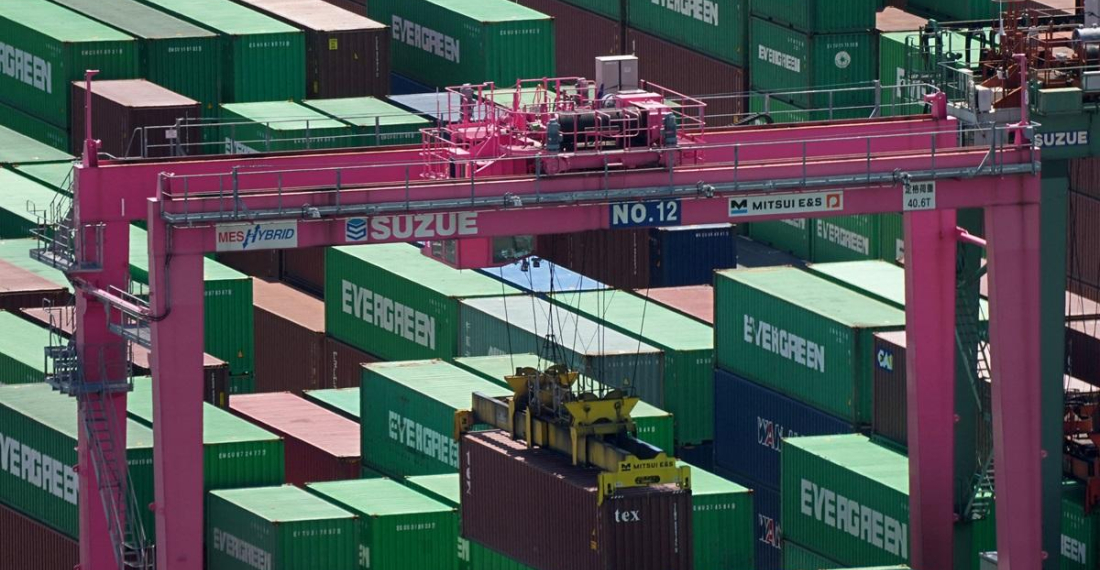
EU greenlights first set of tariffs hitting back at US

The EU on Wednesday adopted its first measures hitting back at President Donald Trump’s tariff onslaught, targeting more than 20 billion euros of US goods including soybeans, motorcycles and beauty products. The levies of up to 25 per cent are retaliation for US duties on steel and aluminium imposed last month - with Europe's response to Trump's latest tariffs salvo yet to be announced.

Duties will start to be collected under the measures on April 15, the commission said. "These countermeasures can be suspended at any time, should the US agree to a fair and balanced negotiated outcome," the European Commission said in a statement issued after EU member states greenlit the measures. "The EU considers US tariffs unjustified and damaging, causing economic harm to both sides, as well as the global economy," it added.

Trump has also slapped a 25-percent tariff on car imports from the EU, and targeted the bloc with so-called reciprocal tariffs of 20 percent that came into force Wednesday, as in dozens of other countries. The response to those measures could be unveiled as early as next week.

Approved by 26 EU countries - with Hungary voting against - the list of targeted products is weighted towards states held by Trump's Republicans. The goods include poultry, rice, corn, fruit and nuts, wood, motorcycles, plastics, textiles, paintings and electrical equipment.

Bourbon had been on a preliminary list, but the EU removed it after pressure from major wine exporters France and Italy, fearing Trump would deliver on threats of a whopping 200-percent tariff on European drinks.

The European Union's response to Trump's tariff assault has sought to balance calibrated retaliation with a push for negotiations to avert an all-out trade war. Its first retaliatory move was approved as Washington and Beijing ratcheted up a tit-for-tat escalation on tariffs - and US Treasury Secretary Scott Bessent said countries which do not hit back would not face higher rates. The measures approved Wednesday consist of two parts.

First, the EU will let a set of levies dating from Trump's first term - but currently suspended - snap back into place and they will be collected from next Tuesday. The second step includes the new list of products to target with tariffs, most of which will take effect next month, with some in December.

EU chiefs Ursula von der Leyen and Antonio Costa emphasised Europe's push for negotiation after meeting with leaders from the American Chamber of Commerce to the European Union on Wednesday. The chamber's members include Amazon, Apple, Boeing, Ford and McDonald's.

Source: commonspace.eu with agencies. Photo: AFP

Related articles

Editor's choice
News
Women emerge favourite to lead United Nations from next year, after straw-poll of UN Security Council members

Women emerge favourite to lead United Nations from next year, after straw-poll of UN Security Council members

​ Two women have emerged as favourite to lead the United Nations as Secretary-General from 1 January 2027, when the term of the present incumbent, Antonio Gutteres, expires. A straw poll of the members of the UN Security Council, held on Thursday, 30 July showed that of the seven candidates, Rebecca Grynspan of Costa Rica and Carolyn Rodriguez-Birkett of Guyana received ten and nine positive endorsements respectively, by the 15 members UN Security Council Although the poll and its result are supposed to be secret, the result leaked within minutes, and was carried on world media outlets, such as Reuters. The result was as follows   Michelle Bachelet 6 encourage 5  discourage   4 no opinion María Fernanda Espinosa 5 2 8 Rafael Grossi 7 2 6 Rebeca Grynspan 10 1 4 Olara Otunnu 2 5 8 Carolyn Rodrigues-Birkett 9 2 4 Macky Sall 6 7 2   Article 97 of the UN Charter states that the “Secretary-General shall be appointed by the General Assembly upon the recommendation of the Security Council”. Straw polls are informal ballots used to determine the viability of Secretary-General candidates.  The seven current candidates are: Michelle Bachelet Jeria (Chile), who was nominated by Brazil, Chile, and Mexico on 2 February, with Chile withdrawing its nomination on 24 March; María Fernanda Espinosa Garcés (Ecuador), who was nominated by Antigua and Barbuda on 11 May; Rafael Mariano Grossi (Argentina), who was nominated by Argentina on 26 November 2025; Rebeca Grynspan Mayufis (Costa Rica), who was nominated by Costa Rica on 3 March; Olara Otunnu (Uganda), who was nominated by Uganda on 24 July; Carolyn Rodrigues Birkett (Guyana), who was nominated by Guyana on 15 June; and Macky Sall (Senegal), who was nominated by Burundi on 2 March. At Thursday's straw poll, there was no difference between the ballots presented to the five permanent members (P5) and the ten elected members (E10). Council members received one ballot per candidate, containing the candidate’s name followed by three options: “encouraged”, “discouraged”, and “no opinion expressed”.   It is ofcourse early days, and the straw poll is just an informal indication of the mood of the UN Security Council, but the strong showwing by the two womencandidates may be an indication that for the first time, the head of the UN can be a women. (click image to read more) ​

Popular

Editor's choice
Interview
Thursday Interview: Murad Muradov

Thursday Interview: Murad Muradov

Today, commonspace.eu starts a new regular weekly series. THURSDAY INTERVIEW, conducted by Lauri Nikulainen, will host  persons who are thinkers, opinion shapers, and implementors in their countries and spheres. We start the series with an interview with Murad Muradov, a leading person in Azerbaijan's think tank community. He is also the first co-chair of the Action Committee for a new Armenian-Azerbaijani Dialogue. Last September he made history by being the first Azerbaijani civil society activist to visit Armenia after the 44 day war, and the start of the peace process. Speaking about this visit Murad Muradov said: "My experience was largely positive. My negative expectations luckily didn’t play out. The discussions were respectful, the panel format bringing together experts from Armenia, Azerbaijan, and Turkey was particularly valuable during the NATO Rose-Roth Seminar in Yerevan, and media coverage, while varied in tone, remained largely constructive. Some media outlets though attempted to represent me as more of a government mouthpiece than an independent expert, which was totally misleading.  Overall, I see these initiatives as important steps in rebuilding trust and normalising professional engagement. The fact that soon a larger Azerbaijani civil society visits to Armenia followed, reinforces the sense that this process is moving in the right direction." (click the image to read the interview in full)

