


Confidence-building measures are an important tool in support of peace in Karabakh, but not a substitute for peace deal

Experts from think tanks and civil society groups in Armenia and Azerbaijan met in Vienna on Thursday (29 June) to discuss issues related to confidence-building measures (CBMs) and how they can contribute to a lasting and peaceful resolution of the Nagorno-Karabakh conflict. Participants discussed the framework in which CBMs can be implemented, as well as tangible proposals on their content and timing.

In the first part of the event hosted and facilitated by LINKS (Dialogue, Analysis and Research) participants had a detailed discussion on areas where work on confidence-building could be implemented in both the military and civilian spheres. They agreed on the importance of adopting a realistic approach which complemented ongoing peace negotiations mediated by the OSCE Minsk Group, as well as on the need of proper sequencing. This work will now continue on an ad-hoc basis. The meeting was also attended by a representative of the Office of the European Union Special Representative for the South Caucasus, who welcomed the initiative.

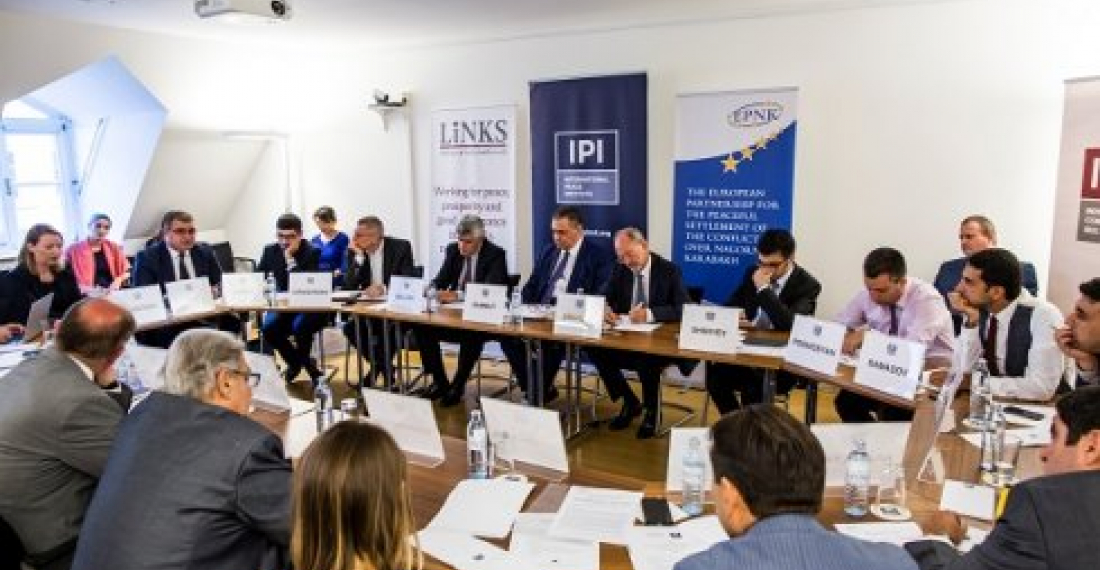
In the afternoon, an expanded meeting on the same topic was held at the offices of the International Peace Institute (IPI) in Vienna. the round table meeting, organised by LINKS (DAR) and IPI was attended by representatives of the Austrian Chairmanship of the OSCE, the European Union, Ambassadors and members of missions from around 20 OSCE participating states, and a number of experts. Also present were diplomats from the Embassies of Armenia and Azerbaijan.

In his opening remarks, Ambassador Gunther Bachler, Special representative of the Chairman-in-Office of the OSCE spoke about the importance of confidence-building measures and the need to engage with a wide range of stakeholders. This was also echoed by the represntative of the Office of the EU Special Representative for the South Caucasus, Atanas Baltov, who reiterated the support of the EU for the work of the OSCE Minsk Group, and spoke about the work of the European Union in the context of the Karabakh conflict and conflict settlement process, particularly tthrough its work with civil society in the framework of the EPNK programme. Baltov praised the systematic work that LINKS (DAR) was doing on confidence-building measures and reiterated the importance of a peaceful settlement to the conflict in Nagorno-Karabakh.

In a short presentation, LINKS (DAR) Executive Director, Dennis Sammut, talked about the role that CBMs can play in the Karabakh context, addressing the questions of when, between who, on what and in what way, the work can be done.

Richard Giragosian, Director of the Regional Studies Centre in Yerevan, Zaur Shiriyev, Associate Academic fellow of Chatham House in Baku, Benyamin Poghosyan, Vice president for Research at the Armenia National Defence University, Yerevan, and Ahmed Allili, Deputy Director, Centre for Economic and Social Development in Baku shared their views on the topic with participants. The representatives of the Embassies of Armenia and Azerbaijan also took the floor. Various participants added their opinions or asked questions to the panellists.

Participants in the meeting emphasised the importance of CBMs for the resolution of the Karabakh conflict, and expressed concern at the lack of progress in the peace negotiations and the deteriorating security situation on the ground. It was highlighted that CBMs are not a substitute for serious peace negotiations, but it was equally argued that CBMs were often an essential ingredient for any peace negotiations.

The meetings in Vienna were the latest in a series of activities that LINKS (DAR) has conducted in support of a peaceful settlement of the Nagrono-Karabakh conflict. A workshop on the theme: Nagorno-Karabakh: is it time to bring peacekeeping and confidence building back on the agenda? was held in Brussels on 6 December 2016, jointly organised with the European Policy Centre. (read more about it here)

In September 2016, Amanda Paul of EPC and Dennis Sammut of LINKS (DAR) published a paper on the same topic. You can read it here.

LINKS (DAR) work on confidence-building measures takes place in the framework of the European Union's EPNK programme

source: commonspace.eu

photo: Participants at a round table discussion organised by LINKS (DAR) and IPI in Vienna on Thursday, 29 June 2017, on the role of CBMs in the process of resolving the Nagorno-Karabakh conflict. (Picture courtesy of Susanne Einzenberger)
 

Related articles

Editor's choice
News
Council of Europe launches new International Claims Commission for Ukraine

Council of Europe launches new International Claims Commission for Ukraine

Thirty-four countries and the European Union have signed a new convention establishing an International Claims Commission for Ukraine at a diplomatic conference co-hosted by the 46-nation Council of Europe and the Netherlands in the Hague. The diplomatic conference was attended by leaders and high-level representatives from over 50 states, including the President of Ukraine, Volodymyr Zelenskyy, the President of the Republic of Moldova, Maia Sandu, and the Prime Minister of the Netherlands, Dick Schoof.  “Today marks a major step forward in ensuring accountability for Ukraine. The International Claims Commission represents justice and hope for tens of thousands of victims—our determination that those who have suffered will not be forgotten. I call for quick ratifications so we can get the commission rapidly up and running for the people of Ukraine,” said Council of Europe Secretary General Alain Berset. Ukrainian President Volodymyr Zelenskyy said: “We expect that every mechanism for compensation from the Register of Damage and Claims Commission to the actual payments – will start working and receive strong and sufficient international support, so that people can truly feel that any kind of damage caused by the war can be compensated. This war, and Russia’s responsibility for it, MUST become a clear example – so that others learn not to choose aggression.” “Accountability is about creating the conditions for peace that endures. And therefore, accountability is a condition of security – today and for the future. But accountability is not only about Ukraine. And it is not only about one aggressor and one victim. Accountability is about Europe. About every country in Europe. It is about whether Europe, as a whole, is willing to defend its peace,” said Maia Sandu, President of the Republic of Moldova, which currently holds the Presidency of the Council of Europe’s Committee of Ministers. The Prime Minister of the Netherlands, Dick Schoof, said: “Every day Russia is deliberately bombarding homes, destroying businesses and damaging infrastructure in Ukraine. Russia must compensate Ukraine for the damage caused. That is why we have launched the International Claims Commission for Ukraine and we are honoured to host it.” The International Claims Commission will be the second part of a comprehensive compensation mechanism related to Russia’s war of aggression, building on the existing Register of Damage for Ukraine. The claims commission will be established within the framework of the Council of Europe and will also be open to other countries. The Register of Damage for Ukraine, created in 2023, collects and records compensation claims submitted by individuals, organisations and public bodies in Ukraine. Forty-four states and the European Union have so far joined the Register, which has already received 86,000 claims. The International Claims Commission will review, assess and decide upon claims submitted to the Register of Damage for Ukraine and determine the amount of compensation, if any, which is due in each case. The convention establishing the commission will enter into force once it has been ratified by 25 signatories, as long as sufficient funds have been secured to support its initial work.

Popular

Editor's choice
News
Council of Europe launches new International Claims Commission for Ukraine

Council of Europe launches new International Claims Commission for Ukraine

Thirty-four countries and the European Union have signed a new convention establishing an International Claims Commission for Ukraine at a diplomatic conference co-hosted by the 46-nation Council of Europe and the Netherlands in the Hague. The diplomatic conference was attended by leaders and high-level representatives from over 50 states, including the President of Ukraine, Volodymyr Zelenskyy, the President of the Republic of Moldova, Maia Sandu, and the Prime Minister of the Netherlands, Dick Schoof.  “Today marks a major step forward in ensuring accountability for Ukraine. The International Claims Commission represents justice and hope for tens of thousands of victims—our determination that those who have suffered will not be forgotten. I call for quick ratifications so we can get the commission rapidly up and running for the people of Ukraine,” said Council of Europe Secretary General Alain Berset. Ukrainian President Volodymyr Zelenskyy said: “We expect that every mechanism for compensation from the Register of Damage and Claims Commission to the actual payments – will start working and receive strong and sufficient international support, so that people can truly feel that any kind of damage caused by the war can be compensated. This war, and Russia’s responsibility for it, MUST become a clear example – so that others learn not to choose aggression.” “Accountability is about creating the conditions for peace that endures. And therefore, accountability is a condition of security – today and for the future. But accountability is not only about Ukraine. And it is not only about one aggressor and one victim. Accountability is about Europe. About every country in Europe. It is about whether Europe, as a whole, is willing to defend its peace,” said Maia Sandu, President of the Republic of Moldova, which currently holds the Presidency of the Council of Europe’s Committee of Ministers. The Prime Minister of the Netherlands, Dick Schoof, said: “Every day Russia is deliberately bombarding homes, destroying businesses and damaging infrastructure in Ukraine. Russia must compensate Ukraine for the damage caused. That is why we have launched the International Claims Commission for Ukraine and we are honoured to host it.” The International Claims Commission will be the second part of a comprehensive compensation mechanism related to Russia’s war of aggression, building on the existing Register of Damage for Ukraine. The claims commission will be established within the framework of the Council of Europe and will also be open to other countries. The Register of Damage for Ukraine, created in 2023, collects and records compensation claims submitted by individuals, organisations and public bodies in Ukraine. Forty-four states and the European Union have so far joined the Register, which has already received 86,000 claims. The International Claims Commission will review, assess and decide upon claims submitted to the Register of Damage for Ukraine and determine the amount of compensation, if any, which is due in each case. The convention establishing the commission will enter into force once it has been ratified by 25 signatories, as long as sufficient funds have been secured to support its initial work.

