Church bells ring across Georgia as Orthodox Church adapts in face of Coronavirus threats

Church bells across Georgia peeled at noon on Sunday (15 March) as a sign of unity among the faithful in the face of the Coronavirus threat.

The Georgian Orthodox Church over the last days appeared to be struggling in the way it deals with the threat of the virus, with controversy over the use of the communal cup when the faithful receive the sacrament during mass. Most religious denominations, including the Catholic Church, have stopped using the communal cup since it is considered a high risk for transmitting the virus. In the very traditional Georgian Orthodox Church the debate has been intense, and the government has tried not to intervene directly but to encourage the Church to make the right sensible decision.

According to Georgian media reports not all Churches in Georgia have taken the same approach. In some Churches the communal cup was still available, but other forms for receiving the sacrament such as spoons or disposable cups, were also used. It was left to the parisheners to make a choice. In other Churches, such as in the Cathedral in Poti, only disposable cups were used.

The Archbishop of Poti, Archbishop Grigol said that until the leaders of the Church gather to take a decision together different congregations are taking decisions locally "in a way that is beneficial to our congregation, which will not damage their faith and distort the church in any way. We will make a decision locally before we gather as senior clergy to draw conclusions about what we are dealing with, and how the church will act. The church has been tested many times before, and it is necessary to refrain from emotional judgment, because a reasonable response is always necessary".

In other Cathedrals and Churches Archbishops and Bishoips called for unity amongst the people, and referred to a message issued earlier by the Catholicos Patriarch Ilya II.

source: commonspace.eu

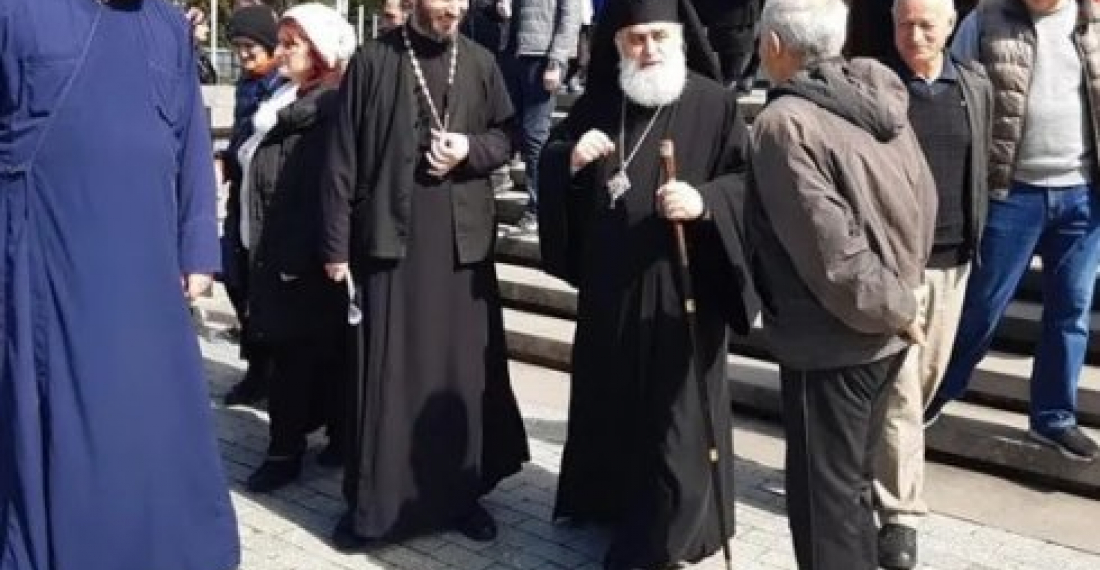
photo: Archbishop Grigol of Poti speaking to parishioners outside Poti cathedral after Sunday Mass on 15 March 2020 during which the faithful received the sacrament through disposable cups because of the Coronavirus (picture courtesy of Inter Press News, Tbilisi)

,
 

Related articles

Editor's choice
News
Russia adds pressure on Armenia ahead of key elections; recalls Ambassador in Yerevan for consultations

Russia adds pressure on Armenia ahead of key elections; recalls Ambassador in Yerevan for consultations

Ahead of key parliamentary elections,scheduled to be held in Armenia on Sunday, 7 June, Russia continues to attempt to put pressure on the Armenian Government led by prime minister Nikol Pashinyan. On 30 May, Russia recalled its Ambassador to Yerevan for consultations. A terse statement, published on the website of the Russian Foreign Ministry, said, "The Ambassador of the Russian Federation to the Republic of Armenia , S.P. Kopyrkin, has been summoned to Moscow for consultations in connection with the steps taken by the Armenian leadership to move closer to the European Union, which are detrimental to cooperation within the EAEU." This followed a statement issued the day before, by the leaders of the Eurasian Economic Union (EAEU) that challenges the Armenian trajectory towards approximating to the European Union. Vladimir Putin is undertood to have personally pushed the other four EAEU leaders to issue the statement, which said: "Taking into account the significant risks to the economic security of the member states of the Eurasian Economic Union (hereinafter referred to as the Union) arising in connection with the preparation of the Republic of Armenia for accession to the European Union, as well as the need to prevent the associated damage to the member states of the Union: decided that the members of the Eurasian Intergovernmental Council from the Republic of Belarus, the Republic of Kazakhstan, the Kyrgyz Republic and the Russian Federation will report at the next meeting of the Supreme Eurasian Economic Council in December 2026 on the possible consequences of the suspension of the Treaty on the Eurasian Economic Union with respect to the Republic of Armenia. We share the position on the need to hold a national referendum in the Republic of Armenia as soon as possible on joining the European Union or continuing to be part of the Eurasian Economic Union."

Popular

Editor's choice
Interview
Thursday Interview: Murad Muradov

Thursday Interview: Murad Muradov

Today, commonspace.eu starts a new regular weekly series. THURSDAY INTERVIEW, conducted by Lauri Nikulainen, will host  persons who are thinkers, opinion shapers, and implementors in their countries and spheres. We start the series with an interview with Murad Muradov, a leading person in Azerbaijan's think tank community. He is also the first co-chair of the Action Committee for a new Armenian-Azerbaijani Dialogue. Last September he made history by being the first Azerbaijani civil society activist to visit Armenia after the 44 day war, and the start of the peace process. Speaking about this visit Murad Muradov said: "My experience was largely positive. My negative expectations luckily didn’t play out. The discussions were respectful, the panel format bringing together experts from Armenia, Azerbaijan, and Turkey was particularly valuable during the NATO Rose-Roth Seminar in Yerevan, and media coverage, while varied in tone, remained largely constructive. Some media outlets though attempted to represent me as more of a government mouthpiece than an independent expert, which was totally misleading.  Overall, I see these initiatives as important steps in rebuilding trust and normalising professional engagement. The fact that soon a larger Azerbaijani civil society visits to Armenia followed, reinforces the sense that this process is moving in the right direction." (click the image to read the interview in full)