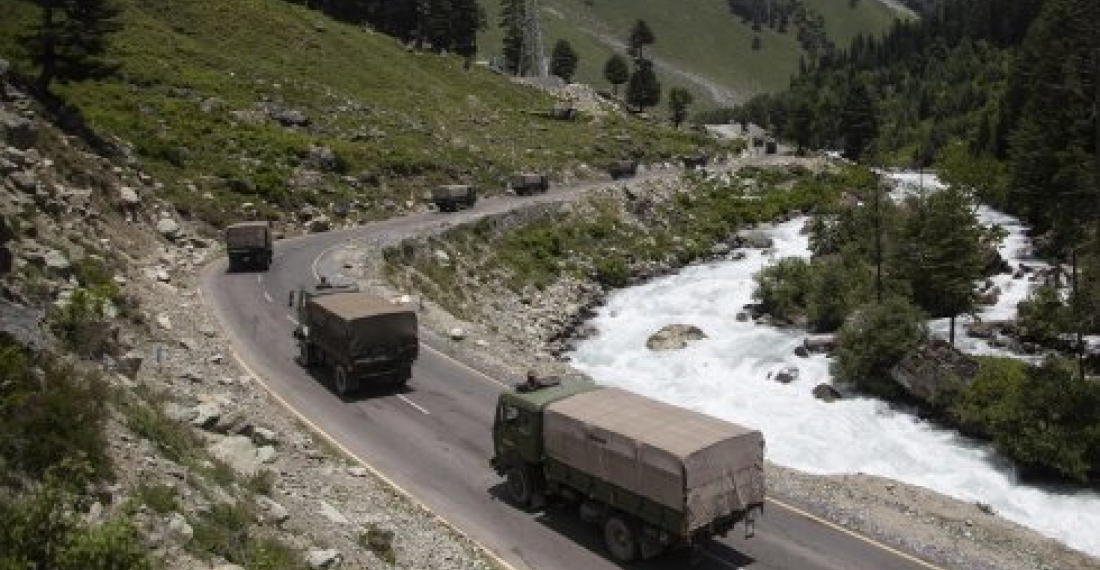
Tension remains high along the long, and in some places undefined, Indian-Chinese border most of which criss-crosses through the Himalyan Mountain range. Where the border is disputed, or undefined, a Line of Actual Control (LAC) is patrolled by both sides.
India says China has been amassing troops and fortifying its presence along the LAC since April-May. Twenty Indian soldiers were killed on June 15 in the Galwan Valley in eastern Ladakh in violent clashes with China's People's Liberation Army (PLA) troops.
About 1,000 square kilometres of area in Ladakh along the Line of Actual Control (LAC) is now under Chinese control, Indian intelligence sources suggest. The sources say that China has occupied territory amounting to nearly 1,000 sq kms which India considers to be Indian territory from its perspective.A senior government official told the newspaper "The Hindu" that from Depsang Plains to Chushul there had been a systematic mobilisation by the Chinese troops along the undefined LAC.
The official revealed that in Depsang Plains, from patrolling point 10-13, the scale of Chinese control of India's perception of the LAC stood at about 900 sq.km.
About 20 sq. km in Galwan Valley and 12 sq. km in Hot Springs area is said to be under Chinese occupation, the official said. In Pangong Tso, the area under Chinese control is 65 sq. km, whereas in Chushul it is 20 sq. km, the official said.
The standoff at the China border continues even after several rounds of diplomatic and military level talks. A partial disengagement commenced after Special Representatives (SRs) Ajit Doval and Wang Yi, tasked to hammer out a solution to the boundary dispute, spoke on July 5.
However, as per the agreement, Indian troops also moved back from their existing positions leading to creation of buffer zones at all the disputed sites.
Chinese forces are occupying a considerable area from Finger 4 to 8 near Pangong Tso (lake). The distance between Finger 4-8, the mountainous spurs abutting the lake, is about eight km. The stretch was patrolled both by India and China till May and India considers it to form part of its perception of the LAC.
In an escalation of the ongoing standoff on the border in Ladakh, Chinese troops carried out aggressive moves to change the status quo on the South Bank of Pangong Tso and the attempts had been thwarted, the Indian Army said on Monday (31 August).
"On the night of August 29/30 2020, PLA troops violated the previous consensus arrived at during military and diplomatic engagements during the ongoing standoff in Eastern Ladakh and carried out provocative military movements to change the status quo," the Army said in a statement. Indian troops pre-empted this PLA activity on the Southern Bank of the Pangong Tso Lake, undertook measures to strengthen our positions and thwart Chinese intentions to unilaterally change facts on ground, the Army said.
A Brigade Commander-level flag meeting was in progress at Chushul to resolve the issues, the Army said adding, they were committed to maintaining peace and tranquillity through dialogue, but was also equally determined to protect its territorial integrity.
China’s foreign ministry spokesman Zhao Lijian, however, said Chinese border troops “never cross the Line of Actual Control for any activities”, referring to their long, unmarked border in the remote Himalayas. A spokesman for the PLA Western Theatre Command said Indian troops broke the consensus and crossed the LAC on August 31 in a provocative move to create tensions.
"The move by the Indian side seriously violated China's territorial sovereignty, seriously sabotaged the peace and stability on the China-India border," Zhang Shuili said in a statement. "They reneged on their own promise deceitfully."
source: commonspace.eu with The Hindu and South China Morning Post
photo: Troop movements in the Himalayas (archive picture)