Changing of the guard in Stepanakert (Update 3)

Update 3  - 1800 CEST

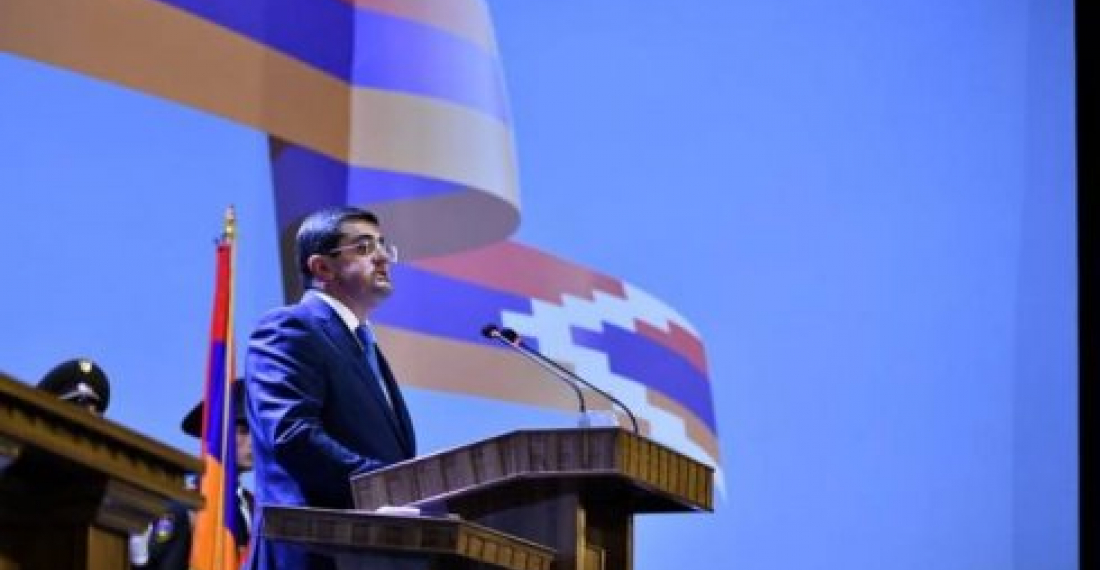
Arayik Harutyunyan took the Oath of Office as President the self-declared Nagorno-Karabakh Republic at a special session of the territory's Parliament on Thursday afternoon (21 May).

Attending the ceremony were Armenia's Prime Minister Nikol Pashinyan, Speaker of Parliament Ararat Mirzoyan, former NKR president Bako Sahakyan,and others,

In a controversial turn of events which is likely to create considerable ripples in the delicate negiations on the future of the territory the new president said "that there is a wish to move the National Assembly of Artsakh from the capital city of Stepanakert to the city of Shushi, and respective actions will be taken on this direction". 

Update 2 1400 CEST

Armenian president Armen Sargisyan has issued a statement on the occasion of the changes taking place in the political leadership of Nagorno Karabakh todayIn the statement the Armenian president said, "The Republic of Artsakh is a mature democratic state, and this is an irreversible fact. With the war still unfinished, Artsakh proves once again that is able to organize for the seventh time parliamentary and for the sixth time presidential elections. Each of these elections further solidifies state and democratic institutions in Artsakh."

Sargsyan had special words of thanks for outgoping president Bako Sahakyan.

"Along with the citizens of Artsakh, the third President of the Republic of Artsakh Bako Sahakian, who today will lay down his authorities, made a great contribution to the maturing of these institutions. I would like to express my special thanks to him. After assuming the office of the President of Artsakh in 2007, he led the Republic with honor, with responsibility of a statesman and determination of a native of Artsakh. I hope that Mr. Sahakian will continue to contribute to the empowerment of Artsakh by passing his experience and knowledge to the younger generation."

In the meantime there has also been a statement from the Armenian foreign ministry responding to their Azerbaijani counterparts (see below)

"It necessary to mention that the threats of war and the belligerent attitude, whether in the form of large-scale military exercises in violation of international commitments, are traditional components of Azerbaijan's non-constructive position, which cannot affect the position of the Armenian parties in the Karabakh issue." on processes. However, they are clearly detrimental to an environment conducive to peace, which is necessary for the consideration of substantive issues. Armenia is committed to an exclusively peaceful settlement of the conflict within the framework of the OSCE Minsk Group co-chairmanship", it added.


_______________________________

Update 1 - 1000 CEST 

Arthur Tovmasyan has been elected Speaker of parliasment in the self-declared Nagorno-Karabakh Republic. he is a member of the faction of the Free Homeland Bloc. He served before as Deputy Speaker.

___________________

There will be a change in the political leadership in the self-declared Nagorno-Karabakh Republic on Thursday (21 May) with a new president and parliament taking office in the most significant change of political power for more than a decade.

Parliament convened this morning for the first time following parliamentary elections. It is expected to elect the Speaker and Deputy Speaker, as well as the Chair of committees.

Five political forces are represented in the new parliament, namely "Free Homeland" bloc - 16 seats, "United Homeland" party - 9 seats, Artsakh Justice Party - 3 seats, ARF Dashnaktsutyun - 3 seats, Artsakh Democratic Party - 2 seats.

In the afternoon, a ceremony will be held to swear in the new president Arayik Harutyunyan who was elected in a recent election. He will replace Bako Sahakyan who had been in office since 2007.

The Nagorno-Karabakh Republic, sometimes called the Artsakh Republic is not recognised by any country, and elections held there are not recognised by the international community. The territory formed part of Azerbaijan during the Soviet era and seceded in a conflict as the USSR disintegrated, as a result of which most of the Azeerbaijani population was displaced.

In a statement issued on Wednesday (20 May) the Azerbaijani Foreign Ministry said that "the holding of illegal 'elections' and the so-called 'inauguration' in the occupied Nagorno-Karabakh region of Azerbaijan by the aggressor state Armenia, is another manifestation of the annexation policy of the Republic of Armenia."

The statement criticised Armenian prime minister Nikol Pashinyan, who is expected to attend the inauguration ceremony on Thursday. The statement added,

"The war is not over yet and Azerbaijan has every right to restore its territorial integrity within its internationally recognized borders by all necessary means. The consistent provocative actions of the Armenian leadership nullify practically all efforts for a peaceful settlement of the conflict and serve to strengthen further military confrontation and increase tension in the region.

Let no one doubt that the occupied territories will be liberated, the territorial integrity of Azerbaijan will be restored within its internationally recognized borders, and the fundamental rights of IDPs will be ensured."

source: commonspace.eu with agencies


Related articles

Editor's choice
News
Borrell tells the European Parliament that the situation in Afghanistan was critical, but the EU will remain engaged

Borrell tells the European Parliament that the situation in Afghanistan was critical, but the EU will remain engaged

Borrell underlined that the European Union will make every effort to support the peace process and to remain a committed partner to the Afghan people. "Of course, we will have to take into account the evolving situation, but disengagement is not an option.  We are clear on that: there is no alternative to a negotiated political settlement, through inclusive peace talks.
Editor's choice
News
NATO Chief says war is on Europe's doorstep, and warns against complacency

NATO Chief says war is on Europe's doorstep, and warns against complacency

Russia could attack a Nato country within the next five years, the Secretary General of NATO, Mark Rutte, said in a stark new warning. "Nato's own defences can hold for now," Rutte warned in Berlin, but conflict was "next door" to Europe and he feared "too many are quietly complacent, and too many don't feel the urgency, too many believe that time is on our side. "Russia is already escalating its covert campaign against our societies," Rutte said in a speech in Germany. "We must be prepared for the scale of war our grandparents or great-grandparents endured." Earlier this month, Russia's President Vladimir Putin said his country was not planning to go to war with Europe, but it was ready "right now" if Europe wanted to - or started a war. But similar reassurances were given by Moscow in 2022, just before 200,000 Russian troops crossed the border and invaded Ukraine. Putin has accused European countries of hindering US efforts to bring peace in Ukraine - a reference to the role Ukraine's European allies have recently played in trying to change a US peace plan to end the war, whose initial draft was seen as favouring Russia. But Putin was not sincere, Nato's secretary-general said in the German capital, Berlin. Supporting Ukraine, he added, was a guarantee for European security. "Just imagine if Putin got his way; Ukraine under the boot of Russian occupation, his forces pressing against a longer border with Nato, and the significantly increased risk of an armed attack against us." Russia's economy has been on a war footing for more than three years now - its factories churn out ever more supplies of drones, missiles and artillery shells. According to a recent report by the Kiel Institute for the World Economy, Russia has been producing each month around 150 tanks, 550 infantry fighting vehicles, 120 Lancet drones and more than 50 artillery pieces. The UK, and most of its Western allies, are simply not anywhere near this point. Analysts say it would take years for Western Europe's factories to come close to matching Russia's mass-production of weapons. "Allied defence spending and production must rise rapidly, our armed forces must have what they need to keep us safe," the Nato chief said.

Popular

Editor's choice
News
NATO Chief says war is on Europe's doorstep, and warns against complacency

NATO Chief says war is on Europe's doorstep, and warns against complacency

Russia could attack a Nato country within the next five years, the Secretary General of NATO, Mark Rutte, said in a stark new warning. "Nato's own defences can hold for now," Rutte warned in Berlin, but conflict was "next door" to Europe and he feared "too many are quietly complacent, and too many don't feel the urgency, too many believe that time is on our side. "Russia is already escalating its covert campaign against our societies," Rutte said in a speech in Germany. "We must be prepared for the scale of war our grandparents or great-grandparents endured." Earlier this month, Russia's President Vladimir Putin said his country was not planning to go to war with Europe, but it was ready "right now" if Europe wanted to - or started a war. But similar reassurances were given by Moscow in 2022, just before 200,000 Russian troops crossed the border and invaded Ukraine. Putin has accused European countries of hindering US efforts to bring peace in Ukraine - a reference to the role Ukraine's European allies have recently played in trying to change a US peace plan to end the war, whose initial draft was seen as favouring Russia. But Putin was not sincere, Nato's secretary-general said in the German capital, Berlin. Supporting Ukraine, he added, was a guarantee for European security. "Just imagine if Putin got his way; Ukraine under the boot of Russian occupation, his forces pressing against a longer border with Nato, and the significantly increased risk of an armed attack against us." Russia's economy has been on a war footing for more than three years now - its factories churn out ever more supplies of drones, missiles and artillery shells. According to a recent report by the Kiel Institute for the World Economy, Russia has been producing each month around 150 tanks, 550 infantry fighting vehicles, 120 Lancet drones and more than 50 artillery pieces. The UK, and most of its Western allies, are simply not anywhere near this point. Analysts say it would take years for Western Europe's factories to come close to matching Russia's mass-production of weapons. "Allied defence spending and production must rise rapidly, our armed forces must have what they need to keep us safe," the Nato chief said.