


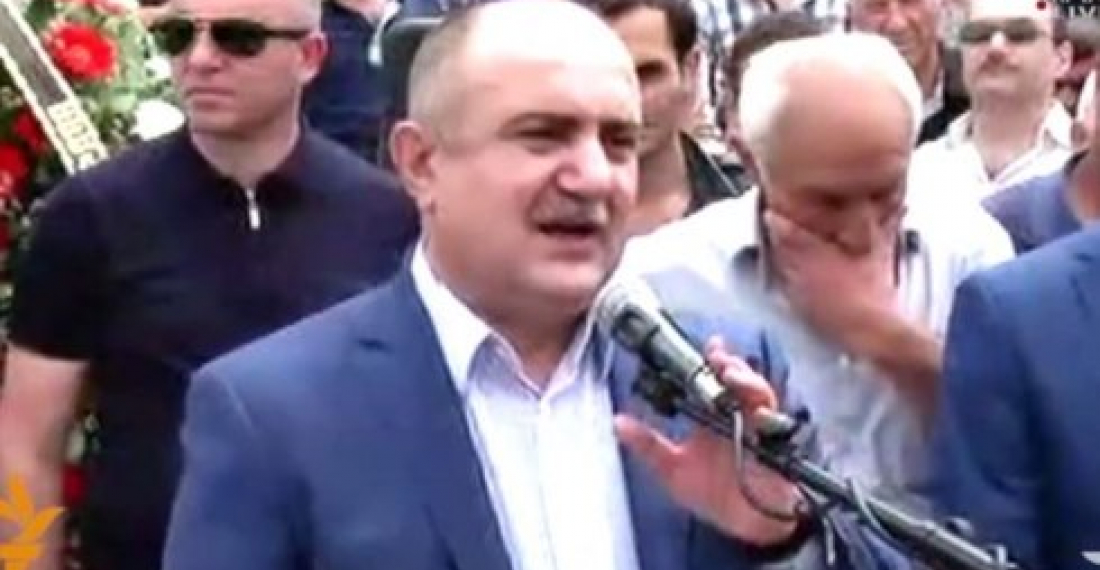
The case of Samvel Babayan continues to cast a shadow over Armenian poll

A court in Yerevan's Kentron District has ordered the pre-trail detention for two months of Samvel Babayan, former Defence Minister of Nagorno-Karabakh and an ally of the ORO Bloc, one of the main political forces contesting the 2 April Parliamentary elections in Armenia.

Earler the Armenia National Security Service said that Babayan and two others were arrested on suspicion of importing parts of a Russian made IGLA hand held anti aircraft missile. The Security Service says that the two unnamed men were working under the instruction of Babayan and that they tried to bring in the missile across the land border with Georgia. The Georgian Ministry of Interior has however denied all knowledge of the incident, and Babayan himself has denied any involvement with the incident.

The matter has cast a shadow on the current Armenian Parliamentary elections campaign. Babayan is considered an ally of the bloc Ohanian-Raffi-Oscanian, led by three former senior Ministers. Leaders of the bloc have rushed to Babayan's defence. After a first statement, issued shortly after Babayan's arrest (see story here), the Bloc upped the stakes on Thursday with another tough statement by its most prominent leader, Seyran Ohanyan, who until recently was the Defence Minister of Armenia, who said that Babayan's arrest was the latest attempt to put pressure on the bloc:

"They don't understand that he is our military brother, and during his time he ensured victory in Artsakh liberation war together with his friends. He is an Artsakh hero. I want to say that we will stand for the protection of Samvel Babayan's rights till the end," Ohanyan said.  

Ohanian himself has in the last days of the election campaign become a main target for pro government media. Referring to this, one of the other ORO Bloc leaders, former Foreign Minister Raffi Hovannissian said,  "I am sure that Seyran Ohanyan is actually persecuted now by relevant authorities, as well as media outlets close to the authorities, as Samvel Babayan was. My family and I had such an experience and anyone can be expected to become a target regardless of whether they are farmers or national heroes. What difference should this make to them? I am not speaking on behalf of Mr Ohanyan but simply sharing my opinion with you as a citizen," Hovannisian added.

According to him, the bloc poses a threat to the authorities, and thus preventive actions have been launched against it by detentions. Referring to the possibility of Seyran Ohanyan's detention, Hovannisian said: "Let them risk doing that."

Other political leaders have commented on Babayan's case.   Spokesperson for the ruling Republican Party of Armenia (RPA), Eduard Sharmazanov, said that political speculations on the case are unacceptable. Referring to the statements of the ORO bloc, Sharamzanov said that the attempt to politicize any legal process for raising the already low rating of the bloc is not the best option. Asked to comment on the case, and on the statements of the ORO Bloc leaders, Prime Minister Karen Karapetyan said he preferred to focus on more ideological issues.

The case has also received the attention of the international community. The head of EU delegation to Armenia Ambassador Piotr Switalski told reporters on Friday that all processes targeted at prevention of violence in Armenia have to be transparent,

"We believe that all disputes and complaints should be settled in courts, and should be settled peacefully. For the European Union the question of preventing violence is very important. We believe that the primary responsibility for preventing violence lies with the law enforcement authorities. All these procedures should be very transparent. If there is suspicion that something wrong is happening, we believe that the law enforcement authorities have to act in full transparency, so that the voters have the confidence that it is done not for political purposes, not done to intimidate others, that it is done within the rule of law", said the Ambassador.

Issues related to the Karabakh conflict continue to feature prominently in the election campaign.

Levon Zurabyan, one of the leaders of the opposition Armenian National Congress told a campaign rally in Yerevan's Malatia-Sebastia administrative district on Friday that victory in Karabakh was achieved thanks to the leadership of the then President and commander in chief, Levon Ter Petrossian

"When we won the Karabakh war in 1994, we first and foremost won thanks to the commander-in-chief Levon Ter-Petrosyan, since the people, soldiers and commanders can be heroes, but victory would be impossible if the organization of war, waging diplomatic work, and economic support to the military effort, is not correctly organized. Ter-Petrosyan simply wanted to reach that victory and make it irreversible", said Zurabyan

Zurabyan also added that the ceasefire cannot become a guarantee of peace. "Ceasefire is merely a temporary arrangement between the parties, which is based on the will of the parties, this not being irreversible. Unless that ceasefire, the achieved victory, and the status of liberated Artsakh is fixed by peace treaty, the victory is reversible", he added.

related content on commonspace.eu:

Karabakh Former Defence Minister Samvel Babayan arrested 

The return of Samvel Babayan to Nagorno-Karabakh

source: commonspace.eu with agencies

photo: Samvel Babayan (archive picture) A wrong picture of another person with the same name was uploaded earlier. We apologise to our readers for the error.
Related articles

Editor's choice
News
Council of Europe launches new International Claims Commission for Ukraine

Council of Europe launches new International Claims Commission for Ukraine

Thirty-four countries and the European Union have signed a new convention establishing an International Claims Commission for Ukraine at a diplomatic conference co-hosted by the 46-nation Council of Europe and the Netherlands in the Hague. The diplomatic conference was attended by leaders and high-level representatives from over 50 states, including the President of Ukraine, Volodymyr Zelenskyy, the President of the Republic of Moldova, Maia Sandu, and the Prime Minister of the Netherlands, Dick Schoof.  “Today marks a major step forward in ensuring accountability for Ukraine. The International Claims Commission represents justice and hope for tens of thousands of victims—our determination that those who have suffered will not be forgotten. I call for quick ratifications so we can get the commission rapidly up and running for the people of Ukraine,” said Council of Europe Secretary General Alain Berset. Ukrainian President Volodymyr Zelenskyy said: “We expect that every mechanism for compensation from the Register of Damage and Claims Commission to the actual payments – will start working and receive strong and sufficient international support, so that people can truly feel that any kind of damage caused by the war can be compensated. This war, and Russia’s responsibility for it, MUST become a clear example – so that others learn not to choose aggression.” “Accountability is about creating the conditions for peace that endures. And therefore, accountability is a condition of security – today and for the future. But accountability is not only about Ukraine. And it is not only about one aggressor and one victim. Accountability is about Europe. About every country in Europe. It is about whether Europe, as a whole, is willing to defend its peace,” said Maia Sandu, President of the Republic of Moldova, which currently holds the Presidency of the Council of Europe’s Committee of Ministers. The Prime Minister of the Netherlands, Dick Schoof, said: “Every day Russia is deliberately bombarding homes, destroying businesses and damaging infrastructure in Ukraine. Russia must compensate Ukraine for the damage caused. That is why we have launched the International Claims Commission for Ukraine and we are honoured to host it.” The International Claims Commission will be the second part of a comprehensive compensation mechanism related to Russia’s war of aggression, building on the existing Register of Damage for Ukraine. The claims commission will be established within the framework of the Council of Europe and will also be open to other countries. The Register of Damage for Ukraine, created in 2023, collects and records compensation claims submitted by individuals, organisations and public bodies in Ukraine. Forty-four states and the European Union have so far joined the Register, which has already received 86,000 claims. The International Claims Commission will review, assess and decide upon claims submitted to the Register of Damage for Ukraine and determine the amount of compensation, if any, which is due in each case. The convention establishing the commission will enter into force once it has been ratified by 25 signatories, as long as sufficient funds have been secured to support its initial work.

Popular

Editor's choice
News
Council of Europe launches new International Claims Commission for Ukraine

Council of Europe launches new International Claims Commission for Ukraine

Thirty-four countries and the European Union have signed a new convention establishing an International Claims Commission for Ukraine at a diplomatic conference co-hosted by the 46-nation Council of Europe and the Netherlands in the Hague. The diplomatic conference was attended by leaders and high-level representatives from over 50 states, including the President of Ukraine, Volodymyr Zelenskyy, the President of the Republic of Moldova, Maia Sandu, and the Prime Minister of the Netherlands, Dick Schoof.  “Today marks a major step forward in ensuring accountability for Ukraine. The International Claims Commission represents justice and hope for tens of thousands of victims—our determination that those who have suffered will not be forgotten. I call for quick ratifications so we can get the commission rapidly up and running for the people of Ukraine,” said Council of Europe Secretary General Alain Berset. Ukrainian President Volodymyr Zelenskyy said: “We expect that every mechanism for compensation from the Register of Damage and Claims Commission to the actual payments – will start working and receive strong and sufficient international support, so that people can truly feel that any kind of damage caused by the war can be compensated. This war, and Russia’s responsibility for it, MUST become a clear example – so that others learn not to choose aggression.” “Accountability is about creating the conditions for peace that endures. And therefore, accountability is a condition of security – today and for the future. But accountability is not only about Ukraine. And it is not only about one aggressor and one victim. Accountability is about Europe. About every country in Europe. It is about whether Europe, as a whole, is willing to defend its peace,” said Maia Sandu, President of the Republic of Moldova, which currently holds the Presidency of the Council of Europe’s Committee of Ministers. The Prime Minister of the Netherlands, Dick Schoof, said: “Every day Russia is deliberately bombarding homes, destroying businesses and damaging infrastructure in Ukraine. Russia must compensate Ukraine for the damage caused. That is why we have launched the International Claims Commission for Ukraine and we are honoured to host it.” The International Claims Commission will be the second part of a comprehensive compensation mechanism related to Russia’s war of aggression, building on the existing Register of Damage for Ukraine. The claims commission will be established within the framework of the Council of Europe and will also be open to other countries. The Register of Damage for Ukraine, created in 2023, collects and records compensation claims submitted by individuals, organisations and public bodies in Ukraine. Forty-four states and the European Union have so far joined the Register, which has already received 86,000 claims. The International Claims Commission will review, assess and decide upon claims submitted to the Register of Damage for Ukraine and determine the amount of compensation, if any, which is due in each case. The convention establishing the commission will enter into force once it has been ratified by 25 signatories, as long as sufficient funds have been secured to support its initial work.

