Campaore sentenced in absentia to life imprisonment for the murder of Thomas Sankara

A Burkina Faso military court has sentenced former Burkinabe President Blaise Compaoré to life in prison for his role in the assassination of pan-African leader Thomas Sankara, nearly three decades after the fact.

Blaise Compaoré, Sankara's successor and former friend, has been in exile in Côte d’Ivoire for several years and was thus tried and convicted in absentia. Some of Compaore lieutenants were also convicted. Hyacinthe Kafando, the man who led the commando group that executed Sankara, who is on the run, and Gilbert Diendéré, one of the army leaders in the 1987 putsch, were also sentenced to life imprisonment by the military court.

Three people were acquitted, and eight other defendants received sentences ranging from three to twenty years in jail.

At the age of 37, Thomas Sankara was gunned down with 12 others in 1987 during a meeting. Blaise Compaoré then ruled Burkina Faso for 27 years, until 2014.

Sankara, nicknamed “Africa’s Che Guevara”, seized power with his friend Compaoré and other army captains in a coup in 1983. Regarded as a role model by African revolutionaries, Sankara ushered in sweeping reforms in an attempt to reduce poverty in the country. Among other things, he implemented nationalisations, mass social housing and a ban on female genital mutilation, polygamy and forced marriage. He also renamed the country from Upper Volta to “Land of Incorruptible People”, which became “Burkina Faso” in the local Mòoré language.

Yet his radical reforms and his anti-imperialist stand irked western powers and his west African counterparts, which weakened him politically until the fatal meeting of 15 October 1987.

As for Blaise Compaoré, he has been living in Côte d'Ivoire since his fall in 2014, where his friend and Ivorian president Alassane Ouattara protects him, even granting him Ivorian nationality. The former president, and now convict, spends his time between his luxurious residences in Cocody-Ambassades and the seaside town of Assinie, and his repatriation to Burkina Faso to serve his sentence is unlikely.

Thomas Sankara's widow said she was satisfied with the verdict of the military tribunal, although she had hoped for the presence of Compaoré and Kafando.

Sources: CommonSpace.eu with Le Monde (Paris), RFI (Paris), DW News (Bonn) and other media outlets
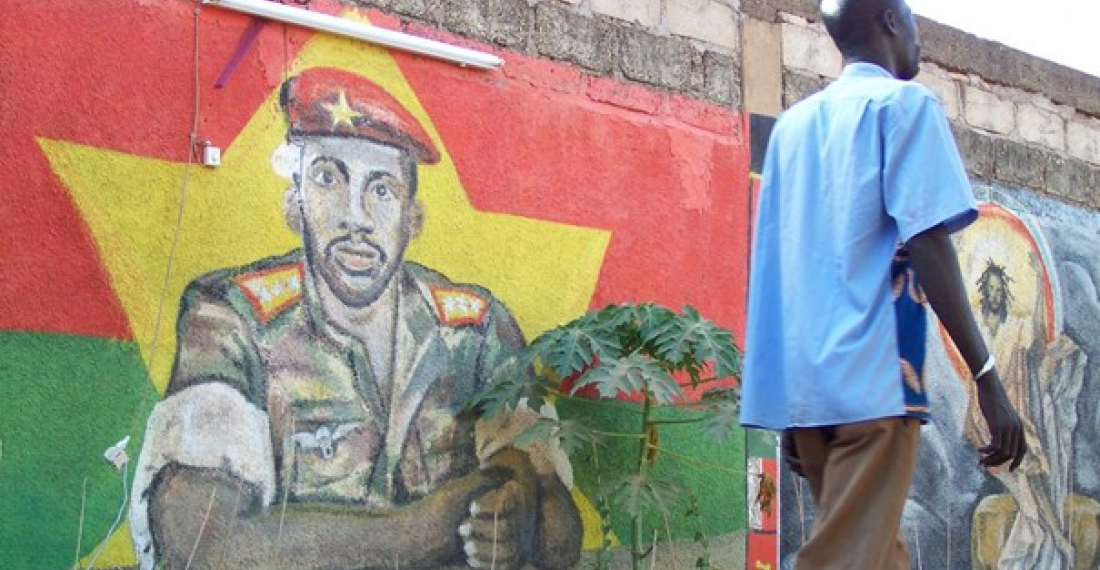
Picture: A graffiti commemorating former Burkinabe leader Thomas Sankara; Twitter: @FELASTORY


Related articles

Editor's choice
News
European leaders set out their plan for Ukraine

European leaders set out their plan for Ukraine

The leaders of Germany, Denmark, Finland, France, Italy, Netherlands, Norway, Poland, Sweden, and United Kingdom, together with the President of the European Council, and the President of the European Commission, o  Monday (15 December) issued a statement, outlining their plan for Ukraine. In their statement, Chancellor Merz, Prime Minister Frederiksen, President Stubb, President Macron, Prime Minister Meloni, Prime Minister Schoof, Prime Minister Støre, Prime Minister Tusk, Prime Minister Kristersson, Prime Minister Starmer, as well as President Costa and President von der Leyen spoke about "Peace for Ukraine". The Leaders welcomed significant progress on President Trump’s efforts to secure a just and lasting peace in Ukraine. They also welcomed the close work between President Zelenskyy’s and President Trump’s teams as well as European teams over the recent days and weeks. They agreed to work together with President Trump and President Zelenskyy to get to a lasting peace which preserves Ukrainian sovereignty and European security. Leaders appreciated the strong convergence between the United States, Ukraine and Europe. Leaders agreed that ensuring the security, sovereignty, and prosperity of Ukraine was integral for wider Euro-Atlantic security. They were clear that Ukraine and its people deserved a prosperous, independent, and sovereign future, free from fear of future Russian aggression. Both the US and European leaders committed to work together to provide robust security guarantees and economic recovery support measures for Ukraine in the context of an agreement on ending the war. This would include commitments to: Provide sustained and significant support to Ukraine to build its armed forces, which should remain at a peacetime level of 800,000 to be able to deter conflict and defend Ukraine’s territory. A European-led ‘multinational force Ukraine’ made up from contributions from willing nations within the framework of the Coalition of the Willing and supported by the US. It will assist in the regeneration of Ukraine’s forces, in securing Ukraine’s skies, and in supporting safer seas, including through operating inside Ukraine. (Click the image to read the statement in full).

Popular