


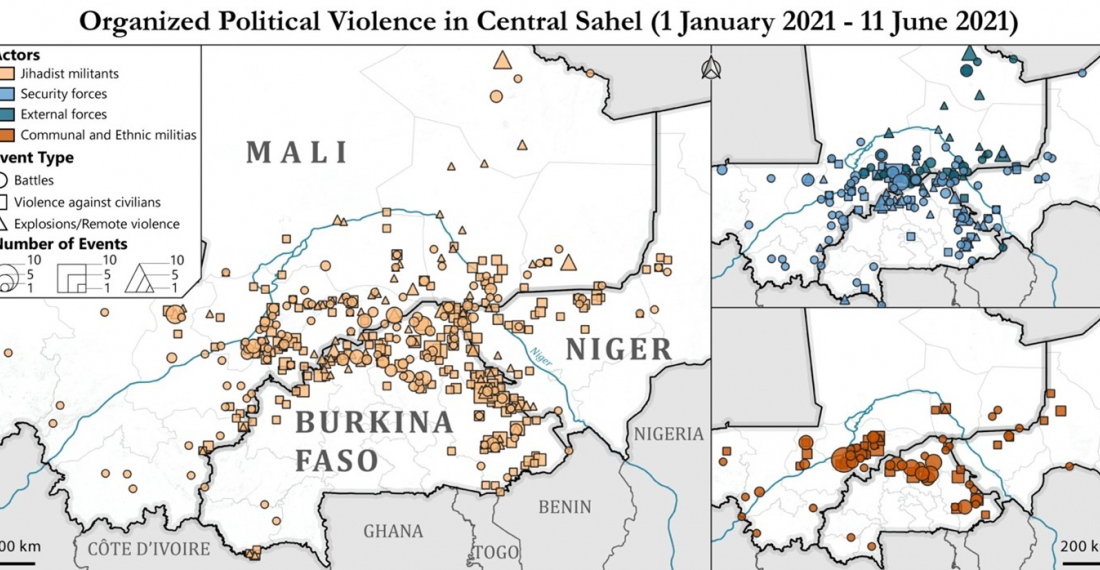
Burkina Faso is now the epicentre of jihadist violence in the Sahel

Burkina Faso has become the epicentre for jihadist violence in the Sahel, with the number of victims in recent years tends to overshadowing the deaths in neighbouring Mali, where the conflict started.

According to a conflict statistics aggregator - the Armed Conflict Location & Event Data Project - the number of violent incidents in Burkina Faso has doubled since 2020, reaching over 1,315 by the end of 2021. This violence, in the form of explosions, car bombs or direct attacks on civilians, has resulted in the death of more than 2,354 people, overtaking Mali for the second time in three years.

By seizing large swathes of territory, armed groups affiliated with al-Qaeda and ISIL have succeeded in instilling fear in Burkina Faso, displacing 1.7 million people according to a UN report published in December 2021. Of the 20 million inhabitants, more than 4.7 million Burkinabe need urgent humanitarian assistance, according to the same report. 

However, one should also not be unaware of certain nuances.  According to several human rights groups on the ground, the source of violence in West Africa is often the local security forces. According to Human Rights Watch, the Burkinabe army killed as many people as the terrorist groups last year. Although the vast majority of their victims are al-Qaeda and ISIL affiliates, one ethnic group is also particularly affected by military reprisals: the nomadic Fulani (Peul) group.

Several mass graves full of Fulani were found in the town of Djibo between November 2019 and June 2020 and are believed to be the consequence of assaults by the Burkina Faso armed forces. Whether because of a lack of accountability and state supervision, or the fact that the northern community often must choose between jihadists and the Burkinabé army to protect themselves, the violence has exacerbated ethnic and religious divisions in the country - divisions that are further exploited by the affiliated jihadists in their recruitment process.

The question arises how could this point be reached.

First, armed Islamist militias are financially able to sustain their military operations through the increasing control they impose over gold mines and major trade routes in the Sahel and West Africa. Yet this would be more difficult if the political situation in neighbouring Mali had not been favorable to the al-Qaeda and ISIL affiliates for nearly two years. Indeed, the political instability in Mali and its two successive coups d'état in less than a year have caused the Malian leaders to concentrate on holding on to power, rather than intensifying the fight against terrorism in the region. It is the regions bordering Mali that suffer the most from jihadist violence in Burkina Faso.

Confronted with the scale and repetition of attacks in Burkina Faso against civilians and the country's military last year, the population and the military reached breaking point resulting in a protest movement that began on 22 January 2022, leading to a military takeover and the suspension of the constitution on the evening of 24 January.

The move had popular support emboldening coup leader Paul-Henri Damiba to take power, at least for three years. The next elections should therefore take place in 2025, and Damiba would not be allowed to run, according to the charter’s terms.

Meanwhile, the deposed president Roch Kaboré, who was first elected in 2015,  appears to be still under house arrest.

Burkina Faso needs urgent military and economic support, but in a context of reorganisation of Sahelian alliances - today marked by a split between growing Russian influence and the redeployment of French and European forces - one wonders what Burkina Faso's role in the region will be tomorrow?

After the departure of French troops from Mali, which effectively signals the end of the Barkhane military operation in Mali, a telephone call between the chief of staff of the French armed forces and his Burkinabe counterpart David Kabré seemed to reassure both sides about a potential future partnership.  It opened the possibility that some of the 3000 French troops to be re-deployed from Mali by May will not all go to Niger as has been understood so far, but some may re-deploy to Burkina Faso.

This question seems pertinent given the growing animosity of local populations towards France and its allies, partly explained by the mixed results of Western military alliances in the fight against terrorism in the region for years, and France's colonial past in the region.

In an interview with Al Jazeera news on Thursday (10 March), the Nigerian President Mohamed Bazoum recalled the significant number of ISIL and al-Qaeda affiliates killed by Operation Barkhane over the past ten years: 2,800; while dismissing the discontent of the population, which he said was exacerbated by social networks.
Sources: CommonSpace.eu with Al Jazeera (Doha), Human Rights Watch (New York), Le Monde (Paris) and other media outlets
Picture: Map highlighting the resurgence of conflicts in Burkina Faso; Website: Armed Conflict Location & Event Data Project

Related articles

Editor's choice
News
Israel recognises Somaliland, opening a pandora's box in Africa

Israel recognises Somaliland, opening a pandora's box in Africa

Israel ‍has recognized Somaliland as an "independent and sovereign state," Israeli Prime Minister Benjamin Netanyahu said on Friday. "Together with Foreign Minister Sa'ar and the President of the Republic of Somaliland, we signed a joint and mutual declaration," Netanyahu posted to X. "This declaration is in the spirit of the Abraham Accords signed at the initiative of President Trump," he said. In doing so, Israel became the first country to recognize the breakaway region. Somalia's Foreign Ministry denounced Israel's "deliberate attack" on its sovereignty and warned that recognizing Somaliland as an independent state would "undermine regional peace." "Illegitimate actions of this nature seriously undermine regional peace and stability, exacerbate political and security tensions," the ministry said in a statement. Egyptian Foreign Minister Badr Abdelatty said he held phone calls with his counterparts from Somalia, Turkey and Djibouti to discuss what they described as dangerous developments in the Horn of Africa, following Israel's announcement The ministers condemned Israel’s recognition of Somaliland, reaffirmed their full support for Somalia’s unity and territorial integrity, and warned that recognizing breakaway regions poses a threat to international peace and security, Egypt's Foreign Ministry said. "This initiative by Israel, which aligns with its expansionist policy and its efforts to do everything to prevent the recognition of a Palestinian state, constitutes overt interference in Somalia's domestic affairs," the Turkish Foreign Ministry said in a statement.  The African Union (AU) joined the condemnations of Israel's recognition of Somaliland.  "Any attempt to undermine the unity, sovereignty, and territorial integrity of Somalia... risks setting a dangerous precedent with far-reaching implications for peace and stability across the continent," an AU statement read. Israel said that it has now established diplomatic relations with Somaliland, and the two will soon set up embassies. commonspace.eu political editor said in a comment that by recognising Somaliland Israel has opened Africa's pandora's box. "The borders of most African countries were drawn in colonial times, and in the post-colonial period of the last seventy years, these borders have been considered sacrosanct. The two exceptions are also to be found in the Horn of Africa, where Eritrea broke away from Ethiopia and South Sudan broke away from Sudan." (click the image to read the full article).

Popular

Editor's choice
News
Israel recognises Somaliland, opening a pandora's box in Africa

Israel recognises Somaliland, opening a pandora's box in Africa

Israel ‍has recognized Somaliland as an "independent and sovereign state," Israeli Prime Minister Benjamin Netanyahu said on Friday. "Together with Foreign Minister Sa'ar and the President of the Republic of Somaliland, we signed a joint and mutual declaration," Netanyahu posted to X. "This declaration is in the spirit of the Abraham Accords signed at the initiative of President Trump," he said. In doing so, Israel became the first country to recognize the breakaway region. Somalia's Foreign Ministry denounced Israel's "deliberate attack" on its sovereignty and warned that recognizing Somaliland as an independent state would "undermine regional peace." "Illegitimate actions of this nature seriously undermine regional peace and stability, exacerbate political and security tensions," the ministry said in a statement. Egyptian Foreign Minister Badr Abdelatty said he held phone calls with his counterparts from Somalia, Turkey and Djibouti to discuss what they described as dangerous developments in the Horn of Africa, following Israel's announcement The ministers condemned Israel’s recognition of Somaliland, reaffirmed their full support for Somalia’s unity and territorial integrity, and warned that recognizing breakaway regions poses a threat to international peace and security, Egypt's Foreign Ministry said. "This initiative by Israel, which aligns with its expansionist policy and its efforts to do everything to prevent the recognition of a Palestinian state, constitutes overt interference in Somalia's domestic affairs," the Turkish Foreign Ministry said in a statement.  The African Union (AU) joined the condemnations of Israel's recognition of Somaliland.  "Any attempt to undermine the unity, sovereignty, and territorial integrity of Somalia... risks setting a dangerous precedent with far-reaching implications for peace and stability across the continent," an AU statement read. Israel said that it has now established diplomatic relations with Somaliland, and the two will soon set up embassies. commonspace.eu political editor said in a comment that by recognising Somaliland Israel has opened Africa's pandora's box. "The borders of most African countries were drawn in colonial times, and in the post-colonial period of the last seventy years, these borders have been considered sacrosanct. The two exceptions are also to be found in the Horn of Africa, where Eritrea broke away from Ethiopia and South Sudan broke away from Sudan." (click the image to read the full article).

