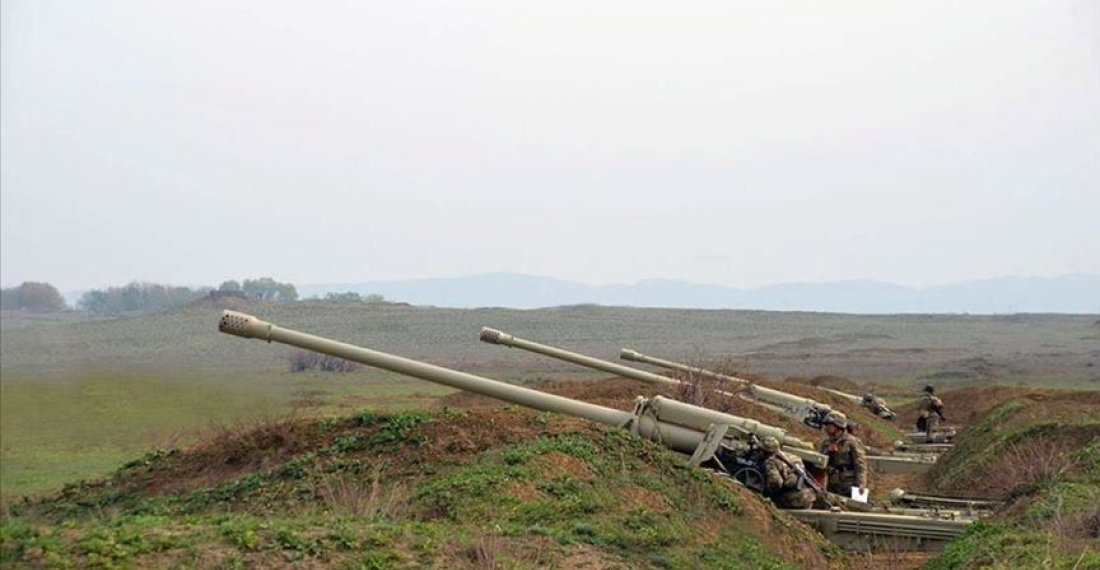
Over the last few days Armenia and Azerbaijan continued to report incidents on their border. Both sides reported casualties, including at least three Armenian fatalities, as a result of the exchange of fire. Both sides appeared to be using drones.
The incidents occurred as tension between the two countries escalated in recent weeks, despite efforts by the international community to help the sides reach a peace agreement to end years of hostilities. The incidents appear to be more serious than recent cease-fire violations, and unless contained may result in serious damage being done to ongoing peace negotiations.
Tension increased following disruption in the movement of goods and people across the Lachin corridor, which up to now has been the main artery connecting the Armenian community of Nagorno-Karabakh with Armenia.
In a statement, the spokesperson of European Council president, Charles Michel, who has been one of the key protagonists mediating between the two countries, it was stated that "President Michel has continued to be intensely engaged in advancing the Armenia-Azerbaijan normalization process. His efforts over the past weeks, supported by Toivo Klaar, EUSR for the South Caucasus, have focused as a priority on addressing the humanitarian situation of Karabakh Armenians.
EUSR Klaar and President Michel’s team have been in frequent contact with Baku, Yerevan and representatives of Karabakh Armenians to work out a solution for unblocking access.
The current humanitarian situation on the ground is deteriorating rapidly; it is imperative to take steps to address the needs of the local population.
European Council President Charles Michel has proposed a step-by-step approach that would reflect a sequencing in the full-fledged operation of the Lachin corridor and the opening of the Ağdam route.
Sequencing of these steps and the type of cargo that would be delivered by each of these roads, as well as attendant procedures, have been the core of the recent discussions.
The EU strongly believes the Lachin corridor must be unblocked, in line with past agreements and the ICJ Order, and notes that the use of the Ağdam road to provide supplies can also be part of a concrete and sustainable solution to the provision of urgent and daily basic needs. Discussions on these elements had started following the last meeting of the leaders in Brussels on 15 July 2023.
The EU side has also stressed the need for Baku to provide clarity to Karabakh Armenians in terms of procedures for their movements through Lachin corridor to and from Armenia.
In parallel, exchanges have also focused on restoring electricity and gas supplies to Karabakh Armenians as soon as possible.
Beyond the immediate situation, the EU side has stressed the need to address legacies of the conflict to facilitate a long-term sustainable resolution.
Dialogue between Baku and representatives of Armenians living in the former Nagorno-Karabakh Autonomous Oblast will be essential in this regard. The rights and security of Karabakh Armenians must be guaranteed and discussions on specific modalities should start as soon as possible.
The dialogue between Baku and the Karabakh Armenians needs to strengthen confidence and trust. To this end the EU has provided various suggestions for international support to this process, as well as for engagement on the ground to underpin the implementation of agreements reached.
All the above efforts have only one goal: ensure irreversible normalization of relations between Baku and Yerevan for the benefit of all populations on the ground. It is now time for courageous compromise solutions, also in light of today's escalation.
The EU has been engaged with other international actors in these efforts, through regular personal contacts and exchanges of views on how best address the current unsustainable situation."