Armenia "ready" to open border with Turkey, more aid passes through, FMs meet in Ankara

The Secretary of Armenia’s Security Council Armen Grigoryan has told journalists at a briefing on Tuesday (14 February) that Armenia is "ready"  for opening of the shared border with Turkey and normalisation of relations any time.

"The Armenian and Turkish sides are holding discussions on the issue and will continue the discussions, hoping that it will take place as soon as possible," Grigoryan said.

He added that an agreement on opening the border for nationals of third countries had indeed been reached last year between Armenia and Turkey, but said that no timeframe was discussed. The agreement was struck in July 2022, but changes on the ground have not yet materialised.

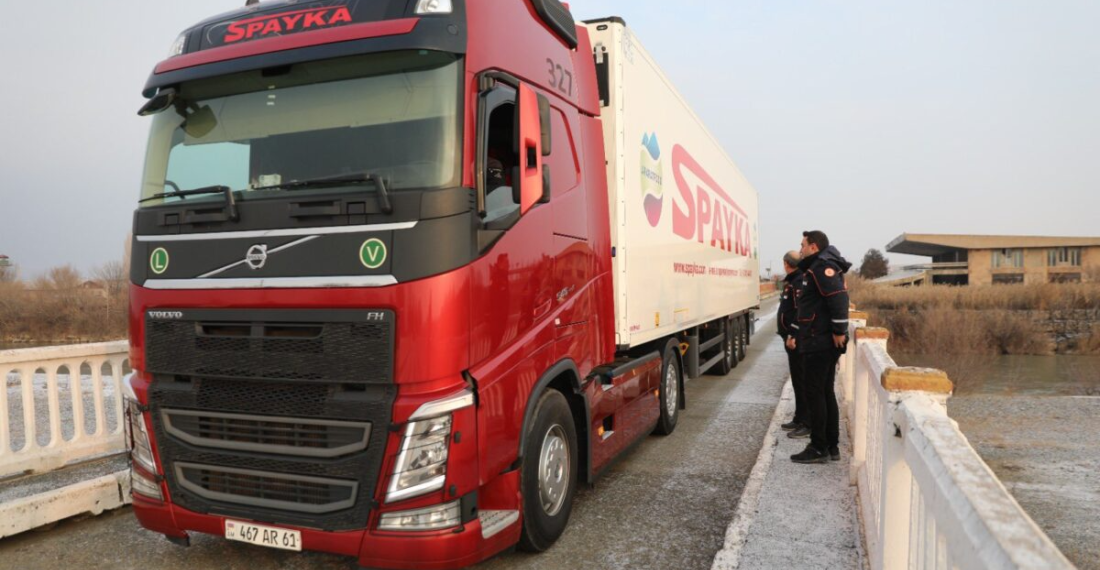
A second aid convoy crosses the Armenia-Turkey border late on Tuesday

Tweeting early in the morning on Wednesday, the Spokesperson for the Armenian Ministry of Foreign Affairs Vahan Hunanyan announced, "Armenia continues sending humanitarian aid to earthquake-affected regions. Late last night, trucks loaded with the second batch of humanitarian aid crossed the Armenian-Turkish border through the Margara bridge."

This was the second aid convoy sent by Armenia to Turkey following the devastating 6 February earthquake, which at the time of writing has killed over 40,000 people in Turkey and Syria.

The Armenian-Turkish border between the villages of Margara and Alican opened for the first time in 30 years on Saturday (11 February), to allow through the humanitarian aid for quake-affected people of Turkey. 

Armenian and Turkish foreign ministers meeting in Ankara

Also happening on Wednesday (15 February), the foreign ministers of Armenia and Turkey, Ararat Mirzoyan and Mevlut Cavusoglu, are meeting in the Turkish capital Ankara.

After the talks they made a statement to the press, and Mirzoyan will then meet the Armenian rescue team that carries out search and rescue operations in the earthquake-affected city of Adiyaman, reports the Public Radio of Armenia.

Responding to news of the visit, the EU Special Representative for the South Caucasus and the Crisis in Georgia Toivo Klaar tweeted, "This is a historic visit following Armenia's decision to support its neighbour in need. Hopefully a harbinger of developments to come in the Turkey-Armenia relationship."
source: commonspace.eu with agencies
photo: Armradio

Related articles

Editor's choice
News
European leaders set out their plan for Ukraine

European leaders set out their plan for Ukraine

The leaders of Germany, Denmark, Finland, France, Italy, Netherlands, Norway, Poland, Sweden, and United Kingdom, together with the President of the European Council, and the President of the European Commission, o  Monday (15 December) issued a statement, outlining their plan for Ukraine. In their statement, Chancellor Merz, Prime Minister Frederiksen, President Stubb, President Macron, Prime Minister Meloni, Prime Minister Schoof, Prime Minister Støre, Prime Minister Tusk, Prime Minister Kristersson, Prime Minister Starmer, as well as President Costa and President von der Leyen spoke about "Peace for Ukraine". The Leaders welcomed significant progress on President Trump’s efforts to secure a just and lasting peace in Ukraine. They also welcomed the close work between President Zelenskyy’s and President Trump’s teams as well as European teams over the recent days and weeks. They agreed to work together with President Trump and President Zelenskyy to get to a lasting peace which preserves Ukrainian sovereignty and European security. Leaders appreciated the strong convergence between the United States, Ukraine and Europe. Leaders agreed that ensuring the security, sovereignty, and prosperity of Ukraine was integral for wider Euro-Atlantic security. They were clear that Ukraine and its people deserved a prosperous, independent, and sovereign future, free from fear of future Russian aggression. Both the US and European leaders committed to work together to provide robust security guarantees and economic recovery support measures for Ukraine in the context of an agreement on ending the war. This would include commitments to: Provide sustained and significant support to Ukraine to build its armed forces, which should remain at a peacetime level of 800,000 to be able to deter conflict and defend Ukraine’s territory. A European-led ‘multinational force Ukraine’ made up from contributions from willing nations within the framework of the Coalition of the Willing and supported by the US. It will assist in the regeneration of Ukraine’s forces, in securing Ukraine’s skies, and in supporting safer seas, including through operating inside Ukraine. (Click the image to read the statement in full).

Popular