


Armenia and Azerbaijan emphasise combat readiness

The Ministers of Defence of Armenia and Azerbaijan have issued instructions to their respective armed forces emphasising the need for combat readiness.

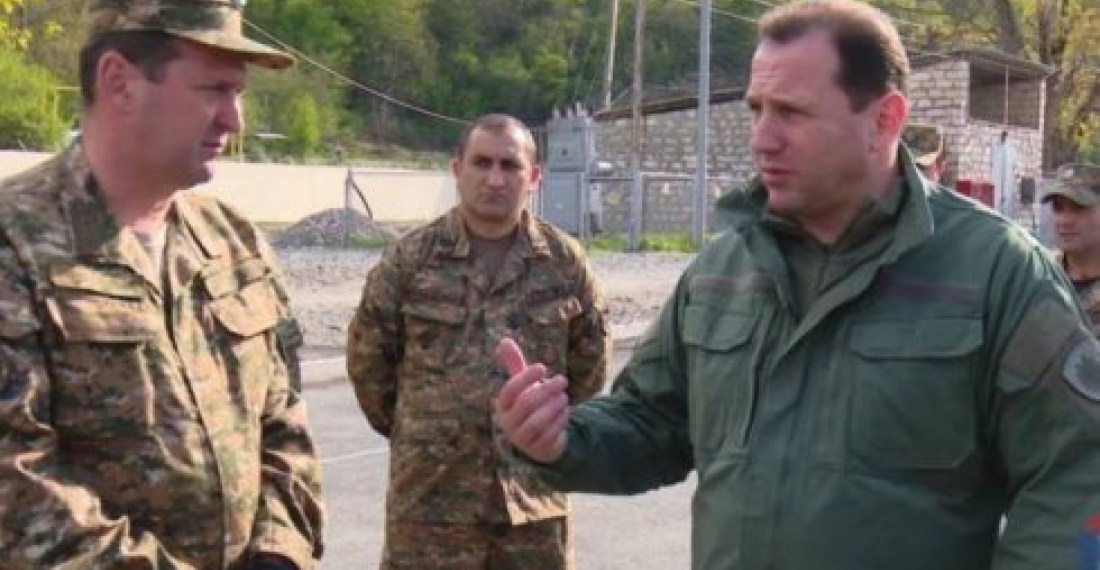
Armenian Defence Minister, David Tonayan was in the Karabakh conflict zone on Friday and Saturday (1-2 May).

Military source told Armenian media that Tonayan, accompanied by the Minister of Defence of the self-declared Nagorno-Karabakh Republic "visited a number of active duty military bases in the northern and central directions, toured various barracks and rear units and met with the troops. The main discussion points focused on the improvement of the service and social-household conditions of the servicemen, as well as combat and morale readiness, effective application of arsenal and military equipment, modernization and logistical issues."

On his part, Azerbaijani Defence Minister, Zakir Hasanov, told a meeting of senior military officers on Saturday (May 2), the "the possibility of renewed hostilities has increased dramatically".

Defence Minister Hasanov was addressing members of the command staff of the Azerbaijan Army on May 2 at the Central Command Post. Hasanov said that as a result of preventive measures taken no cases of coronavirus infection were recorded among military and civilian personnel of the Azerbaijan Army.

Azerbaijani military sources told Azerbaijani media that "the Minister of Defense  drew the attention of the army leadership to the fact that recently, due to the enhanced enemy provocative actions, the possibility of renewed hostilities has increased dramatically".

The Minister of Defense gave specific instructions on the strenghtening of reconnaissance, plans for combat readiness, the provision of comprehensive support to troops, and to check the readiness of military personnel to conduct intensive training and exercises.

The Minister of Defense "demanded that commanders at all levels must be ready to suppress various provocations, decisively prevent the enemy from activating in all directions of the front, as well as be prepared for the conduct of hostilities", the sources said.


Azerbaijani Defence Minister Zakir Hasanov addressing

Staff Officers and military commanders on 2 May 2020

On Wednesday (29 April) both Armenian and Azerbaijani sources confirmed that there had been an exchange of mortar fire in incidents that afternoon in the Karabakh conflict zone. Neither side reported any casualties but this was the first time mortar fire was exchanged this year, although both sides continue to report daily breaches of the cease fire arrangements through the use of machine guns and sniper guns.

Source: commonspace.eu with agencies

Photo 1: Armenian Defence Minister, Davit Tonayan, visiting Armenian military positions in the Karabakh conflict zone on 2 May 2020
Related articles

Editor's choice
News
Council of Europe launches new International Claims Commission for Ukraine

Council of Europe launches new International Claims Commission for Ukraine

Thirty-four countries and the European Union have signed a new convention establishing an International Claims Commission for Ukraine at a diplomatic conference co-hosted by the 46-nation Council of Europe and the Netherlands in the Hague. The diplomatic conference was attended by leaders and high-level representatives from over 50 states, including the President of Ukraine, Volodymyr Zelenskyy, the President of the Republic of Moldova, Maia Sandu, and the Prime Minister of the Netherlands, Dick Schoof.  “Today marks a major step forward in ensuring accountability for Ukraine. The International Claims Commission represents justice and hope for tens of thousands of victims—our determination that those who have suffered will not be forgotten. I call for quick ratifications so we can get the commission rapidly up and running for the people of Ukraine,” said Council of Europe Secretary General Alain Berset. Ukrainian President Volodymyr Zelenskyy said: “We expect that every mechanism for compensation from the Register of Damage and Claims Commission to the actual payments – will start working and receive strong and sufficient international support, so that people can truly feel that any kind of damage caused by the war can be compensated. This war, and Russia’s responsibility for it, MUST become a clear example – so that others learn not to choose aggression.” “Accountability is about creating the conditions for peace that endures. And therefore, accountability is a condition of security – today and for the future. But accountability is not only about Ukraine. And it is not only about one aggressor and one victim. Accountability is about Europe. About every country in Europe. It is about whether Europe, as a whole, is willing to defend its peace,” said Maia Sandu, President of the Republic of Moldova, which currently holds the Presidency of the Council of Europe’s Committee of Ministers. The Prime Minister of the Netherlands, Dick Schoof, said: “Every day Russia is deliberately bombarding homes, destroying businesses and damaging infrastructure in Ukraine. Russia must compensate Ukraine for the damage caused. That is why we have launched the International Claims Commission for Ukraine and we are honoured to host it.” The International Claims Commission will be the second part of a comprehensive compensation mechanism related to Russia’s war of aggression, building on the existing Register of Damage for Ukraine. The claims commission will be established within the framework of the Council of Europe and will also be open to other countries. The Register of Damage for Ukraine, created in 2023, collects and records compensation claims submitted by individuals, organisations and public bodies in Ukraine. Forty-four states and the European Union have so far joined the Register, which has already received 86,000 claims. The International Claims Commission will review, assess and decide upon claims submitted to the Register of Damage for Ukraine and determine the amount of compensation, if any, which is due in each case. The convention establishing the commission will enter into force once it has been ratified by 25 signatories, as long as sufficient funds have been secured to support its initial work.

Popular

