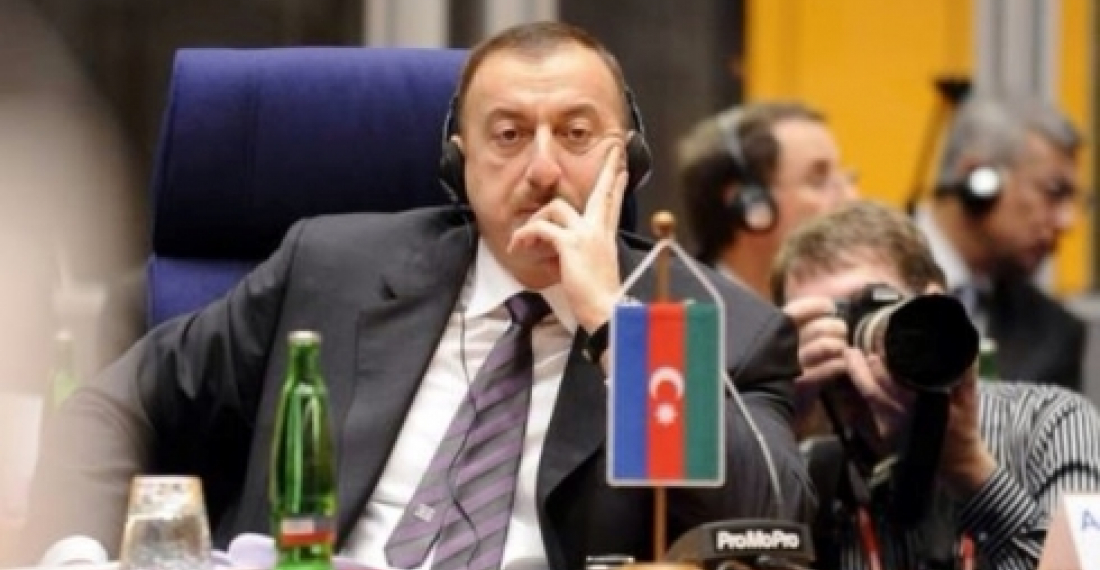
Azerbaijani president Ilham Aliev has decided not to attend the Eastern Partnership summit being hosted by the Latvian Presidency of the European Union in Riga on 21-22 May.
The decision was announced in Baku by the Advisor to the President, Ali Hassanov, who said that the President was busy with the preparations of the European Games to be held in Baku next month.
Shortly afterwards however, the pro government news agency APA ran an exclusive story in which it said that the reason for the absence of Presidnet Aliev from the summit was to show displeasure at the unprecedented anti Azerbaijani campaign currently ongoing in Europe. Azerbaijan accuses a number of NGOs of orchestrating the campaign. European human rights NGOs have recently been actively campaigning for a tougher EU position with regards to the imprisonment of a number of civil society activists in Azerbaijan, and general incidences of pressure on NGOs and independent media.
In its report, APA said,
"Such a decision from President Aliyev lies in the West's recent tendentious campaigns against Azerbaijan and extensive anti-Azerbaijan activities of some NGOs run from various centers in Europe, diplomatic sources told APA.
According to information, the expansion of the "black PR" campaign against Azerbaijan - in close collaboration with some western powers which claim to be interested to develop strategic partnership ties with Azerbaijan - on the eve of the first European Games has triggered a reasonable uproar.
According to other information obtained by APA, Novruz Mammadov, Deputy Head of the Presidential Administration, has recently met with Malena Mard, Head of the EU Delegation to Azerbaijan, to express his protest against the European Parliament that began to intensify its anti-Azerbaijani campaign and demand the suspension of discussions scheduled for May 12 at the European Parliament.
The EU representative was also told that in case the discussions were not suspended, the Azerbaijani president will refuse to participate in the Riga summit.
According to diplomatic sources, the expansion of an anti-Azerbaijani sentiment makes a strategic partnership with the West impossible. The Azerbaijani government has received information that as on the eve of the 2012 Eurovision song contest, a few days before the first European Games, the European Parliament is going to adopt a new special resolution on Azerbaijan. Taking these factors into account, President Ilham Aliyev has refused to participate in the Riga summit."
Azerbaijan will now be represented at the Eastern Summit by the Foreign Minster, Elmar Mammadyarov, and the Deputy Head of the Presidential Administration, Novruz Mammedov.
Commonspace.eu political editor said in a comment that this decision probably takes relations between the European Union and Azerbaijan to their lowest point ever. Some observers had been warning for some time that relations were heading into very difficult waters. Azerbaijani has completely ignored calls to release civil society activists and independent journalists and to ease the pressure on civil society organisations in line with its obligations as a member of the Council of Europe and the OSCE. Azerbaijan however claims that there is an orchestrated international campaign against it.
In itself the absence of President Aliev from the Riga summit has no immediate tangible consequences. But the boycot does mark an important turning point in relations which will have consequences in different areas where Azerbaijan and the EU currently co-operate,- unless the trend can be reversed soon.
souce:commonspace.eu