


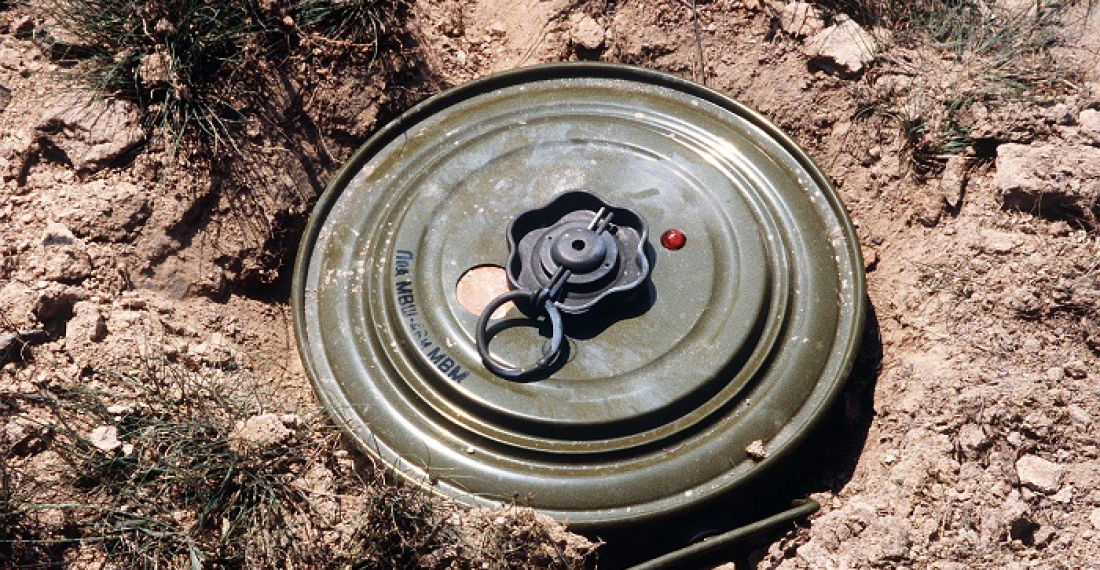
4 April is International Landmine Awareness Day

The United Nations' International Day for Mine Awareness and Assistance in Mine Action is observed on April 4 each year. This day aims to raise awareness about landmines and progress toward their eradication.

Creating a world free from deadly weapons is an important objective for the United Nations. Together with government and civil society groups, it created the Mine Ban Treaty in 1997, which prohibits the use, stockpiling, production and transfer of anti-personnel mines and provides for their destruction.

Signed by over 160 countries, the Treaty has brought about a dramatic reduction in the use of landmines. But there is still a long way to go. Mines are still present in over 60 countries, threatening the lives of millions of people and preventing the land they contaminate from being used, for agriculture and housing, for example.

For this reason, the UN declared that 4 April should be observed each year as the International Day for Mine Awareness and Assistance in Mine Action. The Day serves to raise awareness of the ongoing threat posed by mines, call on those states that have not yet signed the Treaty to do so, and mobilise resources to help the countries affected.

In the South Caucasus, the problem of landmines and other unexploded remnants of war remains a serious issue across the region. Over the last months, since the end of the 44-day Karabakh War, the problem has become more acute as efforts are made to rehabilitate territories that were until recently in the conflict zone. Most of these territories are heavily mined. Problems also remain in other areas on both the Armenian and the Azerbaijani sides of the line of contact and the international border.

The regional campaign Landmine Free South Caucasus has issued a statement on the occasion of International Landmine Awareness Day in which it announced the holding its 2021 campaign in the South Caucasus later this year.  Government agencies and NGOs from Armenia, Azerbaijan, Georgia and beyond, are members of the campaign, including, The Center for Humanitarian Demining and Expertise (Yerevan); The DELTA State Demining Agency (Tbilisi); The Caucasus Policy Analysis Center (Baku); The Europe-Georgia Institute (Tbilisi); The HALO Trust (Thornhill) and LINKS Europe (The Hague). This year's campaign will be organised once more with the support of the European Union.

In their statement on the occasion of International Landmine Awareness Day, the members of the campaign stated:

In December 2005, the United Nations designated 4 April as International Mine Awareness Day. Ever since, it has been marked each year across the globe by the many individuals, states and organisations that support or are involved in the fight to rid the world of landmines. This international day of observance serves to raise awareness and understanding of the ongoing threat posed by mines and other explosive ordnance. On this occasion, we are pleased to announce that the Landmine Free South Caucasus campaign will this year take place once more – with a common message and activities across the region.

Since it was launched in 2019, the Landmine Free South Caucasus campaign has brought together local and international NGOs, governments and civil society groups from across the region in support of the objective of clearing the region of all landmines and unexploded remnants of war.   

Whilst, regrettably, last year’s campaign had to be cancelled due to COVID-19 restrictions, we are pleased to announce the launch of this year’s campaign which will run in two parts. The first part, from 15-30 June, will focus on raising awareness of landmines and their dangers among school children, especially in mine-affected communities. The second part – with the theme, Landmine Free South Caucasus. NOW! will take place across the region from 15 September to 15 October. It will focus on the work and sacrifice put in by de-miners from all parts of the South Caucasus, whilst also highlighting the plight of the region’s growing number of victims of landmines and unexploded remnants of war, their families and communities. The campaign will be conducted in five languages: Armenian, Azerbaijani, Georgian, Russian and English.

On the occasion of International Mine Awareness Day 2021, we call for a concerted effort to rid the South Caucasus of all landmines and invite communities across the region to join the activities of the Landmine Free South Caucasus campaign throughout the year.

Further information on the 2021 regional campaign, Landmine Free South Caucasus, is available from the LINKS Europe, who provide the secretariat of the campaign (office@links-europe.eu)

commonspace.eu is pleased to be the media partner for the Campaign: Landmine Free South Caucasus 2021


 

source: commonspace.eu

Related articles

Editor's choice
News
Borrell tells the European Parliament that the situation in Afghanistan was critical, but the EU will remain engaged

Borrell tells the European Parliament that the situation in Afghanistan was critical, but the EU will remain engaged

Borrell underlined that the European Union will make every effort to support the peace process and to remain a committed partner to the Afghan people. "Of course, we will have to take into account the evolving situation, but disengagement is not an option.  We are clear on that: there is no alternative to a negotiated political settlement, through inclusive peace talks.
Editor's choice
News
NATO Chief says war is on Europe's doorstep, and warns against complacency

NATO Chief says war is on Europe's doorstep, and warns against complacency

Russia could attack a Nato country within the next five years, the Secretary General of NATO, Mark Rutte, said in a stark new warning. "Nato's own defences can hold for now," Rutte warned in Berlin, but conflict was "next door" to Europe and he feared "too many are quietly complacent, and too many don't feel the urgency, too many believe that time is on our side. "Russia is already escalating its covert campaign against our societies," Rutte said in a speech in Germany. "We must be prepared for the scale of war our grandparents or great-grandparents endured." Earlier this month, Russia's President Vladimir Putin said his country was not planning to go to war with Europe, but it was ready "right now" if Europe wanted to - or started a war. But similar reassurances were given by Moscow in 2022, just before 200,000 Russian troops crossed the border and invaded Ukraine. Putin has accused European countries of hindering US efforts to bring peace in Ukraine - a reference to the role Ukraine's European allies have recently played in trying to change a US peace plan to end the war, whose initial draft was seen as favouring Russia. But Putin was not sincere, Nato's secretary-general said in the German capital, Berlin. Supporting Ukraine, he added, was a guarantee for European security. "Just imagine if Putin got his way; Ukraine under the boot of Russian occupation, his forces pressing against a longer border with Nato, and the significantly increased risk of an armed attack against us." Russia's economy has been on a war footing for more than three years now - its factories churn out ever more supplies of drones, missiles and artillery shells. According to a recent report by the Kiel Institute for the World Economy, Russia has been producing each month around 150 tanks, 550 infantry fighting vehicles, 120 Lancet drones and more than 50 artillery pieces. The UK, and most of its Western allies, are simply not anywhere near this point. Analysts say it would take years for Western Europe's factories to come close to matching Russia's mass-production of weapons. "Allied defence spending and production must rise rapidly, our armed forces must have what they need to keep us safe," the Nato chief said.

Popular

Editor's choice
News
NATO Chief says war is on Europe's doorstep, and warns against complacency

NATO Chief says war is on Europe's doorstep, and warns against complacency

Russia could attack a Nato country within the next five years, the Secretary General of NATO, Mark Rutte, said in a stark new warning. "Nato's own defences can hold for now," Rutte warned in Berlin, but conflict was "next door" to Europe and he feared "too many are quietly complacent, and too many don't feel the urgency, too many believe that time is on our side. "Russia is already escalating its covert campaign against our societies," Rutte said in a speech in Germany. "We must be prepared for the scale of war our grandparents or great-grandparents endured." Earlier this month, Russia's President Vladimir Putin said his country was not planning to go to war with Europe, but it was ready "right now" if Europe wanted to - or started a war. But similar reassurances were given by Moscow in 2022, just before 200,000 Russian troops crossed the border and invaded Ukraine. Putin has accused European countries of hindering US efforts to bring peace in Ukraine - a reference to the role Ukraine's European allies have recently played in trying to change a US peace plan to end the war, whose initial draft was seen as favouring Russia. But Putin was not sincere, Nato's secretary-general said in the German capital, Berlin. Supporting Ukraine, he added, was a guarantee for European security. "Just imagine if Putin got his way; Ukraine under the boot of Russian occupation, his forces pressing against a longer border with Nato, and the significantly increased risk of an armed attack against us." Russia's economy has been on a war footing for more than three years now - its factories churn out ever more supplies of drones, missiles and artillery shells. According to a recent report by the Kiel Institute for the World Economy, Russia has been producing each month around 150 tanks, 550 infantry fighting vehicles, 120 Lancet drones and more than 50 artillery pieces. The UK, and most of its Western allies, are simply not anywhere near this point. Analysts say it would take years for Western Europe's factories to come close to matching Russia's mass-production of weapons. "Allied defence spending and production must rise rapidly, our armed forces must have what they need to keep us safe," the Nato chief said.

