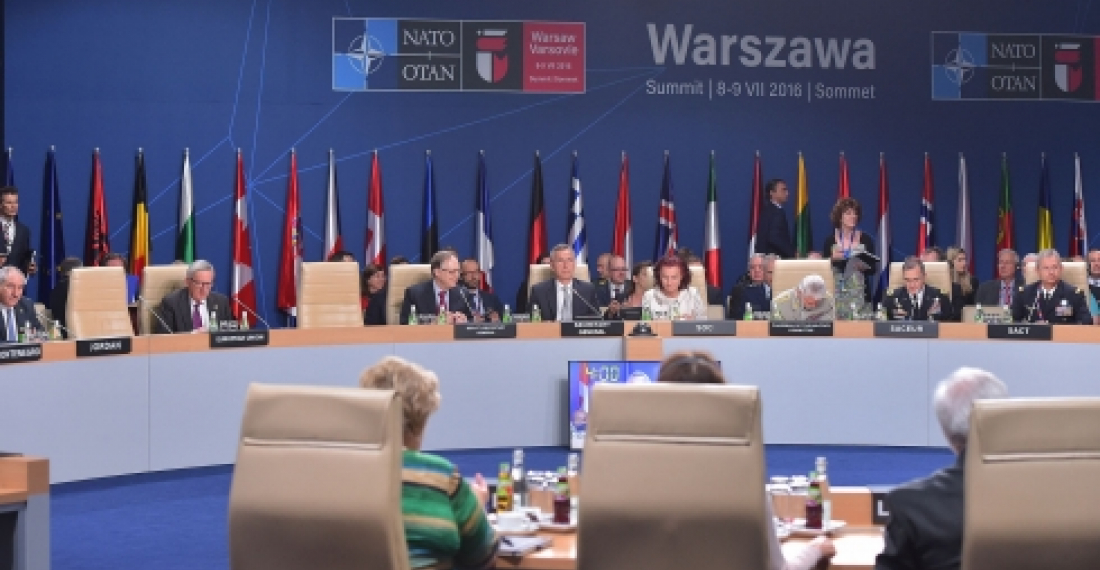
The Warsaw Summit of heads of state and government of the NATO alliance concluded on Saturday with the adoption of a strongly worded communique which talks tough about Russian threats to European peace and security and outlines very extensive plans for strengthening the alliance in response. The wording of the communique is unprecedented since the end of the cold-war and indicates the resolve of the NATO allies to provide a robust response to events in Ukraine and other recent Russian actions, as well as other threats from the south.
The declaration extends the alliance support for Ukraine and also addresses the situation in the South Caucasus, reaffirming NATO's committment to the independence, sovereignity and territorial integrity of Armenia, Azerbaijan and Georgia. In this regard it states,
"We continue to support the right of all our partners to make independent and sovereign choices on foreign and security policy, free from external pressure and coercion. We remain committed in our support for the territorial integrity, independence, and sovereignty of Armenia, Azerbaijan, Georgia, and the Republic of Moldova. In this context, we continue to support efforts towards a peaceful settlement of the conflicts in the South Caucasus, as well as in the Republic of Moldova, based upon these principles and the norms of international law, the UN Charter, and the Helsinki Final Act. We urge all parties to engage constructively and with reinforced political will in peaceful conflict resolution, within the established negotiation frameworks."
On Georgia, the summit communique states among other things:
"At the 2008 Bucharest Summit we agreed that Georgia will become a member of NATO with MAP as an integral part of the process; today we reaffirm all elements of that decision, as well as subsequent decisions. We welcome the significant progress realised since 2008. Georgia’s relationship with the Alliance contains all the practical tools to prepare for eventual membership. This year’s parliamentary elections will be another key step towards the consolidation of democratic institutions. We encourage Georgia to continue making full use of all the opportunities for coming closer to the Alliance offered by the NATO-Georgia Commission, the Annual National Programme, its role as an enhanced opportunities partner, its participation in our Defence Capacity Building Initiative, and the Substantial NATO-Georgia Package. NATO highly appreciates Georgia’s significant and continuous contributions to the NATO Response Force and the Resolute Support mission in Afghanistan and recognises the sacrifices and contributions the Georgian people have made to our shared security."
You can read the full text of the Comunique of the Warsaw Summit here
source: commonspace.eu with the Press Service of NATO
photo: The NATO Summit in Warsaw on 8-9 July 2016 (picture courtesy of the NATO Press Service.)