


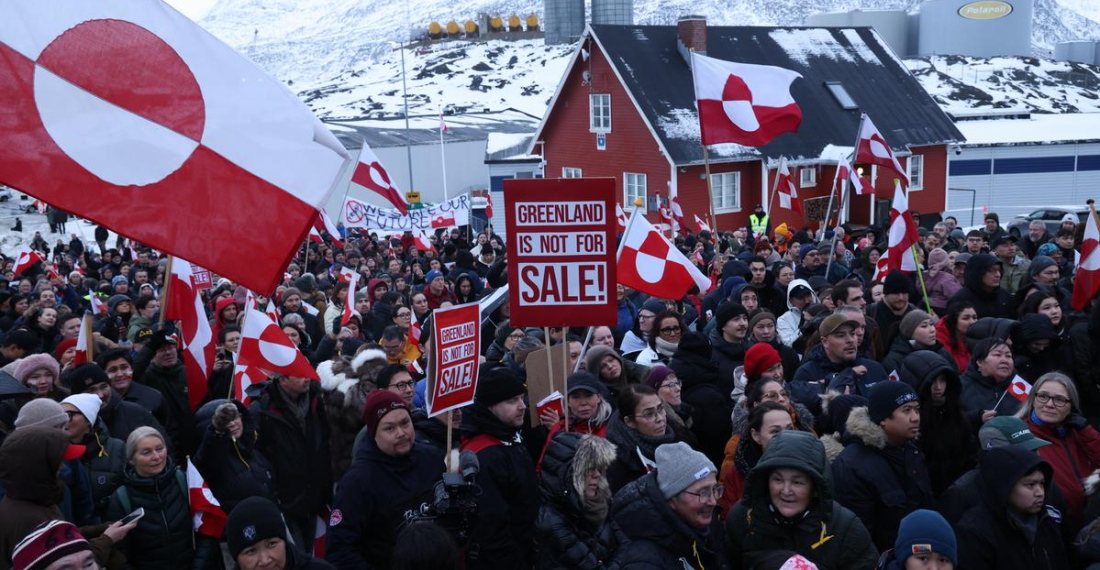
Donald Trump continues to claim Greenland, not on the basis of any legal, historical or moral reason, but just because, as he says, “we must have it”.
Greenland is a self-governing territory, part of the Kingdom of Denmark which has three constituent parts: mainland Denmark, Greenland and the Faroe Islands. Copenhagen is responsible for Greenland’s defence and foreign affairs.
Trump’s claim is so absurd, that initially it was not taken seriously. It was dismissed as another of Trump’s rants, soon to be forgotten. But on Friday (16 January), the president of the United States imposed from 1 February, 10% additional tariffs on eight European countries that had dared question his claim: Denmark, Norway, Finland, Sweden, France, Germany, Netherlands and UK; with a threat that the extra tariffs would increase to 25% on 1 June.
Is it a crises?
Unfortunately, what may first appear to be a Lillipudian soap opera, is in fact a major international crises.
First of all the tiny population of Greenland has been rattled, even though they are standing firm in the face of American advances.
Denmark, which normally prefers to blend-in in international politics, has been put in the eye of the storm, but it too has dug in, and rejected US advances.
But the biggest crises is the one developing between Europe and the US, for Greenland has brought out the best of Europe and the worst of Trump’s United States.
Europe’s principled response
European rebuff of Trumps‘s overtures has been principled, and goes beyond support for a small EU member state. The president of the European Commission summed it up in a tweet on Saturday (17 January):
"Territorial integrity and sovereignty are fundamental principles of international law. They are essential for Europe and the international community as a whole."
In other times the US would have applauded this position. Under Trump, international law has lost all meaning.
Greenland has focused European minds on defence and Arctic Security
The debate in Europe on defence has been going for some time, and it intensified after Russia invaded Ukraine in 2022. Last year the EU published a landmark white paper on defence. Greenland however focused minds. Here was the territorial integrity of a small member state being threatened, by another NATO ally no less. The rush to beef up European defence has now become a scramble.
Arctic Security
Security in the Arctic has long been neglected by the US, Europe and NATO, whilst Russia and China have been busy. Greenland has focused minds on the Arctic also.
Denmark, Finland, France, Germany, the Netherlands, Norway, Sweden and the United Kingdom last week sent military delegations to Greenland at the invitation of the Danish government. The deployment triggered Trump’s tariff response
The eight countries said threats to impose tariffs “undermine transatlantic relations and create the risk of a dangerous spiral of escalation.” In particular, they expressed solidarity with and support for Denmark and the people of Greenland.
“We are fully in solidarity with the Kingdom of Denmark and the people of Greenland. Based on the process launched last week, we are ready for dialogue grounded in the principles of sovereignty and territorial integrity, which we firmly uphold,” the statement said.
Trump’s claim based on might is right
In Trump’s White House, might is right. And this it seems goes equally to friends and allies, as it does to enemies and foes. The seasoned and adroit Economics Editor of the BBC, Faisal Islam wrote on Sunday (18 January), as he was preparing his bags bto go for Davos, for the World Economic Forum, at which another “Trump spectacular” is expected, that the threats of the US president to allies, are without parallel. He wrote, “US President Donald Trump's apparently coercive threat to force Western allies not to oppose his proposed annexation of Greenland, or face further damage to their trade with the US, is without both parallel and precedent.
We've had some unusual and unexpected economic threats from President Trump over the past year, but I think it is safe to say this exceeds all of them, and takes us into both surreal and utterly dangerous territory.
If taken at face value, it is a form of economic war being levied by the White House on its closest allies. That's because it targets allies at incredibly short notice and for a cause that essentially could break up NATO and the western alliance.”
If Trump’s ultimate objective is to break NATO, as some suspect, than he is doing very well.
US – Europe relations will never be the same again – trust is broken
Whatever happens now, transatlantic relations will never be the same again. Trust is broken, and the damage will be difficult to repair, even long after Trump has left the White House.
Europe must now wake up to reality, and responsibility. NATO needs to change if it is to survive, depending less on the US, and being more agile. Trump’s Greenland threats have poisoned US-Europe relations, but they have also shown the meaning of the word solidarity, not only within the EU, but also with non-EU European countries such as UK and Norway, as well as with Canada. From every crises, an opportunity arises.
Source: Monday Commentary is written every week by Dr Dennis Sammut, Director of LINKS Europe and Managing Editor of commonspace.eu
Photo: Protestors against Trump's pressure in the Greenland capital, Nuuk, on 17 January 2026.



