


“Germany is Back on Track” ……..and Europeans should be Happy about it!

On Wednesday (9 April) a new coalition government was announced in Germany bringing back a CDU chancellor working with the centre-left SPD as junior partners. It is an arrangement that Germans are familiar with. Many post-war German governments were similarly constituted, and the German people are comfortable with this arrangement. It buries the prospect of the far-right Alternative fur Deutschland  (AfD), which came second in recent elections, having a role in government.

The 146 pages coalition agreement was hammered out in a relatively short time, with those negotiating fully aware of the urgency of giving the country a stable government at a time of global uncertainty and serious domestic challenges. “Germany is back on track” announced the Chancellor-designate, Friedrich Merz, who is expected to take office in early May. Europeans should be happy. A strong Germany is the backbone of Europe, and the new coalition is the best guarantee of that.

Defence and Foreign Affairs

There is general agreement within the coalition on defence and foreign affairs despite the coalition parties having their different nuances. The CDU will get the Foreign Ministry whilst the SPD will get Defence. The popular and able SPD defence minister, Boris Pistorius, will remain in office. There are a number of issues on which the new government will take early action.

The first is support for Ukraine. Germany is expected to increase its support for Ukraine, quantitively as well as qualitatively. Second is German re-armament. For too long Germany neglected this task.  The process started under Chancellor Scholz, but is now expected to accelerate. Third, even if the coalition agreement says little about this, is the question of the nuclear umbrella. Germany will continue being a non-nuclear power, but now that the US cannot be relied upon to give nuclear cover, Germany will seek alternative arrangements with one or both of Europe’s nuclear powers: France and the UK.

What this arrangement will look like is early to say. But one can assume that the new German government will start talking on this issue with both France and the UK early. Germany has long-standing close relations with France, and has been prominent in seeking to keep the UK as a close partner on defence and security issues, despite Brexit.

Economy

Agreement in the coalition on economic issues has been more difficult to achieve. The coalition agreement reflects that, and both the CDU and the SPD had to accept a compromise. The SPD will take the important Finance Ministry whilst the CDU will head the Ministry of Economy. Germany will get a 500 billion euro infrastructure fund, that is expected to kick-start economic growth. But exports, on which the German economy has traditionally relied, remain weak. 

Merz described the 144-page Coalition Agreement, “Responsibility for Germany” as a roadmap. It “is a very strong and clear signal to the citizens of our country. And it is also a clear signal to our partners in the European Union,” he said during a press conference with his coalition partners.

The coalition agreement includes tax breaks for low- and moderate-income households, phased-in tax reductions for corporations, subsidies for electric cars to help the ailing auto industry and further reform of the “debt brake”. Germany has lacked innovation, and the ability to change fast in the face of challenges. A  new “super–high-tech ministry” responsible for research, technology, and aerospace, is being created, according to the coalition agreement    

Under the plans, the current Ministry of Research and Education will be split. A new ministry for research, technology, and aerospace will be formed, and the education portfolio will be taken over by the current ministry for family, seniors, women, and youth. German research and technology will be under the same ministry, with research separate from education.

Top of Form

Support for artificial intelligence, quantum technologies, biotechnology, microchip development and production, and fusion energy are listed as areas to be supported, according to the coalition agreement. It also mentions personalized medicine, ocean research, and sustainability research as “strategic” areas.

Migration

One other difficult area in which compromise was necessary is Migration. The interior ministry will be headed by the CSU, the CDU sister party in Bavaria, whose rhetoric on migration is very populist. The likely candidate for the post is CSU hardliner Alexander Dobrundt.  With an eye on the increasing strength of the AfD, Merz has secured tougher immigration controls – checks at borders, no family for the first two years, and five years rather than three for citizenship applications.

Managing relations with SPD

Managing relations within the coalition will always remain a challenge. Merz is reported to have good relations with SPD leader, Lars Klingbeil, and this relationship will be crucial to keep the coalition together in what are likely to be turbulent times. The SPD is still licking its wounds after having been relegated to third place in the recent elections, and it is a shadow of its former self when it was led by political giants, such as Willy Brandt. It must use the time in the coalition wisely unless it wants to be doomed to oblivion.

Germany a leader in Europe

One can assume that Germany under Merz will once more become a leader in Europe. In the past Germany’s neighbours in Central and Eastern Europe have not been very comfortable with this. But Putin’s aggression against Ukraine and the shenanigans in Washington have focused minds. Germany is also unlikely to continue playing second fiddle to France in EU councils. Many would welcome this development. The first meeting between Friedrich Merz and French President, Emanuel Macron is likely to be in May and will be worth watching well.

Germany a leader in the world

The big question is, will Germany become more assertive on the world stage? In this difficult moment in world history, many expect no less. So far Germany has been comfortable with the role of economic superpower, and has left geo politics to others. Now it does not have the luxury to do so any more. However, it will not be easy to change roles, and mistakes are inevitable. Initially, it is likely Germany will work with partners, in multilateral frameworks such as the EU and NATO, and bilaterally with like-minded countries such as France, the UK and the Scandinavian countries.

Managing Trump

In all of this Germany must manage the Donald Trump phenomenon. Germany has up to now relied on the security cover of the United States. The US is Germany’s biggest export market. Merz will be cautious. But he also understands that only a strong response from a strong Germany will work.

Friedrich Merz will shortly take the helm of Germany at a difficult time for his country, and for the world. He seems to be ready for the challenge.


Source: Dr Dennis Sammut is the Director of LINKS Europe and Managing Editor of commonspace.eu
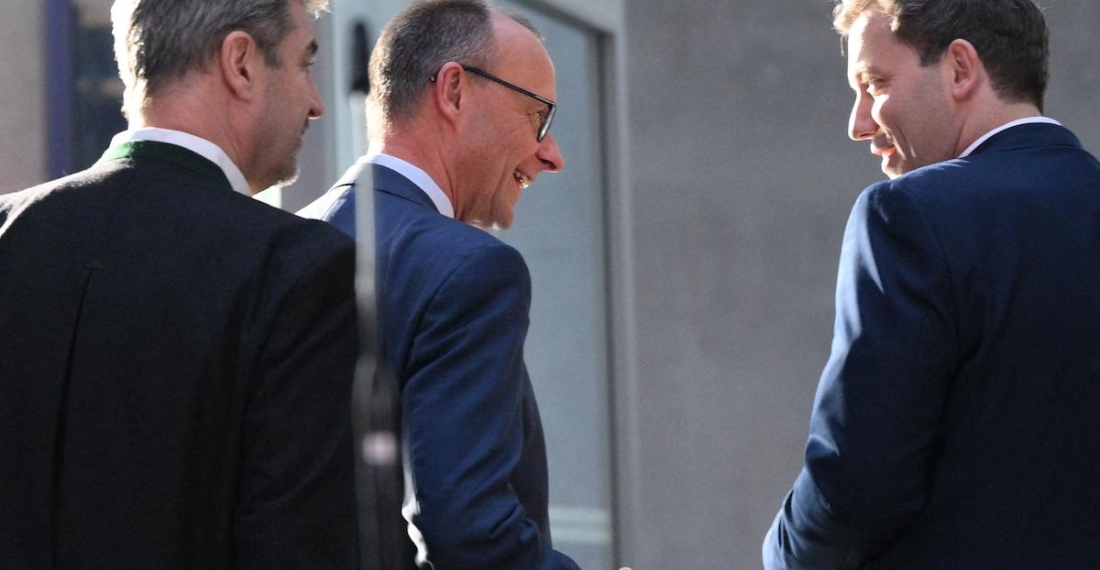
Photo: From left: (Christian Social Union) CSU leader Markus Soeder, Christian Democratic Union (CDU) leader Friedrich Merz and social democratic SPD party co-leader Lars Klingbeil. Photo: RALF HIRSCHBERGER / AFP

The views expressed in opinion pieces and commentaries do not necessarily reflect the position of commonspace.eu or its partners. Photo source: SkyNews

Related articles

Editor's choice
News
Russia adds pressure on Armenia ahead of key elections; recalls Ambassador in Yerevan for consultations

Russia adds pressure on Armenia ahead of key elections; recalls Ambassador in Yerevan for consultations

Ahead of key parliamentary elections,scheduled to be held in Armenia on Sunday, 7 June, Russia continues to attempt to put pressure on the Armenian Government led by prime minister Nikol Pashinyan. On 30 May, Russia recalled its Ambassador to Yerevan for consultations. A terse statement, published on the website of the Russian Foreign Ministry, said, "The Ambassador of the Russian Federation to the Republic of Armenia , S.P. Kopyrkin, has been summoned to Moscow for consultations in connection with the steps taken by the Armenian leadership to move closer to the European Union, which are detrimental to cooperation within the EAEU." This followed a statement issued the day before, by the leaders of the Eurasian Economic Union (EAEU) that challenges the Armenian trajectory towards approximating to the European Union. Vladimir Putin is undertood to have personally pushed the other four EAEU leaders to issue the statement, which said: "Taking into account the significant risks to the economic security of the member states of the Eurasian Economic Union (hereinafter referred to as the Union) arising in connection with the preparation of the Republic of Armenia for accession to the European Union, as well as the need to prevent the associated damage to the member states of the Union: decided that the members of the Eurasian Intergovernmental Council from the Republic of Belarus, the Republic of Kazakhstan, the Kyrgyz Republic and the Russian Federation will report at the next meeting of the Supreme Eurasian Economic Council in December 2026 on the possible consequences of the suspension of the Treaty on the Eurasian Economic Union with respect to the Republic of Armenia. We share the position on the need to hold a national referendum in the Republic of Armenia as soon as possible on joining the European Union or continuing to be part of the Eurasian Economic Union."
Editor's choice
News
The leaders of the states of the Eurasian Economic Union issued a tough statement warning fellow-member state Armenia of the consequences of its desire to join the European Union.

The leaders of the states of the Eurasian Economic Union issued a tough statement warning fellow-member state Armenia of the consequences of its desire to join the European Union.

The leaders of the states of the Eurasian Economic Union (EEAS) issued a tough statement warning fellow-member state Armenia of the consequences of its desire to join the European Union. The stark, sharply worded,  warning, comes days before crucial parliamentary elections in Armenia, scheduled for 7 June. The full statement said, “We, the Presidents of the Republic of Belarus, the Republic of Kazakhstan, the Kyrgyz Republic and the Russian Federation, Taking into account the actions of the Republic of Armenia aimed at joining the European Union, including the approval in 2025 by the National Assembly of the Republic of Armenia and the signing by the President of the Republic of Armenia of the Law of the Republic of Armenia "On the Start of the Process of Accession of the Republic of Armenia to the European Union", as well as the confirmation by the European Union of the European aspirations of the Government of the Republic of Armenia, expressed in the joint declaration following the first Armenia-European Union summit, adopted on 5 May 2026, Taking into account the significant risks to the economic security of the member states of the Eurasian Economic Union (hereinafter referred to as the Union) arising in connection with the preparation of the Republic of Armenia for accession to the European Union, as well as the need to prevent the associated damage to the member states of the Union: decided that the members of the Eurasian Intergovernmental Council from the Republic of Belarus, the Republic of Kazakhstan, the Kyrgyz Republic and the Russian Federation will report at the next meeting of the Supreme Eurasian Economic Council in December 2026 on the possible consequences of the suspension of the Treaty on the Eurasian Economic Union with respect to the Republic of Armenia. We share the position on the need to hold a national referendum in the Republic of Armenia as soon as possible on joining the European Union or continuing to be part of the Eurasian Economic Union. Astana, May 29, 2026” A meeting of the Supreme Eurasian Economic Council was held in Astana, Kazakhstan, on May 29, 2026. The meeting of the Supreme Eurasian Economic Council in a restricted format was attended by Russian President Vladimir Putin, Belarusian President Alexander Lukashenko , Kazakh President Kassym-Jomart Tokayev , Kyrgyz President Sadyr Japarov , Armenian Deputy Prime Minister Mher Grigoryan, and Chairman of the Board of the Eurasian Economic Commission Bakytzhan Sagintayev. From the Russian side, the meeting was also attended by Deputy Prime Minister and member of the Council of the Eurasian Economic Commission Alexey Overchuk and Presidential Aide Yury Ushakov . The heads of delegations from EAEU observer states, including President of Uzbekistan Shavkat Mirziyoyev , Vice President of Cuba Salvador Valdés Mesa, Minister of Industry, Mines, and Trade of Iran Mohammad Atabak, and CIS Secretary General Sergei Lebedev, joined the expanded meeting . Following the meeting of the Supreme Eurasian Economic Council, a number of documents were signed .

Popular

Editor's choice
Interview
Thursday Interview: Murad Muradov

Thursday Interview: Murad Muradov

Today, commonspace.eu starts a new regular weekly series. THURSDAY INTERVIEW, conducted by Lauri Nikulainen, will host  persons who are thinkers, opinion shapers, and implementors in their countries and spheres. We start the series with an interview with Murad Muradov, a leading person in Azerbaijan's think tank community. He is also the first co-chair of the Action Committee for a new Armenian-Azerbaijani Dialogue. Last September he made history by being the first Azerbaijani civil society activist to visit Armenia after the 44 day war, and the start of the peace process. Speaking about this visit Murad Muradov said: "My experience was largely positive. My negative expectations luckily didn’t play out. The discussions were respectful, the panel format bringing together experts from Armenia, Azerbaijan, and Turkey was particularly valuable during the NATO Rose-Roth Seminar in Yerevan, and media coverage, while varied in tone, remained largely constructive. Some media outlets though attempted to represent me as more of a government mouthpiece than an independent expert, which was totally misleading.  Overall, I see these initiatives as important steps in rebuilding trust and normalising professional engagement. The fact that soon a larger Azerbaijani civil society visits to Armenia followed, reinforces the sense that this process is moving in the right direction." (click the image to read the interview in full)

