Our live blog on the coronavirus pandemic and its impact on the world is on every day from 1200-1600 Central European Summer Time (equivalent to 1400-1800 in Tbilisi and Dubai).
This blog is compiled by our team of journalists and researchers based in The Hague in the Netherlands and in Tbilisi, Georgia, working with partners and associates in a number of different countries. You can also follow us on twitter @commonspaceEU. We are happy to hear from you wherever you are. Please send us your comments, stories and suggestions by email to editor@commonspace.eu
This live blog has been running daily since 19 March. You can read earlier blogs here
____________________________________________________________________________________________________________________________________________________
Saturday, 18 April 2020
1600 CEST (1800 Tbilisi/Dubai)
We are now pausing this blog for today.
We will be back tomorrow, Sunday, 19 April 2020 at 12 noon CEST (equivalent to 1400 in Tbilisi and Dubai)
Till then on behalf of our team in the hague and in Tbilisi we wish you a good evening and a good week end
Be Safe! Be Healthy! Be Happy!
_______________________________________________________
1545 CEST (1745 Tbilisi/Dubai)
Back to Jerusalem, where we now understand that the Holy Fire from the Holy Sepulchre - a long standing tradition for Christian Orthodox, has now been moved to Israel's Ben Gurion airport where several planes are on hand to take it to Orthodox Christian communities in different countries. When the planes arrived at Ben Gurion no one was allowed to leave the plaines as a precaution because of covid-19.
As we understand one of these planes will fly to Georgia, where the fire will be delivered later this evening to the Holy Trinity Cathedral where the Georgian Orthodox Church has decided to push ahead with an easter service with the presence of a congregation, despite the coronavirus pandemic.
This year's ceremony in Jerusalem was held without a congregation.A handful of Orthodox priests wearing face masks were present for what is seen as a miracle at the site revered by Christians as the location of Christ's crucifixion, burial and resurrection.
As always, the Greek Orthodox patriarch circled the tomb, then entered and emerged with candles said to have been lit by a heavenly flame. (picture)

1515 CEST (1715 Tbilisi/Dubai)
Watch a modern version of Pushkin's play "Onegin" 
For our wellness moment today we are going to Russian Siberia, to the beutiful city of Novosibirsk
Stage Russia is inviting us all for a free online weekend presentation of Timofey Kulyabin's Golden Mask award-winning production of Alexander Pushkin's "Onegin", which was filmed before a live audience from the Red Torch Theatre in Novosibirsk, Russia.
You can click this link and enter using the password stayhomewithstagerussiahd
This is an unusual rendition of "Onegin"
Timofey Kulyabin's Golden Mask Award winning Onegin removes all expectations of Pushkin's novel in verse and places you not in some historical epoch, but in today's world, immersed in the inner thoughts, hopes, despairs, passions and disappointments that drift in, through and around the 4 central figures, Onegin, Tatiana, Olga and Lensky. There are no grand balls, no fans, no lorgnettes, no "Encyclopedia of Russian life". Just a quiet love story that perfectly conveys the attitude of the great poet and how very much his masterwork still resonates with our 21st century reality.
You can read more on the play and the production here
______________________________________________
1500 CEST (1700 Tbilisi/Dubai)
 Azerbaijan
 has in the last few weeks taken extensive measures to extend the social net to help those who have been adversely impacted by the lock down resulting from the coronavirus.
"Of course, we must further strengthen the social protection of the people. The people of Azerbaijan are well aware that we have immediately begun to seriously address this issue. A significant part of the salaries of people working in the areas most affected by the pandemic is now covered by the state.
This was stated by President Ilham Aliyev at a video conference with the participation of the Minister of Labor and Social Protection Sahil Babayev and Minister of Economy Mikayil Jabbarov on Friday (April 17).
President Ilham Aliyev said that the government will be paying monthly social support equivalent to 190 AZM ($110) to 600,000 people. Previously the recipients of support were estimated at 200,000. The government will also provide around 90,000 unemployed people with public work.
President Aliyev also announced that the quarantine regime in the country would be prolonged. The withdrawal of the regulations will be gradual, but it is not to happen anytime soon.
‘I believe that this will be the right step because so far there are only the first demonstrations of positive dynamics. We must make it sustainable.'
The number of coronavirus cases in Azerbaijan has risen to 1373 and there are 18 deaths
____________
1445 CEST (1645 Tbilisi/Dubai)
Islamic Religious institutions and coronavirus
report by Noman Ahmed, commonspace.eu research team
Middle Eastern religious institutions and clerics might be a crucial factor to support the government to fight the coronavirus pandemic. The institutions, known in many countries as Awqaf (religious affairs) are encouraging people to stay home by issuing fatwas (religious orders) and closing mosques. Many governments have called upon religious institutions to ban gatherings and are relying on them to ensure this crisis passes smoothly.
Islamic charities are also helping fundraise crucial funds for supplies and to alleviate the economic impact of the crisis. However, it is also possible that such a pandemic may provide a greater role for such institutions in the future. It remains difficult to predict any changes now, but the impact of these institutions has also varied across the region.
You can read more in this report by the Carnegie Endowment here
__________________________________________________________________________
1430 CEST (1630 Tbilisi/Dubai)
Stay safe on line during the pandemic
Our public service feature today is about staying safe on line. William Murray says a number of sources are warning of heightened risk of online scams and hacks.
You can read it here
________________________________________________________________________________
1415 CEST (1615 Tbilisi/Dubai)
 The Netherlands
Schipol Airport
Amsterdam's Schipol Airport will not be back to its previous level of activity until 2023. An update of Maximiliaan van Lange, a member of the research team.
Amsterdam Airport Schiphol had been discussing further expansion with government, environmental organisations, and local residents for many years. The Covid-19 measures seem to benefit environmental organisations and local residents, but Schiphol wants to return to its previous level of activity, but slowly
Dick Benschop, chairman of the board, said that the number of flights at Schiphol will not be back to its old level until 2023. After Covid-19, the number of flights will gradually increase to the maximum of 500,000 flights per year. There will be a controlled recovery of the airport activity, he said.
_____________________________________________________________________________________________________________________
1330 CEST (1530 Tbilisi/Dubai)
This is a screen grab from an important moment for Orthodox Christians worldwide - the timne when the holy fire is taken out from the Sepulchre Chapel in Jerusalem and symbollically shared among Orthodox Christian Communities world wide, as it happened in the last hour in Jerusalemn

1315 CEST (1515 Tbilisi/Dubai)
 United Kingdom
No Trooping the Colour and no Gun Salutes on Queen's birthday
There will be no ceremony of the trooping the colour in June this year when HM Queen Elizabeth celebrates her official birthday, because of the coronavirus crisis. Now it has been announced that on the Queen's actual birthday which is on Tuesday (21 April) there will also not be the traditional gun salutes that are usually fired in the capitals of the four UK nations to mark the occasion.
The Queen has decided that to do so in the present crisis would not be appropriate. This would be the first time in her 68 year long reign that this has not happened.
HM Queen Elizabeth will be 94 years old on Tuesday

1300 CEST (1500 Tbilisi/Dubai)
 Georgia
The controversy over the position of the Georgian Orthodox Church on coronavirus is dominating the public debate in Georgia at the moment. The Church leadership have insisted that all Easter services will be held and that they will be open to the congregation.
This has created a serious controversy, not only in the wider Georgian society, but in the Church itself.
Two senior Metropolitan Bishops - the ones in Batumi and in Poti, have distanced themselves from the decision of the Patriarchate in Tbilisi, and we hear reports that Churches in Kakheti, Shida Kartli, Samegrelo are now also telling the faithful to stay at home and that services will be conducted for clergy only.
But at the main Trinity Cathedral in Tbilisi, the Easter service will start at 2300 tonight, and they are expecting a congregation
The latest number of covid-19 cases in Georgia is a total of 385 - which remaions one of the lowest in the world. There have been three deaths.
1245 CEST (1445 (Tbilisi/Dubai)
Azerbaijan
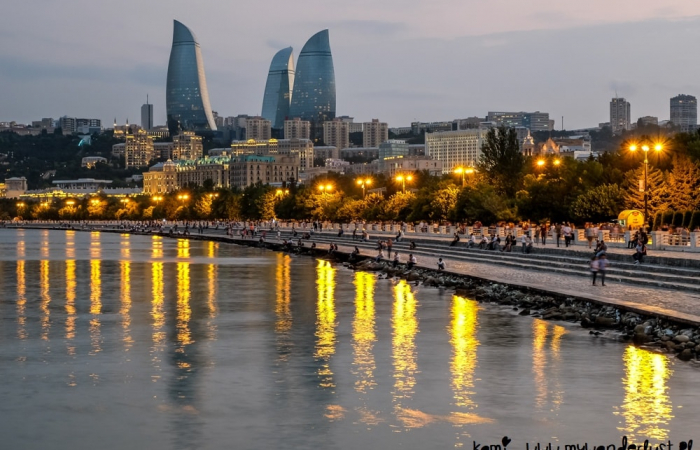
In Azerbaijan the government has been enforcing a strict quarantine regime. There have however been reports of thousands of violations.
Police have booked a total of 27,587 road users for offences related to quarantine violations since 1 April.
The latest figures from Azerbaijan show 1340 cases and 15 deaths
1240 CEST (1440 Tbilisi/Dubai)
 Armenia
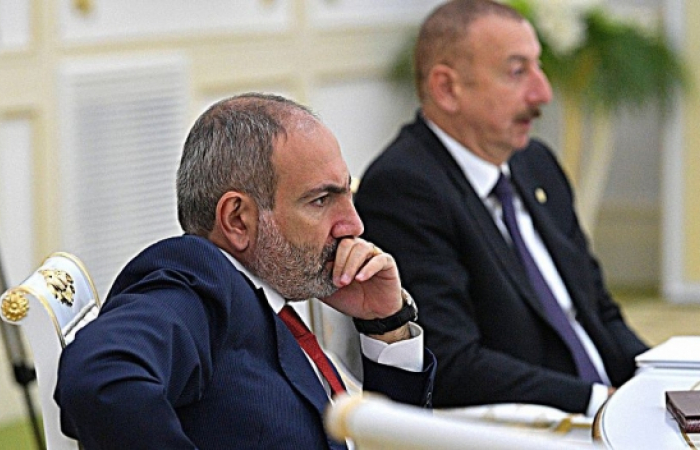
Prime Minister Nikol Pashinyan addressed the nation on Television last night stating that the coronavirus will remain, and will continue to infect citizens as long as a vaccine for it hasn't been created, he told viewers. The Armenian prime minister added,
"Armenia's strategic objective is to make sure there are as few infected citizens as possible and to make sure the Ministry of Health is able to provide treatment for all infected citizens. However, we also can't keep the country in a lockdown forever and live under quarantine or in a state of emergency. Therefore, our task is to live with the coronavirus.
We need to take advantage of this period of the state of emergency to acquire the necessary skills to live with the coronavirus.
The government is launching economic activities in various sectors in stages, but particularly expects employers to be responsible and ensure special conditions to combat the coronavirus. Starting today, all businesses need to have plans to ensure safety from the coronavirus at their cafes and restaurants to be opened in the future.
We all have to do our part to make sure we're not infected and don't infect others. We need to follow three simple rules: keep at least a 2-meter distance from people during interaction, touch the face only after sanitizing our hands and use only clean silverware and sanitized hairstyling tools". Pashinyan said.
Armenia has now reoported 1248 cases of coronavirus and there have been 20 deaths
1230 CEST (1430 Tbilisi/Dubai)
Russia
Cornavirus has now started hitting Russia hard. Russia saw an increase of nearly 5000 covid-19 cases yesterday, bringing the total above 36,000. The number of deaths has increased to 313.
The Russian Orthodox Church has sent mixed messages throughout the crisis. It has largely resisted government recommendations to close places of worship to the public throughout the Holy Week and on Easter. It has, however, advised the faithful to stay home.
Thousands of worshippers across the country celebrated Orthodox Palm Sunday on April 12, drawing criticism for the lax social distancing observed during some services.
Both the Russian government and Russian Orthodox Church leadership have this week advised worshippers to stay inside over Easter, with many churches planning to broadcast services online so people can pray at home.
In Moscow, the epicenter of the coronavirus outbreak in Russia, churches have been ordered by the city's health officials and Church leadership to hold services with only priests, clergy members and volunteers present.
Moscow Times however reports that outside the capital, Orthodox cathedrals in 43 out of Russia's 85 regions still plan to keep their doors open to the public for Easter services, the RBC news website reported. Alexander Verkhovsky, director of the Moscow-based Sova Center for Information and Analysis, told the news website that regional governors will likely allow these services to take place to avoid a hit to their approval ratings.
____________________________________________________________________
1215 CEST (1415 Tbilisi/Dubai)
Georgia remains under complete lockdown, with a state of emergency in place, a night curfew, and since yesterday a complete ban on traffic.
Georgians were touched by a story of a man whose pregnant wife was taken by ambulance to hospital yesterday in the city of Rustavi. Because on the traffic ban the man had to accompany the ambulance on his bicycle. (picture below)

1205 CEST (1405 Tbilisi/Dubai)
 Romania
 is one of Europe's Orthodox countries, and the controversy around Easter dominated the political debate in the country throughout this week.
It was however finally agreed that the Church will not allow a congregation at Easter night services, but that priests will afterwards distribute the holy fire on Saturday evening to people's houses.
In a message, Patriarch Daniel of Romania said:
"Today we celebrate Easter in a time of sorrow, a time of pandemic that causes fear, sickness and death, and at the same time the state authorities must take measures to stop the spread of the disease. The church is in pain that its servants, the worshipers, cannot pray together in the same place. May the house of each parishioner become the chapel of your family, which together pray for the crucified and resurrected Christ. We need to prove our humble and merciful love for everyone, especially the sick, the poor and the lonely. Let us pray for our crucified Christ to cover all doctors and people who help the sick and those who care for the well-being of our people. Happy Easter. Christ is risen! "

_______________________________________________________________________________________
Good day and welcome to our readers
It is Saturday, 18 April 2020: 12 noon Central European Summer Time, 1400 in Tbilisi and in Dubai
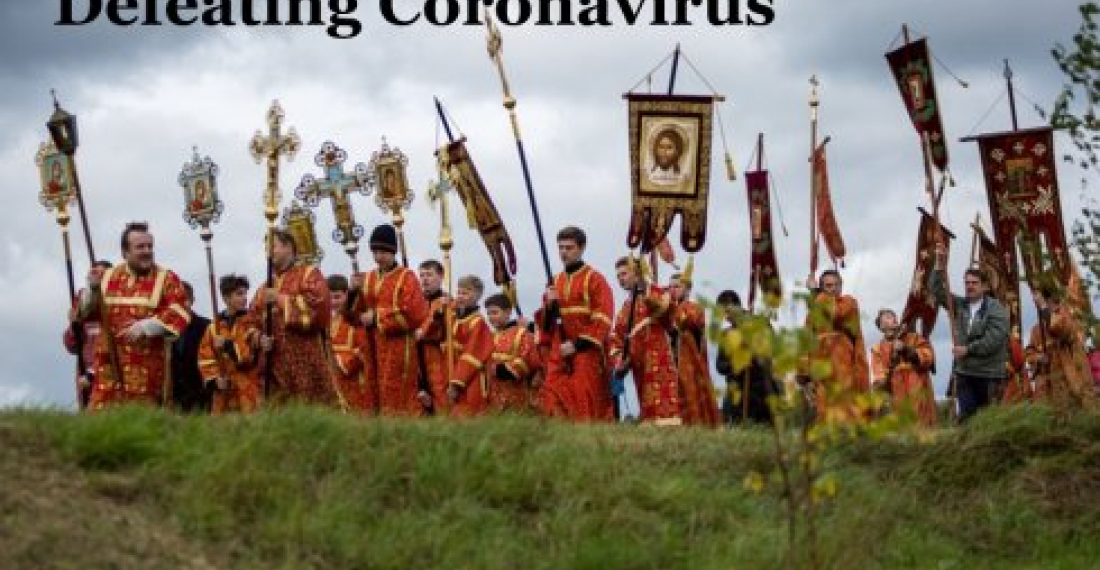
Orthodox Churches across the world this weekend celebrate Easter. The Orthodox World has over the last weeks been caught in controversy over its approach to coronavirus, and to the measures introduced by governments in most countries to protect their populations. Whilst some Orthodox Churches, for example Russia, moved resolutely, even if belatedly to put in measures that would help stop the spread to covid-19, such as holding services in Churches without a congregation, others have insisted to do business as usual. Easter is the time when many Orthodox Christians usually go to Church, even if they do not for the rest of the year. So the Church leaderships are wary to stop people from attending. This has brought Churches in direct confrontations not only with the governments of their countries but with the whole society.
The cover of today’s blog shows a procession in Russia of people praying for the world to be rid of coronavirus, held last month before the Orthodox Church there stopped gatherings of parishoners. In today’s blog we will be watching closely events in Georgia and in other parts of the Orthodox world on this Orthodox Easter weekend in the midst of a pandemic.