This blog is compiled by our team of journalists and researchers based in The Hague in the Netherlands and in Tbilisi, Georgia, working with partners and associates in a number of different countries. You can also follow us on twitter @commonspaceEU. We are happy to hear from you wherever you are. Please send us your comments, stories and suggestions by email to editor@commonspace.eu
____________________________________
Friday, 10 April 2020
We are now pausing this blog for today. It is Good Friday and for millions of Christians - the start of the Easter Festival. This year it is spent at home as mopst people are under lockdown. The number of deaths from coronavirus is now close to 100,000. But across the world nations and individuals reach out to each other in solidarity.
We will be back with this live blog tomorrw Saturday, 11 April at 12 noon Central European Summer Time ( 14.00 in Tbilisi and Dubai)
Till then from our team in The Hague and in Tbilisi, a good evening. Be Safe! Be Healthy! Be Happy!
and.......

1530 CEST (1730 Tbilisi/Dubai)
 Israel
With 127 new coronavirus cases, the total in Israel reached 10,095 with 92 deaths. The country is in lock down, and the streets are so empty that, as seen in this picture residents of Ramat Gan near Tel Aviv are playing tennis on an empty road.

1515 CEST (1715 Tbilisi/Dubai)
Over and over again we reiterate the importance of solidarity, between nations and between people, in these difficult times.
1445 CEST (1645 Tbilisi/Dubai)
 Spain
One country which is definetely going to require a lot of assistance is Spain. The economic costs of the pandemic on Spain are huge.
Spain - a country that has for decades depended on tourism as one of its main revenues, is this summer telling people not to come. Maximiliaan van Lange from our research team has the story:
The Spanish newspaper El País reports that since Thursday (10 April) 605 new deaths have occurred in Spain as a result of the COVID-19 virus. It should be noted that not all the victims are from the last 24 hours. In fact, a large proportion of the reports are passed on with one or more days' delay. The number of confirmed infections in Spain increased by 4.500 patients to 157.022. Spain has the highest number of infections in all EU countries.
The Spanish government is currently working on a scenario in which the land borders remain closed for a more extended period, and foreign tourists are not allowed into the country during the summer holidays. Coastal provinces are dependent on tourist revenues, which makes more enormous economic consequences inevitable in the country.
The state of emergency in Spain has been in effect since 14 March, and the country has been in full lockdown since 30 March. A few days ago, the measures were extended until 26 April.
__________________
1430 CEST (1630 Tbilisi/Dubai)
 European Union
And ofcourse if we are talking about countries helping each other we must also reflect on the EU's efforts both to provide a framework for the member states to help each other, and for the Union to help neighbouring and other countries. EU finance ministers on Thursday (9 April) agreed a €540 billion package to support member states, companies and workers in the coronavirus crisis, after The Netherlands and Italy overcame their differences. Leaders will discuss in the coming days the recovery plan and the possibility of issuing so-called ‘coronabonds'.
The deal was reached on Thursday evening after an intense round of bilateral contacts that postponed the start of the teleconference by more than four hours.
The draft text was finally supported by Italy and Spain, the two countries hardest hit by the coronavirus, and The Netherlands, which was the last EU country still opposing light conditions to cheap loans provided by the European Stability Mechanism, the eurozone's bailout fund.
Germany and France supported Eurogroup President Mario Centeno's mediation efforts, after a 16 hour Eurogroup teleconference failed to reach an agreement on Wednesday.
The European Commission has already announced an ambitious package of international assistance to neighbourhood countries and others.
The issue of EU solidarity has been much under discussion in recent days and weeks, with some feeling that the more solidarity could have been shown. No doubt there will be a time for reflection on this later. For the moment the financial packages should prove decisive in helping both the member states and others to overcome the present challenges.
______________________
1415 CEST (1615 Tbilisi/Dubai)
In the course of writing up this blog we often get overwhelmed by sad stories and bad news. This battle against coronavirus is a difficult one for all humanity. But we are also touched by stories of people helping each other, and also countries helping each other. Here are some examples

 Azerbaijan-Georgia
A food aid campaign was initiated by the Azerbaijani Embassy in Georgia and financially supported by the Azerbaijani Businessmen's Union (AZEBI).
400 boxes of food were delivered to Marneuli today.
Along with Marneuli, food aid will be distributed to socially disadvantaged residents of Bolnisi.
The assistance was presented to Kvemo Kartli Governor Shota Rekhviashvili with the participation of Azerbaijani Ambassador to Georgia Dursun Hasanov.
The ambassador said the charity event was held on the initiative of Azerbaijani President Ilham Aliyev : "The campaign started yesterday. The aid campaign will also cover Tbilisi, Rustavi, Gardabani, Kakheti and Shida Kartli regions.


 Turkey - UK
A Turkish military aircraft carrying medical aid for the fight against the novel coronavirus departed from the capital Ankara for the U.K. on April 10.
"At the direction of President Recep Tayyip Erdoğan, the Turkish Armed Forces aircraft that will transport to the United Kingdom the medical aid supplies prepared by Turkey's Health Ministry to be used in the fight against COVID-19 has departed Etimesgut/Ankara," the Turkish Defense Ministry said on Twitter.
The aid carried to the U.K. by Turkey includes protective masks and overalls.
There was also a quote by Sufi poet Mevlana Jalaluddin Rumi on the aid boxes, saying: "After hopelessness, there is so much hope and after darkness, there is the much brighter sun - Rumi."

________________________________________
1330 CEST (1530 Tbilisi/Dubai)
On this blog we have also been trying to follow the situation in North Caucasus
This is from Daghestan, The Office of the Mufti of Dagestan appealed to residents to pray at home and not to go to mosques. Shamil Alikhanov, chairman of the muftiyat of Dagestan, said that, ‘in order to avoid the coronavirus infection contamination spreading around the world', they ask people to perform all prayers at home.
Additionally, the muftiyat appealed to imams with a request to limit the number people allowed to attend mosque prayers to no more than forty people per mosque.
_________________________________________________
1300 CEST (1500 Tbilisi/Dubai)
 Belgium
We keep being surprised how this pandemic is affecting everything and eveyone. The latest group to be negatively impacted are the Belgian Chocolate producers.
The Easter weekend is usually an essential weekend for Belgian chocolatiers, but because of the COVID-19 pandemic, this year is different.
Because of the strict lockdown measures, Belgians must stay at home. As a result, sales figures for chocolatiers dropped by 90%. Belgians are only allowed to go outside for essential groceries. The good side is that Chocolatiers are now handing over 13 million chocolate eggs, rabbits and sweet biscuits to hospitals in the country.
More on this story of France24 here
1240 CEST (1440 Tbilisi/Dubai)
 Italy remains at the epicentre of the coronavirus pandemic. 18279 people have died so far.
Maximiliaan van Lange from our research team has been following developments:
In order to prevent the further spread of the COVID-19 virus the Italian authorities are stepping up police checks during the Easter holidays, said Luciana Lamorgese, Minister of the Interior. The government of Italy wants to prevent non-essential travel during the Easter weekend. Everyone should stay at home and respect the current measures. The government is concerned that because of the excellent weather forecast, more citizens will be tempted to go outside.
Since 11 March, the start of the lockdown, the police have reportedly checked almost six million people and imposed more than 220,000 fines.
1230 CEST (1430 Tbilisi/Dubai)
We have a number of updates from the Arabian peninsula prepared by Noman Ahmed of our research team
 Saudi Arabia
About 150 members of the Saudi royal family were infected with #COVID19. Prince Faisal bin Bandar bin Abdulaziz Al Saud, the governor of the capital Riyadh, is in intensive care. The King and Crown prince were isolated in the Red sea coast. Many royal family members travel regularly to Europe and may have contracted the virus there. Authorities have issued a high alert amidst speculations that cases may spike in the country.
Meanwhile it was announced overnight that OPEC giants agreed to cut oil output by more than a fifth and said they expected the United States and other producers to lift prices that plummeted due to the coronavirus outbreak. In May and June 10 million barrels less per day will be produced.
Saudi Arabia's King Salman, US President Donald Trump and Russian President Vladimir Putin reviewed, in a phone call, the importance of cooperation after yesterday 's OPEC meeting. The next meeting is to be held in June.
 Kuwait
The Kuwait government is considering a full curfew in the country. The cabinet discussed preventive measures and the authorities were ordered to create an executive plan if a curfew is imposed. Kuwait citizens are expected to be brought home shortly Expats are due to be evacuated soon for those who register on a special website.
 Bahrain
 announced yesterday that it would allow shops providing necessary goods/services to open if they follow appropriate precautions to avoid the spread of coronavirus. Wearing face masks in public is now compulsory for all citizens and residents as well as shop workers. The Ministry of Industry, Trade and Tourism has made more than a million medical masks available in markets and pharmacies starting Wednesday to contribute in the fight against COVID-19. Bahrain has 887 total cases with 5 deaths and 519 recoveries.
 Yemen
Yemen reported its first coronavirus case in Al Shihr, a port town in Hadhramaut Governorate, supreme national emergency committee tweeted this morning. The patient was stable and receiving health care. It is suspected that the infection came on a boat from the UAE, but the exact nationality of the patient isn't confirmed. Authorities have isolated several port workers, but no further details were provided.
A nationwide ceasefire began today, and the UN Envoy expected to announce progress soon.
_______
1215 CEST (1415 Tbilisi/Dubai)
Azerbaijan
We want to focus first this morning on the situation in Azerbaijan where the number of coronavirus cases appears to be increasing. The latest data available is of 926 cases, but we expect this to be updated later this afternoon.
Azerbaijan says that it might need to further restrict the movement of its residents. The authorities have been enforcing an electronically enforced quarantine regime. An SMS needs to be sent to a central number with the appropriate reason. Permission is given once every 24 hours. As of now, the rules are in effect through April 20.
Azerbaijan is following one of the strictest measures in the region. The numbers have spiked and took over Armenia as the most infected country in the Caucasus.
In the meantime the authorities have been doing an intensive programme of disinfection in the capital Baku.
The website Haqqin Az this morning reported that municipality workers were destroying illegal abbatoirs that existed in various corners of the city.

___________________
Welcome to this live blog on commonspace.eu
It is Friday, 10 April 2020, 12 noon Central European Summer Time (CEST) equivalent to 14.00 hours in Tbilisi and Dubai.
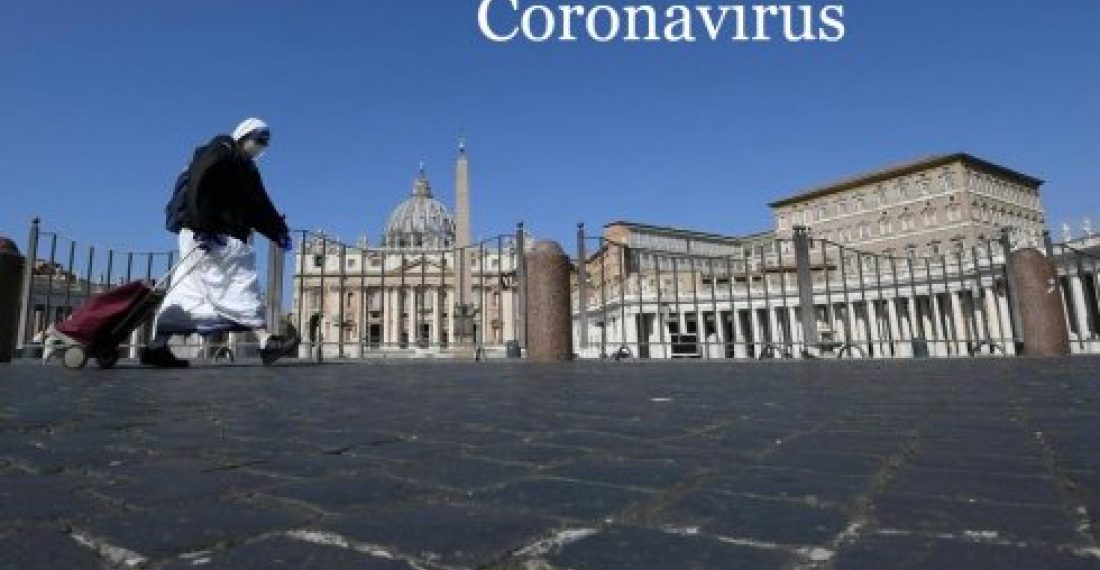
Today is Good Friday in many countries of the world - a religious feast marked by Christians, and particularly poignant in Southern Europe, in countries such as Italy, Spain and France, that have been badly hit by the coronavirus pandemic, and where normally believers will on this day flock to the Churches to mark the crucifiction of Christ. Our cover photo however shows an empty St Peters Square in Rome, with a lone nun walking in the shadow of the Basilica.

In this blog in the last three weeks we have been examining how various faiths have been dealing with the impact of the virus on their congregations.
In the meantime a number of priests in Ukraine and Russia have tested positive for the virus. In Kiev, Mayor Vitali Klitschko said that 26 clerics have tested positive for coronavirus in the Kiev Pechersk Lavra.
"I have met several times with representatives of different religious confessions and told them that they need to realize how much responsibility they have for the safety of believers," Klitschko said. The monastery was closed for pilgrims a few days ago.
In Moscow, 8 clerics tested positive for coronavirus in Moscow.
According to Russian media, the symptoms of coronavirus were observed in three other priests, but their diagnosis will be known later. According to the Russian Orthodox Church Working Group dealing with the pandemic, parishoners of 6 churches of Moscow could have been infected and they were asked to self-isolate.
____________________
read the live blog on 9 April here
read the live blog from 5 - 8 April here
read the live blog from 30 March - 4 April here
read the live blog from 25-29 March here
read the live blog from 18-24 March here
_______________
Editorial Note issued on 18 March 2020:
Commonspace.eu in the age of corona - A message from the editorial team in response to the global pandemic caused by the Covid-19 virus
Dear readers and subscribers,
Since it was established in 2011, commonspace.eu has been contributing to the public debate in and about the Caucasus region and the region's relations with Europe, focusing primarily on the need for peace in the region, on the value of co-operation, and on strengthening the relations between the countries of the region and Europe. Those ideas and values will always remain at the core of our work.
However the events of the last few weeks and months have taken humanity to uncharted waters. The coronavirus crisis caused by the spread of the Covid-19 virus is a major global emergency - a pandemic on a size not seen in modern times. Its effect on countries and societies has already been unprecedented, and the pandemic has already caused major disruptions to the way of life of people that no one could have anticipated only a few weeks ago. This disruption is likely to increase in the coming days, weeks and months. It is now almost a certainty that the current medical crisis will soon expand into an economic crisis, and that in turn will have deep-rooted social and political consequences.
In the present circumstances therefore, commonspace.eu will focus on the crisis by providing factual information enabling our readers and subscribers to get a better understanding of what is going on, not only in their own countries but more widely. We will focus on the medical, economic and political aspects of the crisis, and the response of individual states and the international community.
Commonspace.eu will remain loyal to its ethos as a public service. We will have messages that will help educate and inform the general public; we will give a voice to those that are often not heard enough; we will support a collaborative approach to resolving the crisis and its many effects through institutions such as the United Nations, the European Union, the G20 and others; we will maintain a focus on the wider Caucasus region but will also cover stories in nearby regions, especially Europe, the Middle East and Central Asia.
In these challenging times we recognise the need to step up and refocus. We believe humanity has the strength and the resilience to overcome the present crisis, and that a better world can emerge from it, and we will contribute as much as we can towards that.
Stay safe, be well, and help each other. This is the time for solidarity.
The editorial team of commonspace.eu
18 March 2020