


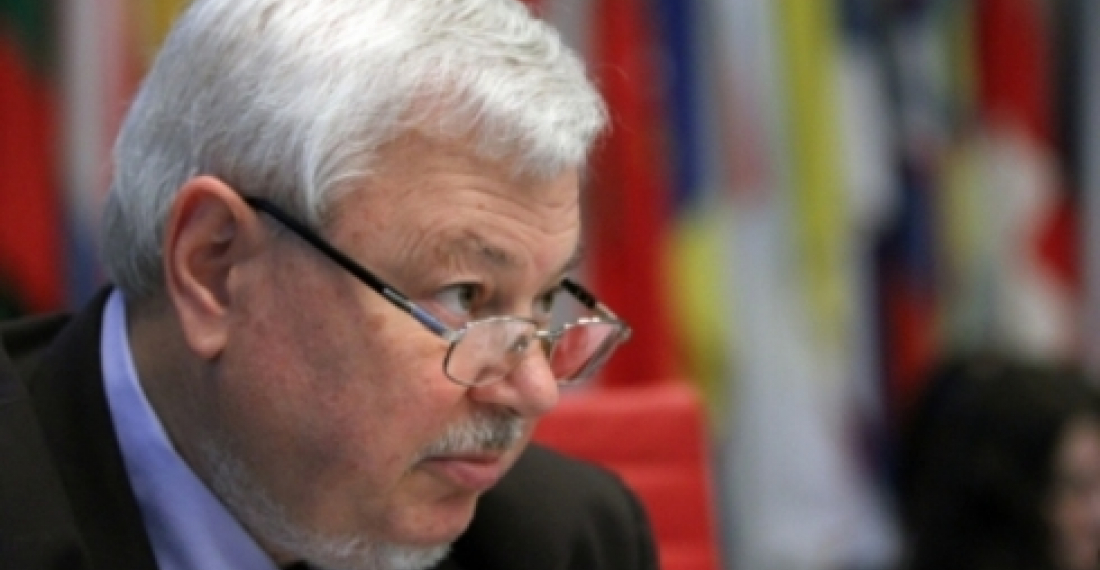
Kasprzyk: "We have neither mandate nor resources to investigate incidents".

In an interview with the Armenian news outlet, news.am, the Special Representative of the Swiss Chairmanship of the OSCE, Ambassador Andrzej Kasprzyk reached out to the people of Armenia and Azerbaijan who long for peace and reconciliation:

"I am privileged to meet, talk to and work with Armenian and Azerbaijani men and women of different generations from across this region. Some are people with dynamic public profiles; others are private individuals. The lives of almost all of them alike are marked by the conflict and its consequences. Among them are a number of people who not only long for peace and for reconciliation but are also energetically engaged in achieving these. I wish them every success and hope that we can continue to work together towards what are our common goals", he said.  

Kasprzyk also spoke about the numerous cease fire violations that seem to be increasing. He said that "visits by OSCE teams to the border and the Line of Contact are no substitute for a ceasefire verification mechanism, such as those that can be seen in many other parts of the world. Nonetheless, local commanders and others continue to tell us that our visits provide valuable opportunities for those involved to address issues of mutual concern and, where necessary, to mitigate the risk of any escalation. These visits also enable us to convey to the OSCE Chairperson-in-Office and the OSCE Minsk Group Co-Chairs, information about the situation as seen by those on the ground."

However Kasprzyk also hinted at the difficulties that exist in the implementation of even the current mandate, It is my duty to work with the sides to develop measures that will help the sides reach a lasting political settlement. As far as monitoring activities are concerned, the main challenges are ensuring the safety of all those involved, including security guarantees, and securing the resources needed to implement such measures. For these reasons, unannounced visits to the border or Line of Contact are not possible."

"Our teams have neither the mandate nor the resources required to investigate reported incidents", he added.

source: commonspace.eu with news.am

photo: Ambassador Andrzej Kasprzyk (archive picture).
 

Related articles

Editor's choice
News
Despite crisis, Lebanon takes the lead to become first country in the Middle East to abolish the death penalty

Despite crisis, Lebanon takes the lead to become first country in the Middle East to abolish the death penalty

Lebanon's parliament has voted to abolish the death penalty, a move that would make it the first country in the Middle East to formally end capital punishment. A majority of MPs in the 128-seat parliament backed the measure on Tuesday (11 August), while Hezbollah's parliamentary bloc voted against it. The legislation will now go to the cabinet before being passed to President Joseph Aoun for signing. The government has already expressed its support for the measure. Lebanon has not carried out an execution since January 2004, although courts have continued to hand down death sentences. Rights groups estimate that more than 78 people remain on death row. Under the new legislation, capital punishment will be replaced with life imprisonment with hard labour. However, the legislation does not yet set out in detail how the new sentence would be enforced. Hard labour is already written into Lebanese law but has rarely been implemented in recent years. The country's financial crisis and overcrowded prisons have limited the authorities' resources and capacity. The latest legislation follows years of campaigning by civil society groups and lawyers for the removal of capital punishment from Lebanese law. (click image to read more)

Popular

Editor's choice
Interview
Thursday Interview: Murad Muradov

Thursday Interview: Murad Muradov

Today, commonspace.eu starts a new regular weekly series. THURSDAY INTERVIEW, conducted by Lauri Nikulainen, will host  persons who are thinkers, opinion shapers, and implementors in their countries and spheres. We start the series with an interview with Murad Muradov, a leading person in Azerbaijan's think tank community. He is also the first co-chair of the Action Committee for a new Armenian-Azerbaijani Dialogue. Last September he made history by being the first Azerbaijani civil society activist to visit Armenia after the 44 day war, and the start of the peace process. Speaking about this visit Murad Muradov said: "My experience was largely positive. My negative expectations luckily didn’t play out. The discussions were respectful, the panel format bringing together experts from Armenia, Azerbaijan, and Turkey was particularly valuable during the NATO Rose-Roth Seminar in Yerevan, and media coverage, while varied in tone, remained largely constructive. Some media outlets though attempted to represent me as more of a government mouthpiece than an independent expert, which was totally misleading.  Overall, I see these initiatives as important steps in rebuilding trust and normalising professional engagement. The fact that soon a larger Azerbaijani civil society visits to Armenia followed, reinforces the sense that this process is moving in the right direction." (click the image to read the interview in full)


