


KARABAKH-ENERGY

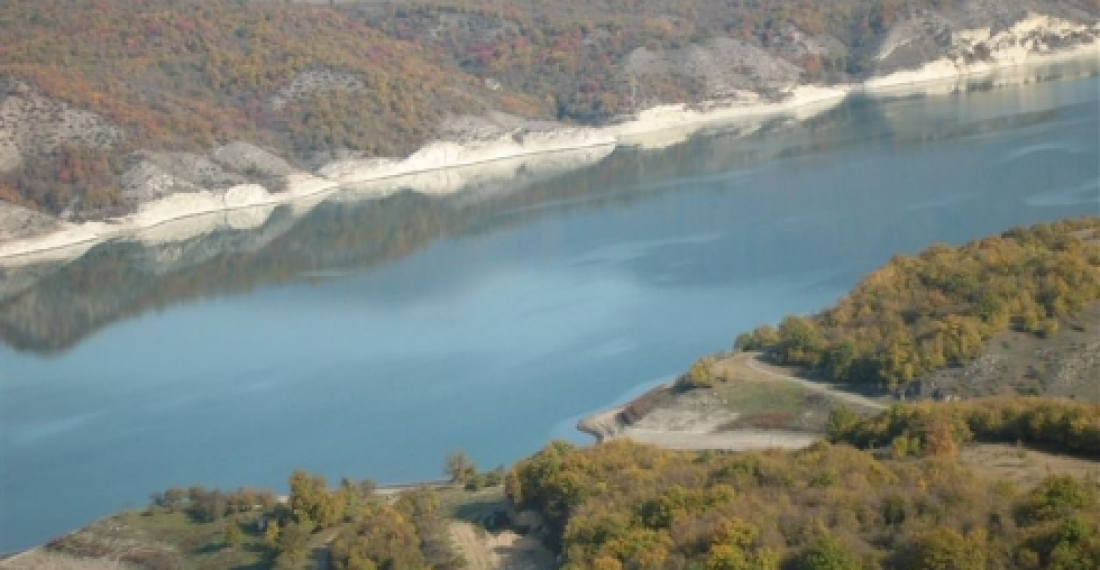
Within the next 3-4 years Karabakh will not only ensure its energy independence, but will also become an electric power exporter. According to experts, the effective use of rich water resources of Karabakh, particularly, the water of the mountain rivers will allow fulfilling all the outlined plans. 

ArmInfo correspondent in Stepanakert reports with reference to the NKR Prime Minister Ara Haroutyunyan that the total potential of the republic allows generating up to 700 mln KW/h electric power per annum. Today the domestic energy consumption is about 250 mln KW/h.  Sansang hydropower plant in Martakert region with 50 MW capacity, which generated 90-140 mln KW/h electric power annually, only satisfied up to 50% of the republic's needs. The rest of the necessary power was imported from Armenia.  The small Trge-1 hydropower plant in the same region annually generates 16.5 mln KW/h electric power.  This is the first of the three hydropower plants to be set up on the River Trge. The three hydropower plants will generate a total of 65.5 mln KW/h electric power. With the launch of 3 more small hydropower plants - Trge-2, Madaghis-1 and Madaghis-2, about 80% of the electric energy input in the NKR will be ensured.  In 2011 the total investment in construction of the hydropower plants will be about 1 bln 700 mln AMD (about 4 mln 700 thsd USD).

It is also envisaged to build hydropower plants with the capacity of about 30 MW in Kashatagh region.  Approximately 200 job positions will be opened with the launch of these plants. Two years ago relevant personnel training started on the basis the Artsakh State University. 

For consistent implementation of the energy supply program, Artsakh HPP OJSC was set up in November 2007 by the decision of the NKR government. Under an investment program, the joint-stock company issues shares and sells them to both individuals and legal entities at an affordable price of 1050 AMD per share (the nominal price is 1000 AMD).

By participating in the program, the citizens become co-owners of the hydropower plant and receive a profit of up to 15%. Thus, the population of Artsakh, Armenia and Diaspora is directly involved in development of the NKR energy sphere.   

The NKR government also approved a concept for using alternative energy resources. The state program to be implemented under this concept aims to develop the production of electric and thermal power on the basis of its own resources, reduce the negative impact of the imported energy resources fluctuation, etc.

The NKR Premier Ara Haroutyunyan thinks that the republic's domestic needs in thermal power will be satisfied due to biofuel, and many populated areas will have autonomous electric power supply. The development of the biofuel system envisages opening of heat entities and hundreds of new job positions. 

In addition, Bioenergetika LLC has been set up. It invites foreign specialists to Karabakh, who study the republic's opportunities and discuss the development prospects with the local specialists. Experts say that Karabakh has enough forest resources, and the timber reserves can not only be used to supply the republic with thermal and electric power, but can also be exported to other countries. 

According to preliminary estimations, due to the timber waste in the NKR, it is possible to obtain 330 MW of thermal power, 85 MW of electric power; and additional 80 MW of thermal power and 20 MW of electric power can be obtained from the wheat and corn stems.    

A new woodworking enterprise has been opened in Avetaranots village of Askeran region of Karabakh.  The enterprise is equipped with Swedish and Finnish facilities. Within the next few years the NKR will take measures to create solar power systems.
Related articles

Editor's choice
News
Russia adds pressure on Armenia ahead of key elections; recalls Ambassador in Yerevan for consultations

Russia adds pressure on Armenia ahead of key elections; recalls Ambassador in Yerevan for consultations

Ahead of key parliamentary elections,scheduled to be held in Armenia on Sunday, 7 June, Russia continues to attempt to put pressure on the Armenian Government led by prime minister Nikol Pashinyan. On 30 May, Russia recalled its Ambassador to Yerevan for consultations. A terse statement, published on the website of the Russian Foreign Ministry, said, "The Ambassador of the Russian Federation to the Republic of Armenia , S.P. Kopyrkin, has been summoned to Moscow for consultations in connection with the steps taken by the Armenian leadership to move closer to the European Union, which are detrimental to cooperation within the EAEU." This followed a statement issued the day before, by the leaders of the Eurasian Economic Union (EAEU) that challenges the Armenian trajectory towards approximating to the European Union. Vladimir Putin is undertood to have personally pushed the other four EAEU leaders to issue the statement, which said: "Taking into account the significant risks to the economic security of the member states of the Eurasian Economic Union (hereinafter referred to as the Union) arising in connection with the preparation of the Republic of Armenia for accession to the European Union, as well as the need to prevent the associated damage to the member states of the Union: decided that the members of the Eurasian Intergovernmental Council from the Republic of Belarus, the Republic of Kazakhstan, the Kyrgyz Republic and the Russian Federation will report at the next meeting of the Supreme Eurasian Economic Council in December 2026 on the possible consequences of the suspension of the Treaty on the Eurasian Economic Union with respect to the Republic of Armenia. We share the position on the need to hold a national referendum in the Republic of Armenia as soon as possible on joining the European Union or continuing to be part of the Eurasian Economic Union."
Editor's choice
News
The leaders of the states of the Eurasian Economic Union issued a tough statement warning fellow-member state Armenia of the consequences of its desire to join the European Union.

The leaders of the states of the Eurasian Economic Union issued a tough statement warning fellow-member state Armenia of the consequences of its desire to join the European Union.

The leaders of the states of the Eurasian Economic Union (EEAS) issued a tough statement warning fellow-member state Armenia of the consequences of its desire to join the European Union. The stark, sharply worded,  warning, comes days before crucial parliamentary elections in Armenia, scheduled for 7 June. The full statement said, “We, the Presidents of the Republic of Belarus, the Republic of Kazakhstan, the Kyrgyz Republic and the Russian Federation, Taking into account the actions of the Republic of Armenia aimed at joining the European Union, including the approval in 2025 by the National Assembly of the Republic of Armenia and the signing by the President of the Republic of Armenia of the Law of the Republic of Armenia "On the Start of the Process of Accession of the Republic of Armenia to the European Union", as well as the confirmation by the European Union of the European aspirations of the Government of the Republic of Armenia, expressed in the joint declaration following the first Armenia-European Union summit, adopted on 5 May 2026, Taking into account the significant risks to the economic security of the member states of the Eurasian Economic Union (hereinafter referred to as the Union) arising in connection with the preparation of the Republic of Armenia for accession to the European Union, as well as the need to prevent the associated damage to the member states of the Union: decided that the members of the Eurasian Intergovernmental Council from the Republic of Belarus, the Republic of Kazakhstan, the Kyrgyz Republic and the Russian Federation will report at the next meeting of the Supreme Eurasian Economic Council in December 2026 on the possible consequences of the suspension of the Treaty on the Eurasian Economic Union with respect to the Republic of Armenia. We share the position on the need to hold a national referendum in the Republic of Armenia as soon as possible on joining the European Union or continuing to be part of the Eurasian Economic Union. Astana, May 29, 2026” A meeting of the Supreme Eurasian Economic Council was held in Astana, Kazakhstan, on May 29, 2026. The meeting of the Supreme Eurasian Economic Council in a restricted format was attended by Russian President Vladimir Putin, Belarusian President Alexander Lukashenko , Kazakh President Kassym-Jomart Tokayev , Kyrgyz President Sadyr Japarov , Armenian Deputy Prime Minister Mher Grigoryan, and Chairman of the Board of the Eurasian Economic Commission Bakytzhan Sagintayev. From the Russian side, the meeting was also attended by Deputy Prime Minister and member of the Council of the Eurasian Economic Commission Alexey Overchuk and Presidential Aide Yury Ushakov . The heads of delegations from EAEU observer states, including President of Uzbekistan Shavkat Mirziyoyev , Vice President of Cuba Salvador Valdés Mesa, Minister of Industry, Mines, and Trade of Iran Mohammad Atabak, and CIS Secretary General Sergei Lebedev, joined the expanded meeting . Following the meeting of the Supreme Eurasian Economic Council, a number of documents were signed .

Popular

Editor's choice
Interview
Thursday Interview: Murad Muradov

Thursday Interview: Murad Muradov

Today, commonspace.eu starts a new regular weekly series. THURSDAY INTERVIEW, conducted by Lauri Nikulainen, will host  persons who are thinkers, opinion shapers, and implementors in their countries and spheres. We start the series with an interview with Murad Muradov, a leading person in Azerbaijan's think tank community. He is also the first co-chair of the Action Committee for a new Armenian-Azerbaijani Dialogue. Last September he made history by being the first Azerbaijani civil society activist to visit Armenia after the 44 day war, and the start of the peace process. Speaking about this visit Murad Muradov said: "My experience was largely positive. My negative expectations luckily didn’t play out. The discussions were respectful, the panel format bringing together experts from Armenia, Azerbaijan, and Turkey was particularly valuable during the NATO Rose-Roth Seminar in Yerevan, and media coverage, while varied in tone, remained largely constructive. Some media outlets though attempted to represent me as more of a government mouthpiece than an independent expert, which was totally misleading.  Overall, I see these initiatives as important steps in rebuilding trust and normalising professional engagement. The fact that soon a larger Azerbaijani civil society visits to Armenia followed, reinforces the sense that this process is moving in the right direction." (click the image to read the interview in full)

