
Karabakh: The big debate
Commonspace.eu today publishes the 5th in a series of twenty interviews with key personalities from Nagorno-Karabakh. The interviews give a vivid, even if sombre picture, of the attitude of Armenians and Azerbaijanis from Karabakh whose lives have been deeply affected by the conflict, and whose destiny will be at the heart of any future conflict settlement. Those interviewed sometimes use harsh language. Their opinion is almost inevitably controversial, as are sometimes their biographical notes. However it is through listening to these opinions that a path through the labyrinth that is the Karabakh conflict can be found. A full editorial policy of commonspace.eu is available at the About Us section. The next interview will be with Professor Havva Mammadova, member of the Azerbaijan National Academy of Sciences.
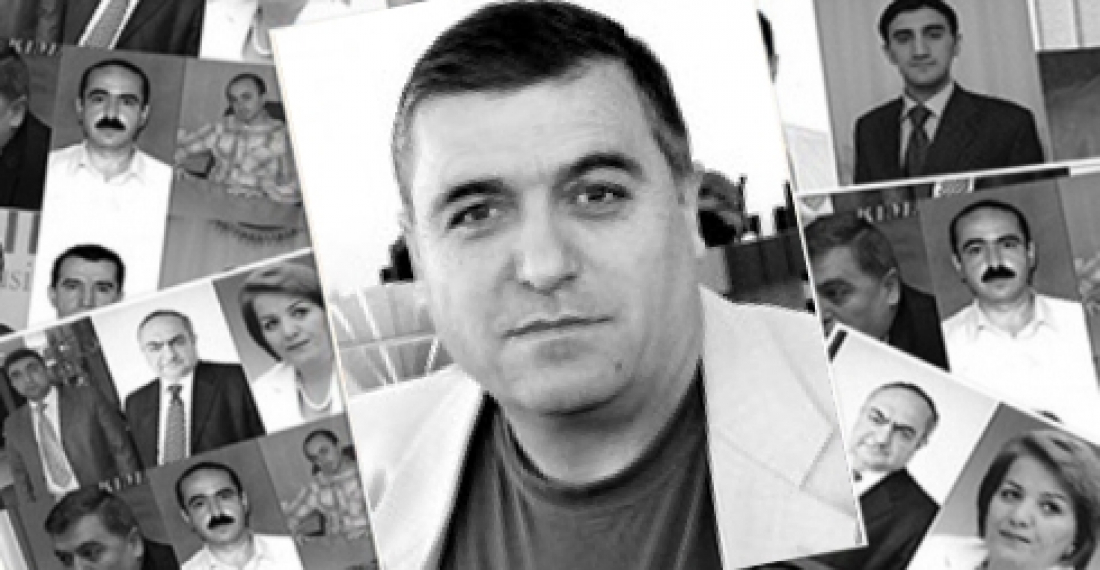
Interview with Vahram Atanesyan

|
Vahram Atanesyan was born in 1959, and majored in linguistics. He has worked as a journalist for the last twenty years and been a Special Correspondent of the RFE/RL in Stepanakert. Atanesyan’s political career began with his election at the first convocation of the Supreme Council (Parliament) of the Republic of Armenia. Prior to that Atanesyan was a member to the Artsakh Peoples Council, and is now an MP in the NKR National Assembly in his third consecutive term. Atanesyan has also been the Chairman of the NKR Parliament Foreign Affairs Standing Committee since its inception. He is married with two children, and his wife is a lecturer at Artsakh State University. Biographical notes are provided by the interviewees themselves. |
Can you summarize your overall position on the Karabakh conflict and the conflict resolution process?
The right of the Armenian majority of Nagorno-Karabakh for free self-determination was abused in the early 20th century, when the political status of the Oblast (i.e. region) "was determined" by the Caucasian Bureau of the Russian Bolshevik political party. Before that the Azerbaijani Democratic Republic (ADR) and de facto authorities of Nagorno-Karabakh (the National Council) had reached an "interim agreement", which prescribed more peace talks to determine the final legal and political status of the region.
That agreement was breached when Bolshevik rule was established in Azerbaijan. Cutting the story short, this is the essence of the issue - the Armenian majority population of NK should exercise their inherent right of free self-determination.
We believe that such an opportunity arose with the collapse of Soviet Union. On December 10, 1991, based on effective and legitimate USSR legislation, as well as based on the fundamental norms and principles of international law, the Armenian majority of Nagorno-Karabakh voted on a NK-wide referendum in favor of independence for the newly-born Nagorno-Karabakh Republic. The Azerbaijani minority population of NK didn't participate in that referendum. That was their choice. We believe that the utmost effective way for conflict resolution is the international recognition of NKR's de facto independence, which will open the space to negotiate and solve all the wide spectrum of different issues and disagreements with Azerbaijan based on the principles of equal rights for all nations and the right of free self-determination - through negotiations and peace talks.
In the long term do you want to see Nagorno-Karabakh (a) as an independent state; (b) as part of Armenia (c) as part of Azerbaijan; (d) none of the above but in as yet undefined status. Comment on your choice?
I have already answered this question above. The Nagorno-Karabakh Republic is an independent state and there is no alternative to the international recognition of this de facto situation.
What is your biggest objection/concern to Nagorno-Karabakh being part of Azerbaijan?
As I totally exclude such a scenario I do not wish to elaborate on it.
Are you satisfied with the policy of the de facto Nagorno-Karabakh Republic authorities towards the conflict and its resolution?
The authorities of the Nagorno-Karabakh Republic have been formed based on free and fair elections by the citizens of NKR, including my vote. These authorities have been serving the citizens within the frameworks of their powers and I am satisfied with their policies - both internally and externally.
Were you directly involved in armed hostilities between 1989-94?
Yes, I was. I was involved as a human being trying to defend myself, my family and beloved, as any other citizen of our country.
How do you evaluate the work of the OSCE Minsk Process?
I am positive on this. I believe the mediators have been doing their best to bring Azerbaijan to a realization that it needs to be the first to recognize the independence of the Nagorno-Karabakh Republic.
Do you have a publicly expressed a position on the Madrid Principles?
Yes, I do, but unfortunately am unable to outline it here. Cutting a long story short, the Madrid Principles do not wholly satisfy the interests of NKR, but the principles are an opportunity to solve the conflict peacefully. We regret that Azerbaijan doesn't accept the conflict resolution concept that has so far been offered by the international mediators.
Do you think it is important/appropriate that the de facto authorities of the Nagorno-Karabakh republic be part of the peace process facilitated by the Minsk Group? If yes should they be there instead of the Armenian Government?
The Nagorno-Karabakh Republic (and I don't really appreciate the term "de facto" in your question) is a full party to the ceasefire agreement of 1994, therefore recognized as such by all, including Azerbaijan, as a self-determined political-military subject. NKR bears certain obligations flowing from this ceasefire; and the participation of NKR in the peace talks derives directly from the logics of the peace process. This is to say (regarding the logics of the peace process) to find and secure an acceptable solution for all sides which will also meet the interests of all.
Sometimes the possibility is mentioned that the territories around Nagorno-Karabakh under Armenian control since 1994 should be returned to Azerbaijan as part of an interim peace arrangement, leaving the issue of the status of Nagorno-Karabakh to a later date. Do you have an opinion on this issue?
Such a "possibility" is only theoretical. In real life, all the questions should be negotiated and the agreement be secured altogether. NKR has its own understanding and ideas on territories and position on its own territorial integrity.
What is your opinion with regards to the role of Turkey, Russia, Iran, the United States, the European Union or any other country or international organisation, or the international community in general, with regards to the Karabakh conflict and its settlement:
Turkey cannot be named as a mediator. That country has a well-known biased stance and known prejudices. Turkey indeed has a direct side in this conflict. Whereas the mediators have a single, united role to play - to restrain possible inflammation of the conflict, as well as assist and support Nagorno-Karabakh and Azerbaijan to solve the disputed issues through negotiations.
How do you evaluate the role of informal, NGO-level contributions to the peace process? Do you believe that informal contacts have a useful role to play prior to or after a formal agreement?
In such situations there cannot be formal and non-formal contacts. Everything, unfortunately, is highly politicized (especially on the Azerbaijani side). However we still need to try more to have common people interacting with each other.
Do you have a position on the desirability or not of free movement of Armenians and Azeris between their two countries before a final peace agreement?
Armenians and Azeris have more than "two countries". Azeris believe they are one nation with Turks, although divided in two countries, whilst NKR is the second Armenian state in the region. Regarding the "desirability" of free movement, I would say that, again unfortunately, this will only be a matter for the distant future. On our part, we are not sure that the Azeri side is even ready to discuss such issues. In Azerbaijan the authorities, unfortunately, prepare not for peace, but a new war against Nagorno-Karabakh and Armenians.
Do you think that Armenian and Azerbaijanis will ever be able to live together peacefully in Karabakh again in the future?
If those people, who are kept like hostages of the Azerbaijani leadership, would ever wish to contribute to the development and well-being of an independent NKR, I believe, they would have the opportunity to return to their previous settlements and exercise their civil and human rights. However, they cannot return to NK as citizens of Azerbaijan.
What is your opinion on the issue of return of refugees/IDPs to Nagorno-Karabakh?
Around 40,000 people have become refugees from the Shahumian and Martakert districts of NKR, currently under the partial occupation of the Azerbaijani army. I guess those people and their relatives, irrespective of their current hometowns, shall be granted NKR citizenship and have the opportunity to decide on issues of repatriation. With regards to Azerbaijani refugees, I have shared my views earlier.
(c) commonspace.eu
Read previous interviews in this series: