
Karabakh: The big debate
Commonspace.eu today publishes the 17th in a series of twenty interviews with key personalities from Nagorno-Karabakh. The interviews give a vivid, even if sombre picture, of the attitude of Armenians and Azerbaijanis from Karabakh whose lives have been deeply affected by the conflict, and whose destiny will be at the heart of any future conflict settlement. Those interviewed sometimes use harsh language. Their opinion is almost inevitably controversial, as are sometimes their biographical notes. However it is through listening to these opinions that a path through the labyrinth that is the Karabakh conflict can be found. A full editorial policy of commonspace.eu is available at the About Us section. The next interview in the series will be with Rizvan Hassanov, a war veteran from Shusha.
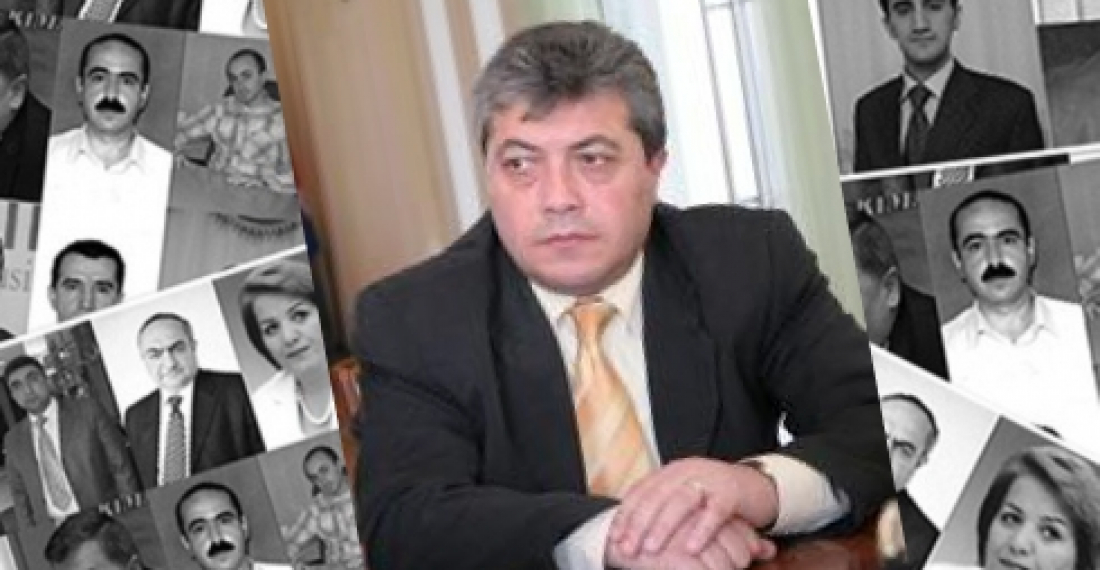
Interview with Garik Grigoryan

|
Garik Grigoryan was born in 1958 in Stepanakert, NKAO. After graduation from the Yerevan Polytechnic Institute he worked at the NKAO Radio Programme's Committee in several different positions from 1981. Grigoryan was the Head of NKR TV-Radio State Corporation from 1992-1995, and from 1995-2000 an MP in the NKR National Assembly (second convocation) and Vice-Chairman of the Foreign Relations Standing Committee. He also served as an MP in the NKR National Assembly (third convocation) from 2000-2005, and as Assistant to the NKR President from 2005-2007. Grigoryan has been a non-partisan MP in the NKR National Assembly (fourth convocation) since May 2010, and is a member to the Standing Committee on State and Legal Affairs. He is married with one daughter. Biographical notes are provided by the interviewees themselves. |
Can you summarize your overall position on the Karabakh conflict and the conflict resolution process:
The issue should be dealt with from the following viewpoint. If the parties to the conflict want to discuss the right of self-determination, Armenia and NKR will have something to discuss in this peace process. If the discussion is around the principle of territorial integrity – only Azerbaijan can play there. Meaning, if self-determination is not the issue – I don’t think NKR or Armenia can do anything with the peace process, we will not be interested in it. This is my understanding. There is nothing else to discuss. The other end is not in line with Azerbaijan's interests.
For a moment it may seem that there is kind of a rapprochement between the sides. However I think that the co-Chair countries serve issues of their own national interests with these kinds of statements. The other day the co-Chairs declared that "the current status quo cannot be maintained for a long time". Now I turn it back: "Any kind of change in the status quo regime is able to result in a new war". Those who don’t understand the situation in the LOC – cannot realize where we are. Those who didn’t live in this region in 1992, cannot understand what it means to have Aghdam 30km from Stepanakert.
So, my position is that we need to preserve the status quo regime, although I do understand this is not a solution.
In the long term do you want to see Nagorno-Karabakh (a) as an independent state; (b) as part of Armenia (c) as part of Azerbaijan; (d) none of the above but in as yet undefined status. Comment on your choice:
Naturally, today the Nagorno-Karabakh Republic (Artsakh) is an independent statehood, irrelevant to the fact of recognition from any foreign state. If they don’t want to recognize our independence and sovereignty – that’s their own issue. Let them go. We are an independent state with all relevant state institutions and agendas. However I do think that in the long run, perhaps, we may re-unite with Armenia. At the end of the day, we started our Movement with slogans of reunification with Armenia in the late 1980s. I cannot see any other scenario, except for staying an independent state with a perspective to re-unite with Armenia in the future. How long it will take – I can't say.
What is your biggest objection/concern to Nagorno-Karabakh being part of Azerbaijan?
To be honest, I cannot imagine how NKR can become a part of Azerbaijan - In what status? In what capacity? This is simply excluded. I say this, by the way, also considering the anti-Armenian, bellicose statements heard from Azerbaijan on a daily basis. The only agenda of Azerbaijan is to sweep Armenians from this region. I think that Europe should understand this, if they haven’t yet. The aim of Azerbaijan is to sweep Armenians from here, the same way they did in Nakhijevan, and establish the Big Turan between Azerbaijan and Turkey, also aspiring to occupy the Syunik region of Armenia. I don’t believe what the Europeans or any other political scientists and experts are talking about regarding different terms. If they again occupy Karabakh by force, Armenians will flee from this region in 5 years.
Are you satisfied with the policy of the de facto Nagorno-Karabakh Republic authorities towards the conflict and its resolution?
My answer would be between Yes and No, and this is quite objective with its reasoning. Yes – because NKR is not a party to the ongoing negotiations, but is closely coordinating its policies with Armenia on this. I can't blame the executive authorities of NKR for not being part of the current peace process – what for? We are a third party to the conflict which is now delinked from the process. Instead, the NKR authorities constantly declare their readiness to re-engage the peace process. At the end of the day, the status of NKR can be finalized only with the direct voice and participation of the NKR authorities and its citizens. Keeping it short, this is why I say Yes and No.
Were you directly involved in armed hostilities between 1989-94?
If you pay attention to my biography, I was awarded the "Medal of Honor", so logically I took part in the war. I headed the State Radio TV Company during the wartime years – 1992-1995 – and all the documentary of the war you may find now in archives is produced by our team of journalists during those years.
How do you evaluate the work of the OSCE Minsk Process?
I would again elaborate on the status quo issue that I mentioned earlier. I do support the Minsk Group in whatever they do which is aimed at preserving peace. I do appreciate this. Unfortunately however, they are a bit easy on this issue, as our suggestions are often ignored, and very often they are under the control of Azerbaijan. Look – all the monitoring missions on the LOC are 90% breached by Azerbaijan which is shooting with snipers at the missions on the border. I don’t understand why Azerbaijan is never punished for these policies.
Recently much has been reported on the snipers – it seems like the rule of vendetta is here. I see the Minsk Group’s mission as to ease these kinds of things and lobby for pulling back the snipers.
Do you have a publicly expressed a position on the Madrid Principles?
No, I don’t have. These Madrid Principles are against my own understanding of conflict resolution; they lead to a breach of the status quo.
Do you think it is important/appropriate that the de facto authorities of the Nagorno-Karabakh republic be part of the peace process facilitated by the Minsk Group? If yes should they be there instead of the Armenian Government?
On participation, I do think that the NKR authorities must take part in this peace process. Today, when the talks are between Armenia and Azerbaijan, the latter has been doing its best to portray the conflict as between those two countries. If NKR joins the talks instead of Armenia, I don’t think Azerbaijan would accept this as it will be against its own interests. I am a realist, you know? I guess the talks need to be tripartite so Azerbaijan does not terminate its participation in the negotiations.
Sometimes the possibility is mentioned that the territories around Nagorno-Karabakh under Armenian control since 1994 should be returned to Azerbaijan as part of an interim peace arrangement, leaving the issue of the status of Nagorno-Karabakh to a later date. Do you have an opinion on this issue?
Definitely not, by no means we will sacrifice any territory of ours until the NKR status is finalized and recognized. Any kind of territorial concession at this stage would lead to a war. If they want it – we can go to war. I guess the next war will pave a way to the Kura river, we will map natural borders for NKR. In the early 1990s we were quite able to do that, but the leadership of Armenia, headed by Levon Ter-Petrosyan, kept us away from that. The Azeri soldiers from then have all fled, not one is left there after the Mirbashir region. We would then be able to march ahead up to the Kura river, and all these interviews would be unnecessary, and the negotiations would finish up soon after that.
What is your opinion with regards to the role of Turkey, Russia, Iran, the United States, the European Union or any other country or international organisation, or the international community in general, with regards to the Karabakh conflict and its settlement:
Naturally, all great powers have great national interests. I mean, all states have their own interests and stakes in this region and I cannot give preference to any of them now, even Russia – because it adopted a very dualistic policy toward this issue. The policies of the United States, Europe and Iran are not that clear, but Russia has a strongly highlighted "double standards" policy. Therefore, I don’t give preference to any of these great powers.
Instead, the conflict should be solved by the direct parties themselves. All others can stay as mediators at a maximum. All the talks on peacekeepers and anything else – are just talks. Look at Libya and Egypt for example.
How do you evaluate the role of informal, NGO-level contributions to the peace process? Do you believe that informal contacts have a useful role to play prior to or after a formal agreement?
I regard all those informal, NGO level contributions as a simulation, with the scenario written overseas. They derive their financial resources from abroad and imitate a serious job here, while there is nothing serious but simulation, which, by the way, they dont believe themselves. I dont believe in this stuff.
Do you have a position on the desirability or not of free movement of Armenians and Azeris between their two countries before a final peace agreement?
The borders should be kept closed until the issue is finally solved. And even after the final settlement we will need dozens of years to make, what you phrased in the question, a reality. Instead, the direct contacts may be maintained in third countries.
By the way, did you mean "two countries" in your question? You mean Armenia and Azerbaijan? Interesting... I took it as NKR and Azerbaijan... Well, in this case I cannot interfere in the business of a third country – Armenia. Let their MPs be asked this. (Laughing) I could only answer on behalf of NKR.
Do you think that Armenian and Azerbaijanis will ever be able to live together peacefully in Karabakh again in the future?
I don’t think our generation will face this, unfortunately. The coming generations will need to solve this issue. Until the issue is solved, what kind of cohabitation do you want to discuss? Don’t you understand that if a sniper sees you – he or she will not think twice about whether you are old, disabled or a child – you will be shot down! How can you imagine cohabitation after such incidents?
Look – in Moscow Armenians are "making and enjoying BBQ" together with Azeris and Turks – that’s affordable there. I mean, the atmosphere and the environment shapes the people's minds. In Moscow that is possible, here – no way.
What is your opinion on the issue of return of refugees/IDPs to Nagorno-Karabakh
This issue has been closed down long ago. There is no refugee issue. Those are not refugees. They were nomadic tribes who came here once long ago, and now fled from here to their natural living space. This is called a migration policy; this is not a refugee issue.
(c) commonspace.eu
Read previous interviews in this series: