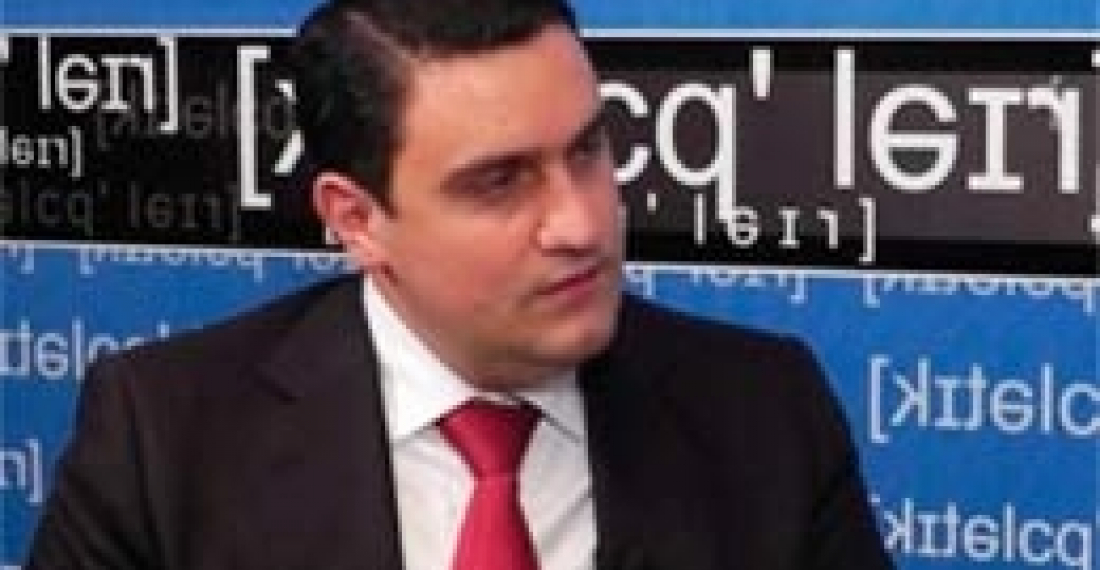
ArmInfo’s interview with Arthur Ghazinyan, Head of the Center for European Studies, Yerevan State Univeristy
Mr. Ghazinyan, what is you assessment of the European integration policy of Armenia? Are there any rapprochement trends, considering the current negotiations for the Association Agreement and the Deep and Comprehensive Free Trade Agreement?
Rapprochement with the EU may lead to development of the domestic reform models. We must chose a model: the closed political economic system characteristic to Russia, Belarus or Kazakhstan, the monopoly system or the open system with competitive economy and without domination in the market i.e. all the elements of liberal economy in the EU member-states. It would be perfect if Armenia could preserve the current peculiar 'status-quo' simultaneously developing cooperation with both Moscow and Brussels. But, such scenario is impossible. Armenia has got an opportunity to apply the western model of development by joining the EU Eastern Partnership Project in May 2009. It would be a serious mistake for Armenia to deviate from the launched pro-Western course. As for the DCFTA, is provides for facilitation of trade process, transboundary cooperation, customs clearance on preferential terms etc. All these reforms require internal reforms, first of all.
May Moscow’s idea of Eurasian Union become an obstacle to that liberation?
Surely, the Eurasian Union is a serious threat to rehabilitation of the political and economic system of Armenia. Russian President Vladimir Putin's idea of the Eurasian Union is aimed at regional integration. Russia, Belarus and Kazakhstan have already achieved certain success in the given dimension by creating the Customs Union. For Armenia, if it is offered to join the project that is widely discussed by experts and politicians, the Eurasian Union implies specific isolation in the South Caucasus. I doubt very much that Azerbaijan will support the idea of the Eurasian Union. I rule out Tbilisi's joining it. In such situation, they use Armenia's economic blockade by Azerbaijan and Turkey and make it seek 'shelter' in Moscow, in the systems of military and economic security offered by the Kremlin.
Should Armenia learn the experience of Georgia that has achieved economic and political successes due to rapprochement with the West, but has lost Abkhazia and South Ossetia after the August War of 2008?
Georgia actually lost control of those two countries after the collapse of the Soviet Union, and the August War 2008 just confirmed that loss de-jure. At the same time, Georgia has got rid of a sore, which made it possible for the entire organism to live and develop. Russia annexed those territories, which is not favorable to it. It would be more reasonable for Moscow to leave the conflict unresolved in order to come out as an arbiter at any moment and use the conflict for its purposes. Occupying and recognizing the two countries Moscow lost its levers of influence on Georgia.
Bringing the example of Georgia many experts, sure, hint at a danger of losing Karabakh in case of pro- Western orientation. However, I think that Azerbaijan is not ready and will hardly ever dare to launch military actions against pro-western Armenia and Karabvakh, as it has huge western oil and gas economic capital and is not sure in its success in that war.
Any attempt to withdraw from the peace talks and unleash war will create real grounds for the USA and EU to recognize independence of Nagorno Karabakh on the basis of incompatibility of two nations forced to co-exist within one state. Such scenario has already been observed in Kosovo when Serbia decided to response to military force against the Kosovo Albans. Azerbaijan must realize and, I think, they have already understood that the West will now allow a new war and violence in the South Caucasus.
Do you think that Armenia could preserve the current peculiar 'status-quo' simultaneously developing cooperation with both Moscow and Brussels?
I would be ideal, but such scenario is impossible. We have been trying to wage the notorious complementary policy for over 20 years. Now, the terms are being toughened and we are reluctant to make a choice. And these terms are toughened by Moscow, first of all. Brussels went on specific constructive cooperation offering funds, assistance in protection of the intellectual property rights, adoption of sanitary and phytosanitary measures, standardization procedures, certification, metrology, accreditation. In the case of the Eurasian Union, I expect no such assistance, for instance, in upgrade of food security.
What do you think of the future of the big enterprises operating on the Russian capital in Armenia in case if the above negotiations with the EU are successfully completed?
If Russian companies in Armenia can work in the conditions of the western management and in full line with legislation, if they have such a management system that meets new requirements, there will be no problem of their further activity in case of successful ending of talks with EU and serious economic reforms.
Russian capital has been also presented at the European market and has no problem there. In case of successful ending of talks with the EU, using of new standards and effective reforms in Armenia, the situation will radically change. I mean reduction of corruption risks and, as a result, improvement of administration. One must not be scared that Russia will start sabotage against Armenia, as here it owns strategic facilities. Armenia has got enough levers and means not to let it.
One should not forget that about 80% of capital in Armenia is the Russian capital, which is politically motivated and seriously limits attraction of the Western capital to the Armenian economy. Because of the way of its formation the Russian capital is not ready to work at the legal field within the frames of the law. It has serious management problems. All this supposes growth of corruption risks. It is no secret that the present economic system of Russia is fully corrupted and the Russian capital has been working in Armenia using the same vicious traditions. The availability of the western capital, that passed a rather serious way of formation and development for 150-200 years, will bring the western judicial companies which prefer to protect economic interests only in court basing on legislation...There is a problem of business environment improvement and diversification of the general system in Armenia. We remember what was happening at the Internet services market of Armenia before the Orange company coming. The presence of one European company in our country radically changed the entire telecommunications market. The same may and should happen in all the rest spheres of the Armenian economy.
Western politicians often said that they would like to cooperate with the South Caucasus region like an integrated whole. However, many experts criticize the West for drifting away from its own positions from time to time in the context of the energy projects, in particular, Baku-Tbilisi-Ceyhan oil pipeline…
The above mentioned energy project is an American but not a European one. The EU said earlier it does not want to take part in this project because of its discriminating nature, as in fact Armenia was forced out of it.
What about Nabucco, which will not involve Armenia either?
It is naive to speak about fulfillment of the project that costs 15 bln EUR, in the conditions when the Karabakh conflict has not been settled and when there is no stability in the region. Nabucco has no problem linked with financing or gas supply. The only problem is a threat of the new war in the region. The pipeline cannot go around Nagornyy Karabakh and Armenia, as the route through these two Armenian republics is very much beneficial. Moreover, the Europeans do not want to force Armenia out of the regional programmes. The more isolated Armenia because of the Karabakh conflict, the less possible its participation in big programmes. In such conditions Yerevan has nothing else to do than to run into Moscow's arms. As for the Russians, they want just this, encouraging and stimulating the regional isolation of our country and offering an idea of the EurAsian Union. Moreover, unsettlement of the Karabakh conflict is a result of the fixed balance in our region. Any changing of the balance of forces towards this or that geo-political pole will lead to settlement of conflicts in the region. This will create favorable conditions for fulfillment of geo-political and economic programmes, which will involve all the countries of the South Caucasus.
The CSTO CRRF exercises scheduled for early September were postponed simultaneously with the mass media reports on NATO Secretary General’s visit to Armenia. Are there any links between those two events?
I think that Rasmussen’s visit to Armenia in the period of the exercises speaks volumes. The West has no intention to stay aside the processes in the South Caucasus, including in the security sphere. Given today’s situation in the Middle East, the political crisis in Syria, the Iranian problem, the northern border with Iran is very important for the West and NATO, particularly. I thin that NATO Secretary General’s visit to Armenia aims to verify all these issues.
by Ashot Safaryan
05.09.12. ArmInfo
Interview
OPINION: Arthur Ghazinyan "Eurasian Union may become a serious threat to rehabilitation of the political and economic system in Armenia"