This is a commentary prepared by the editorial team of commonspace.eu
The political maturity of a nation is difficult to define, but on 8 October Georgians will contribute to the world's perception of their political maturity through the way they will engage with the electoral process.
Parliamentary elections in Georgia on 8 October are a good opportunity to assess the current mood in the country on a number of important issues, but furthermore the elections also provide a good indicator of the current level of political maturity among the Georgian electorate.
Georgia has a good legal framework for elections. There have been major reforms and important tweaks over the years, and the laws governing elections are as good as can be. Proper implementation of the laws and the rules that govern the process are also much improved.
There are no signs, so far, that any of the political parties are trying to defraud the process, nor that they will not accept the results of the elections, whatever that maybe.
Given Georgia's troubled electoral history these "certainties" are not to be taken lightly. They are the foundations on which Georgian statehood is being built, and without them any talk of Georgia's European and Euro-Atlantic aspirations will be useless prattle.
But there is something subtler related to this process - something that is not dependant on legislators or government officials, or even on party leaders. Political maturity is somewhat difficult to define, and even the most mature electorate often indulges in exercises of political recklessness. Political maturity cannot be packaged or spun. It is not something that depends solely on political elites, although they certainly contribute a lot to its formation. And it is not something that can be hidden, in fact it is often a characteristic (or lack of) that nations wear as a badge of honour or dishonour as the case may be.
Ahead of the vote on 8 October, the editorial team of comonspace.eu has identified five criteria on which it will evaluate the level of political maturity in Georgia as expressed in this election:
a) Turnout
Turnout in Georgian elections tends to be respectable - hovering between 60-65%. The situation is much less polarised today than in 2012, or during elections previous to that. Some are wondering if Georgians will bother going to vote at all in this election. A respectable turnout, even in the current calm conditions would be a good indicator that people see voting as an important civic act, not simply an exercise in glorifying or penalising politicians - or as has been the case on a number of occasions in the past, an existential act of defiance.
b) Peaceful campaigning, peaceful voting
Campaigning through the hot summer months has been remarkably peaceful and uneventful. The one incident that took place in Kortskheli even the before the campaign started, remains the exception that proves the rule. All political forces understand that violence will be counterproductive and may work against them so the chances of organised violence seem very low. Earlier this week the Georgian Interior Ministry said it had some information of planned incidents of violence being planned by the opposition UNM. The UNM promptly denied this, and so far, no hard evidence has emerged proving the accusation. One can only hope this was a case of a misunderstanding since much of the kudos that Georgia has gained over the last years can easily be wiped out if there is a recurrence of violence.
Georgians tend to be temperamental, and scuffles occur often, in any social situation where people gather, and drink is consumed. It would be a pity if such things also mar the electoral process. Of course it is up to the police to secure law and order, but society in general should through its action and response, isolate violence incidents when they occur, and frown on those who participate in them. This more so on election day itself.
c) Smooth election day process
Paranoia based on past history that someone will "steal" the election has resulted in tens of thousands of observers being mobilised to monitor the election process. There are now so many of them that have become a feature of the polling station. Of course transparency is not only welcomed but also necessary. But one also expects that as trust in the electoral process increases the need for so many observer decreases.
The Georgian Central Elections Commission is well organised and properly resourced. On can expect that in most cases the electoral process on election day will be smooth. But given the numbers of those involved in one way or other in the polling stations, and with dozens of parties on the ballot sheets, a certain amount of confusion, even chaos is likely to be inevitable. Here again it is the population at large that through its actions can ensure that the process is conducted with dignity
d) Free, open and responsible media
Georgia's media is free. The opposition has access to - and in some cases control of - major media outlets. Past problems of access to different TV stations in different parts of the country are, by and large, something of the past as new technology allows digitalised access to all. However political maturity means that the onus is not only on the authorities - their duty is to ensure a free and open media. Media outlets on the other hand need to show maturity by being responsible - not sensationalising issues unnecessarily; approaching issues with a degree of respect and swiftly and unambiguously condemning violence. They also need to be as careful as they possibly can not to spread incorrect information, especially if it can trigger violence. A responsible media is not created by laws, but by the values that the society that it communicates with holds high. How the Georgian media covers this election will also tell us a lot on the nation's political maturity.
e) Population constructively engaged with the political process
Georgians tend to enjoy politics. They are often very opinionated, but there is nothing wrong in that. They also tend to have a cynical approach to both their politics and their politicians. In most cases this is a sign of healthy politics. Unlike political parties that spring to life as elections approach, and hibernate for most of the time in between, Georgian civil society is ever-green and today constitutes an important block in the state-building process. The elections are a good time to get a sense of how much people engage with the political process - not only through the turnout, but also through the way they engage with political activity, how they respond to polls, opinion polls, door to door canvassing etc. Unlike the voting turnout which is precisely recorded, gauging citizen engagement with the political process in this way can be based mainly on anecdotal evidence. But even such an imperfect evaluation is useful
Commonspace.eu will not be official monitors in the Georgian elections, although we will be reporting on them comprehensively for our readers. However, our editorial team and contributors will be keeping an eye on the five criteria and reporting against them as the process unfolds, and after.
This commentary was prepared by the editorial team of commonspace.eu
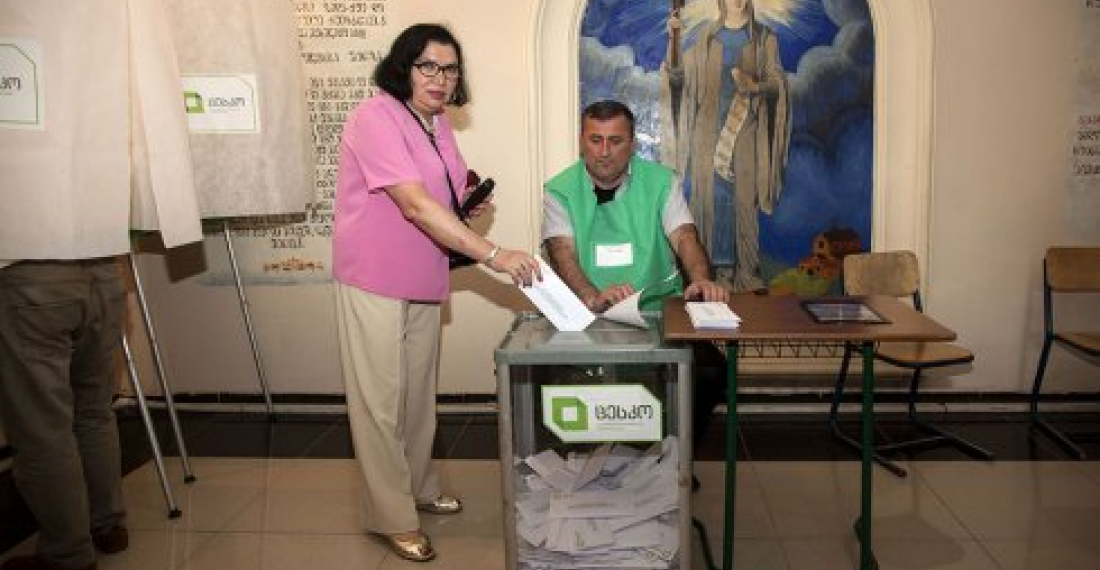
photo: A Georgian women casts her vote in the Georgian capital, Tbilisi.