


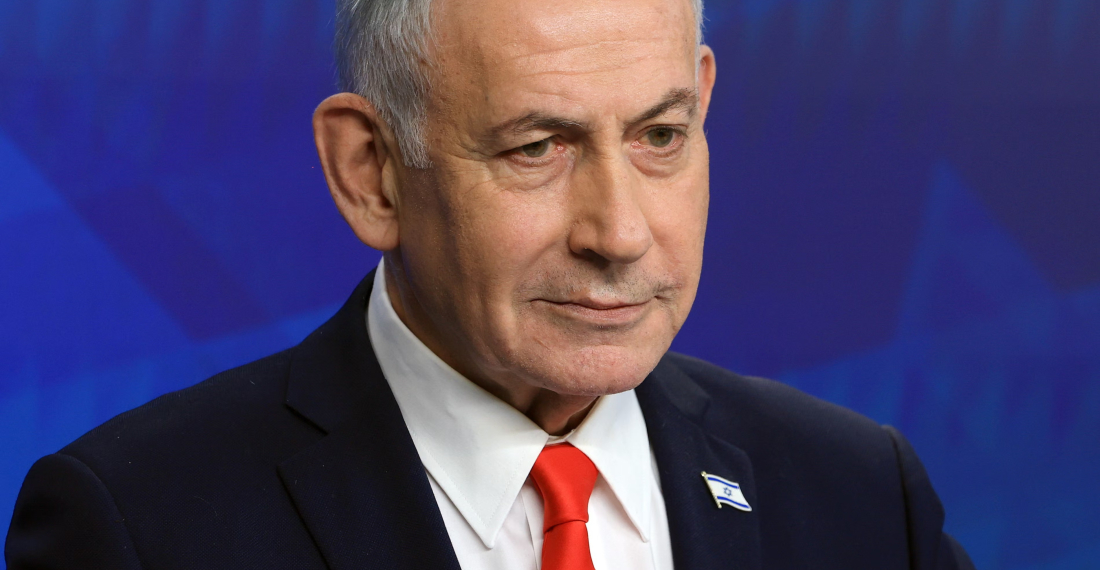
The Prime Minister of Israel, Benjamin Netanyahu, has hailed a historic victory over Iran and ruled out an immediate withdrawal from Lebanon on Monday (15 June). He said that Israel’s forces would remain there “for as long as necessary”.
“We established deep security zones around the state of Israel. We did this in Gaza, in Lebanon and in Syria,” the Israeli prime minister said in a televised press conference on Monday. “And I want to make it clear: we will remain in these security zones … to protect our country.”
He claimed that the US-Israeli war against Iran had spared Israel from “nuclear annihilation”, and that the destruction and timing of the campaign was necessary in order to prevent Iran from having nuclear weapons.
The exact details of the interim deal between the US and Iran are still unclear. The Guardian reports that it might “include a ceasefire in Lebanon, where Israel launched a wide-ranging offensive after attacks on northern Israel by Hezbollah at the beginning of the 15-week-long conflict”.
US officials said on Monday (15 June) that the withdrawal of Israeli forces was not a condition of a pact between the US and Iran, and Israel would have the right to defend itself against attacks by Hezbollah. It should be noted that details of the Memorandum of Understanding between the US and Iran are still very much unclear, and JD Vance said that the framework is ‘very general’ with many details yet to be negotiated.
“The MoU … is about a page and half so it is a very general document,” Vance said on CNN on Monday night. “On a number of issues, we are going to have to figure this stuff out during the technical negotiation phase.”
Israeli media has framed the outcome as an “abject failure”. Israel had strongly opposed Iranian attempts to make any interim agreement with the US conditional on ending Israeli strikes against Hezbollah in Lebanon.
Opposition figures in Israel have also moved quickly to criticise the deal. With elections due before October, and the race expected to be closely contested, the agreement is likely to become a major political issue. Netanyahu said on Monday that he intended to stand in the election and win.
Yair Golan, leader of the centre-left Democrats, accused Netanyahu of allowing “military achievements won through the courage of [Israel’s armed forces] to be erased”.
“Trump signs an agreement that funnels billions to the ayatollahs’ regime, leaves the nuclear infrastructure intact, preserves the ballistic [missile] threat as it is, and throws a lifeline to the murderous regime in Tehran,” Golan said.
Naftali Bennett, the former prime minister and one of Netanyahu’s main challengers in the upcoming election, said Netanyahu was “incapable of achieving a decisive victory” and had dragged Israel into wars of “stagnation and attrition”.
Far-right members of Netanyahu’s governing coalition urged Israel to disregard the terms of the deal, arguing that the country had not taken part in the negotiations and was therefore not bound by the agreement.
“We are not party to this agreement. It does not safeguard our security,” National Security Minister Itamar Ben-Gvir wrote on Telegram.
Source: commonspace.eu with The Guardian



