


Iran has begun several days of public mourning and funeral processions for its former Supreme Leader, Ayatollah Ali Khamenei, more than four months after he was killed in strikes launched by the US and Israel.
The former Ayatollah's body on Fruday (3 July) lay in state at Tehran's Grand Mosque, ahead of his burial in his hometown of Mashhad next Thursday.
Iranian authorities said 12 to 20 million people were expected to attend the ceremonies, which are part of what they are calling the "funeral of the century".
Iran's President Masoud Pezeshkian was among those paying their respects after the coffin was placed at the vast religious complex.
There will be an official funeral ceremony in Tehran on Saturday, which the Tehran-based Mohammad Rasulullah Corps is leading, as part of six days of ceremonies.
Authorities have ordered public and private offices in Tehran to close from Saturday through Monday, while traffic restrictions will shut down most of the city centre to private vehicles, AFP reported. The airspace over Tehran was partially closed on Friday and will be fully closed on Monday.
On Tuesday, events will move to Qom, just south of Tehran, where a senior Shia cleric will lead funeral prayers at Jamkaran - one of Iran's most prominent and symbolic religious sites
Khamenei's body will then travel to Najaf in Iraq on Wednesday. Following a procession at the shrine of Imam Ali, Shia Islam's first imam, ceremonies will continue in Karbala before the body returns to Iran.
Iranian officials say the Iraq events follow requests from Iraqi groups, with some analysts seeing them as representative of Khamenei's influence across the Shia Muslim world and Iran's religious and political ties across the region.
Iranian Foreign Minister Abbas Araghchi visited Baghdad to coordinate the arrangements, saying the funeral had a "symbolic importance".
On Thursday, Khamenei will be buried in the city of his birth, Mashhad, at the Imam Reza Shrine, the mausoleum of Shia Islam's eighth imam and Iran's most important pilgrimage site, which attracts millions of visitors each year..
Black-clad mourners carried Khamenei’s coffin aloft at Tehran’s vast Grand Mosalla religious complex on Friday, with the casket draped with the national flag of the Islamic Republic that he led for more than three decades.
Authorities expect public mourning and grand processions to attract millions before burial next week, four months after the 86-year-old leader was killed at his compound on February 28, the first day of a joint United States-Israeli war on Iran.
Alongside Khamenei’s casket lay those of his three-year-old granddaughter, eldest daughter, son-in-law and daughter-in-law – all killed in the strike on February 28.
Iranian State TV broadcast footage of Iranian President Masoud Pezeshkian paying his respects at Khamenei’s coffin, alongside the parliament speaker and chief negotiator, Mohammad Bagher Ghalibaf.
Ahmad Vahidi, head of the Islamic Revolutionary Guard Corps (IRGC), the ideological arm of the Iranian military, also made his first appearance since the start of the war.
The funeral was scheduled for March, but was delayed due to the war on Iran.
Many world leader are also attending the six days of commemoration, with a public ceremony scheduled on Saturday in Tehran, followed by a procession through holy cities in both Iran and neighbouring Iraq, butbthe government has not invited several European countries to the funeral, and the attendees were mostly from either neutral or friendly states.
According to the Foreign Ministry spokesperson, so far more than 50 delegations have already paid their respects to Iran’s late supreme leader, naming the presidents of Iraq, Tajikistan, Turkmenistan, Georgia, as well as Pakistan’s Prime Minister Shehbaz Sharif.
source: commonspace.eu with BBC (London), al Jazeera (Doha), and agencies
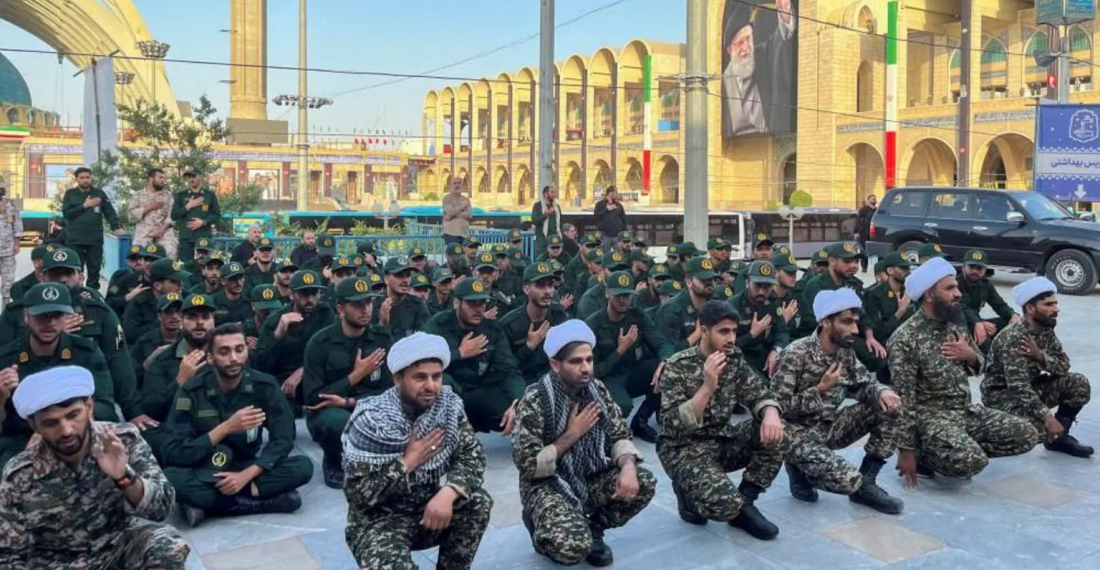
photo: Members of the Basij paramilitary forces gather on the day international delegates participate in a farewell ceremony



