On Wednesday, 14 November, at the same time that Prime Minister Bidhzina Ivanishvili was in Brussels meeting EU and NATO leaders, the Russian newspaper Kommersant published an interview with the new Georgian Foreign Minister, Maia Panjikidze in which she reiterated that Georgia's policy for European and Euro-atlantic integration were the asspirations of the Georgian people and not simply the policies of either the Saakashvili or the Ivanishvili governments.
The interview, conducted for Kommersant by Georgi Dvali is reproduced here:
[Dvali] You, like Prime Minister Bidzina Ivanishvili, consider that there is no alternative to Georgia's pro-Western policy. Why?
[Panjikidze] Georgia has done a great deal of work over the last 20 years to make progress along the road of European and Euroatlantic integration. But much more could have been done. The previous authorities started to forget that the EU is not just an economic union and NATO is not just a military alliance. Both the European Union and the North Atlantic Alliance are primarily associations based on common values -- the protection of human rights, democratic institutions, media independence, an independent judiciary, and a developed civil society. Our efforts will be directed primarily at strengthening democracy. Countries that do not completely meet the standards in the military sphere have also been admitted to NATO -- but they shared common democratic values. The path that Georgia needs to follow in order to join NATO and the EU is much more important than the actual goal, because successful progress along this path will enable us to build the kind of country that we dream of -- civilized, democratic, developed, and secure. But joining NATO and the EU will be only the culmination of the process.
[Dvali] Does that mean that you feel that the previous regime's violation of democratic standards was the main obstacle to success for Georgia's strategically correct pro-Western policy?
[Panjikidze] This was one of the reasons. Because of the previous regime Georgia suffered a setback in developing democratic institutions.
[Dvali] Is it possible to combine an aspiration to join NATO with a wish to improve relations with the Russian Federation, which Prime Minister Ivanishvili talks about? Many people regard this task as insoluble....
[Panjikidze] There are no insoluble tasks. Something that seems unlikely right now may turn out to be totally natural in a few years' time. For example, I studied in the GDR between 1979 and 1983. At that time nobody could even imagine that the Berlin Wall would collapse and Europe would unite, like Germany itself. That the USSR would collapse and Georgia would become independent. If somebody had told me at that time that I would become the ambassador of an independent Georgia to a unified Germany I would have thought that my interlocutor had lost all sense of reality. Yet all of this happened before our very eyes!
Our task (in joining NATO and improving relations with Russia -- Kommersant) is a very tricky, but we will work on resolving it. The countries of East Europe probably felt the same at one time. Their path to Europe was blocked, but today they are already members of the EU and NATO. Russia has the most secure borders and fewest problems with specifically these countries. Everybody needs to realize that a democratic and stable neighbor is better than a totalitarian and unpredictable one. There are numerous examples of NATO membership being compatible with good relations with Russia. Our task is to become the next example.
[Dvali] You assert that diplomatic relations with Russia will not be restored since it is occupying Abkhazia and South Ossetia. Are other formats for relations with Moscow possible?
[Panjikidze] Despite the fact that diplomatic relations between our countries have been severed, actual relations exist. First, one manifestation is the Geneva format. Admittedly within this format we have not achieved substantive results mak ing it possible to hope for a solution of the main problems, but it exists and needs to be preserved. Second, certain decisions have been adopted on the subject of the Russian Federation's admission to the WTO. Third, Russian business has the possibility of operating comfortably in Georgia. Fourth, Georgia unilaterally abolished the visa regime with Russia. Fifth, the idea of participating in the Sochi Olympics has been made public.
There is a great deal that can be done even when there was no diplomatic relations. So the creation of new mechanisms for interaction such as, for example, the introduction of the post of the prime minister's special representative for relations with the Russian Federation, should not cause surprise. Links can be built through this channel too. Diverse channels of interaction are an important condition for unfreezing relations
[Dvali] But Moscow is awaiting specific steps from Tbilisi. What else can Georgia do to improve relations?
[Panjikidze] I can add that we do not rule out involving the international community in galvanizing the mechanism for interaction with Russia. The role of a mediator is generally very important when relations are strained.
As for the specific steps that people in Moscow talk about -- this is a subject for further consultation. Our message is specific, and we for our part are hoping to receive a more specific answer than are hearing right now.
[Dvali] Russia is in favor of the integration of the post-Soviet area. There is the Eurasian Union project, the Customs Union is operating, and the CIS, from which Georgia withdrew in 2008, still exists....
[Panjikidze] Our country acquired independence with enormous difficulty and will never give it up. We adhere to a clear policy of European and Euroatlantic integration. This is an irreversible process. The only associations that Georgia will join are NATO and the EU. Our country has no other path, and no regime will deviate from it.
source: Kommersant Website
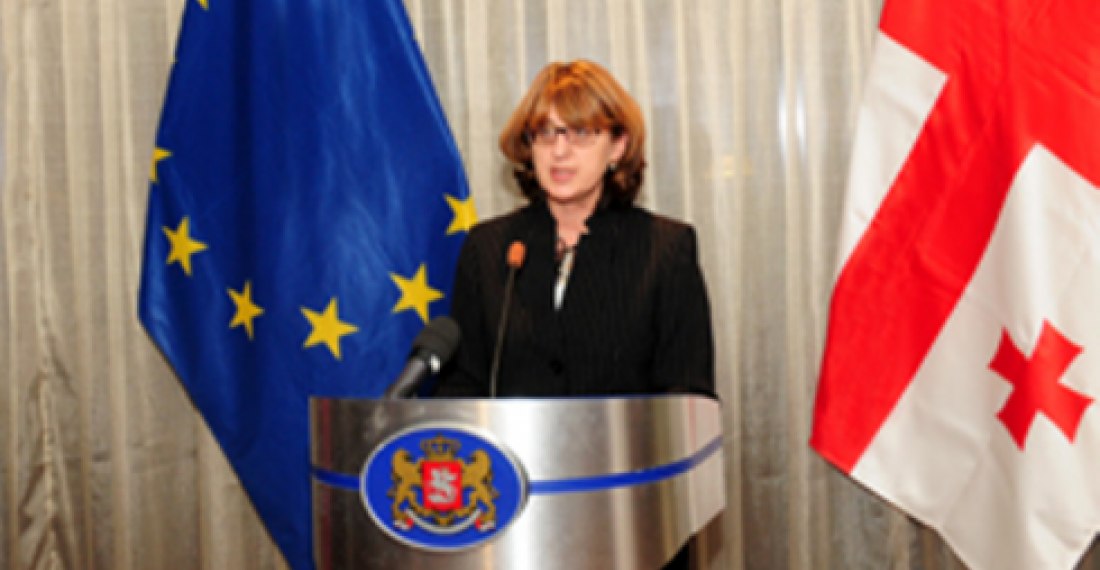
Photo: The Foreign Minister of Georgia Maia Panjikidze (photo courtesy of the Press Service of the Georgian Foreign Ministry).