


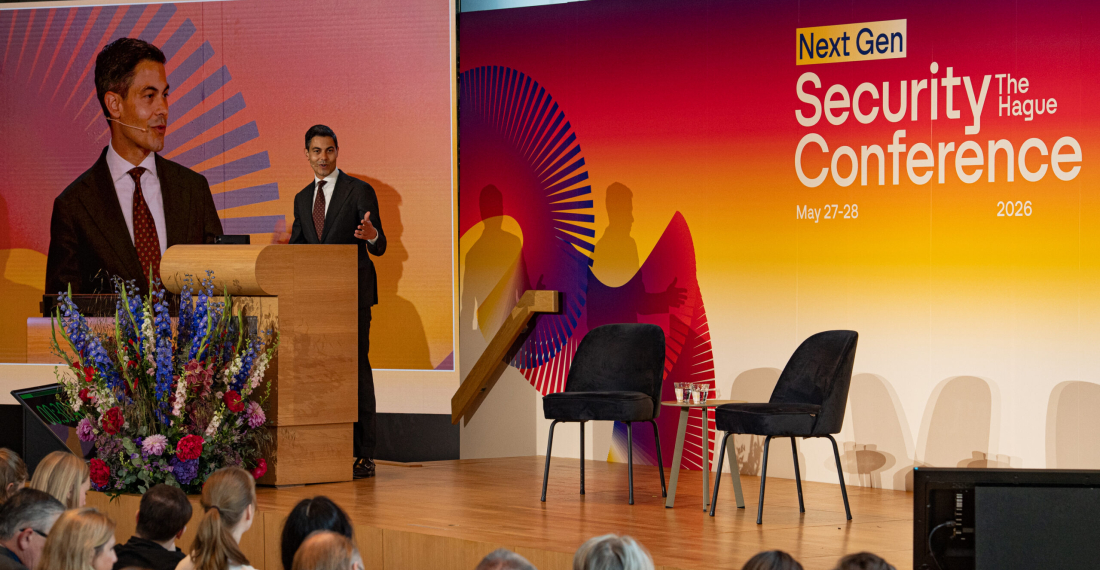
On 27-28 May, the Netherlands Atlantic Association, the Clingendael Institute and Leiden University Campus The Hague co-hosted the Next Gen Security Conference, with support from the Ministry of Defence, the Ministry of Foreign Affairs and the Municipality of The Hague.
The event, which brought established professionals and the next generation of leaders, sought to encourage intergenerational dialogue on pressing global challenges. Through the exchange of knowledge, ideas, and experiences, participants explored how young people can contribute to shaping future policy and societal developments.
Panel discussion: Escalation in the Middle East
On 28 May, at Campus The Hague, experts on Iranian foreign policy, Turkish strategy, US foreign policy, and developments in Israel and the Palestinian Territories came together to share their perspectives on the military escalation, shifting regional alliances, and the use of strategic leverage points in the Iran war and the Palestine war.
In her opening remarks, moderator Fernande van Tets, a freelance journalist and former Middle East correspondent, invited the members of the panel discussion to a conversation on what they believed to be the role of modern diplomacy – whether from middle powers or influential external actors – in creating space for de-escalation.
Israel-Iran War: Regional responses and prospects for de-escalation
Fernande van Tets first inquired about the pre-war expectations of the countries involved, encouraging speakers to give an analysis of the domestic dynamics behind the international conflicts.
Nate Swanson, Resident Senior Fellow and Director of the Iran Strategy Project at the Atlantic Council, opened by arguing that the Trump administration initially expected the war to be short-lived, similar to the previous confrontation between the US and Venezuela. However, he suggested that this assumption quickly proved incorrect, as Iran demonstrated a greater capacity to absorb pressure and sustain confrontation than many policymakers in Washington anticipated. While rising fuel prices and growing public dissatisfaction with the war created domestic political costs, Swanson argued that President Trump's decision-making remained highly centralized and largely insulated from these pressures. At the same time, he noted that the administration did not want to become entangled in another prolonged Middle Eastern conflict.
Building on the question of Iran's resilience, Hamidreza Azizi, Visiting Fellow at SWP, argued that Iranian authorities had anticipated the possibility of a military confrontation, particularly following waves of domestic unrest beginning in December 2025. Referring to warnings issued by the Intelligence Ministry, President Masoud Pezeshkian, and the former Supreme Leader Ali Hosseini Khamenei, he explained that the Iranian leadership viewed the conflict not only as a military challenge but also as a potential catalyst for internal instability.
Competing visions for a ceasefire
In a second round of questions, Fernande van Tets asked speakers about their assessment of the future of ceasefire negotiations. Discussing Iran's perspective on the matter, Azizi stressed that Tehran remains deeply sceptical of ceasefires, viewing them less as pathways to peace and more as opportunities for Israel to recover militarily before launching renewed attacks. He argued that previous ceasefires in the region have often allowed Israel to regroup while simultaneously weakening its adversaries, creating mistrust and skepticism among Iranian officials regarding future agreements.
This assessment was challenged by Nasrah Habiballah, Correspondent for Israel and the Palestinian Territories at NOS, who explained that Israeli perceptions of the conflict are shaped by a widespread belief that Iran constitutes the country's most significant security threat. While she acknowledged that Israel had underestimated the scale of Iran's response, she argued that most Israelis continue to see military pressure as necessary because they believe a weakened Iran would reduce long-term risks to Israeli security. This, she suggested, helps explain why Israeli public support for a ceasefire remains limited. Habiballah further noted that many Israelis expected the conflict to contribute to regime change in Iran, a goal that reflected broader concerns about Tehran's regional influence.
Responding indirectly to this point, Azizi cautioned that external pressure on Iran could produce unintended consequences. While acknowledging that the conflict may have generated certain strategic gains for Tehran, he argued that the greatest challenges are likely to emerge after the fighting ends. He cited internal estimates placing reconstruction costs at approximately USD 300 billion and warned that economic hardship, combined with existing social grievances, could fuel renewed protests, especially considering that during the war, Iran has used the conflict as a cover for the increased execution of political opposition. According to Azizi, this explains why Iran's leadership is seeking sanctions relief and economic support while simultaneously cracking down on domestic dissent.
Türkiye's strategic ambitions
Fernanda van Tets also questioned speakers about the regional implications of the conflict. Hürcan Aslı Aksoy, Senior Fellow at the Centre for Applied Turkey Studies (CATS) at SWP, argued that Ankara views the fragmentation of the Middle East through a distinctly pragmatic lens. While Türkiye shares concerns about regional instability, she suggested that it sees opportunities to expand its influence and strategic autonomy. Aksoy also argued that Türkiye has sought to strengthen its position through a combination of military engagement, diplomacy, and economic connectivity initiatives.
Aksoy also responded to the discussion on Iran by noting that Türkiye's interests differ substantially from both Israeli and Iranian objectives. While Ankara does not want to see a nuclear-armed Iran, it also fears the consequences of a severely weakened Iranian state, including refugee flows and further instability in Iraq and Syria. In this sense, she suggested that Turkish policymakers occupy a middle ground between the security concerns outlined by Habiballah and the warnings about regional destabilisation raised by Azizi.
Regional conflicts, global interests
The speakers also discussed the role of external powers. Swanson argued that Iran possesses advantages in negotiations that other actors such as Lebanon or Gaza lack, particularly through its ability to threaten disruption in the Strait of Hormuz. This gives Tehran leverage that can complicate efforts to impose ceasefire arrangements. Azizi expanded on this point by highlighting the support Iran continues to receive from China and Russia. He noted that both countries provide diplomatic protection at the UN Security Council, while China remains an important economic partner. Nevertheless, he emphasised that Iranian officials continue to seek engagement with Europe and generally distinguish between European governments and the United States, even if relations with some countries, particularly Germany, have deteriorated significantly.
The conversation on Europe prompted reactions from both Habiballah and Aksoy. Habiballah argued that disappointment with Europe is widespread among both Israelis and Palestinians, though for different reasons. Many Israelis feel that Europe does not adequately recognise their security concerns and point to rising antisemitism across the continent. Palestinians, by contrast, are frustrated by what they perceive as Europe's unwillingness to use its political and economic leverage to restrain Israeli actions in Gaza and the West Bank.
Aksoy largely agreed that Europe's influence has declined but argued that this trend began well before the current conflict. According to her, many Turks view the EU as increasingly inconsistent in its application of international law, undermining its credibility in the region. While pro-European groups in Türkiye continue to advocate closer cooperation, she suggested that many young people simultaneously see Europe as an attractive destination while questioning its political reliability.
Domestic dynamics
The moderator subsequently raised the role of domestic politics in shaping conflict outcomes. Habiballah argued that Prime Minister Netanyahu has increasingly linked his political legitimacy to his ability to provide security. Although the war in Gaza initially weakened his standing, military successes against regional adversaries, such as the elimination of Ali Hosseini Khamenei, have helped restore support for his leadership.
The discussion concluded with a reflection on public discourse and information environments. Habiballah stressed that journalists have a responsibility to engage with multiple perspectives and resist the tendency to retreat into ideological bubbles. She warned that self-censorship and algorithm-driven media consumption increasingly limit meaningful dialogue across political divides.
This summary was provided by Anna Szedlacsek, Junior Research Assistant at LINKS Europe, who attended the event. Image courtesy of the Netherlands Atlantic Association.



