On Karabakh the EU reaffirmed that the status quo is unacceptable and that the solution of this conflict remains a top priority.
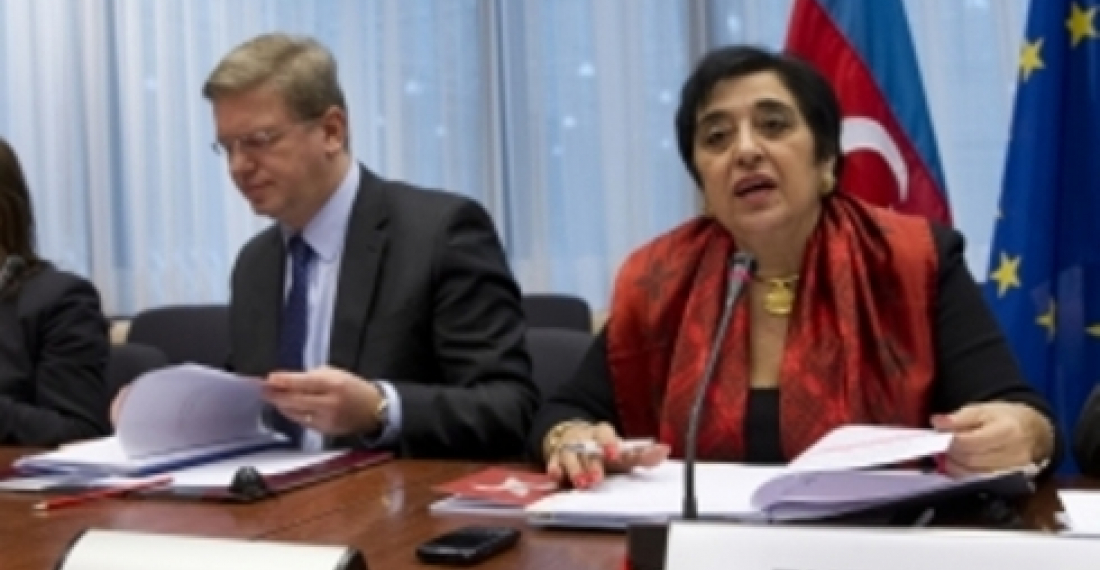
The Cooperation Council between the European Union (EU) and the Republic of Azerbaijan held its thirteenth meeting on Monday 17 December 2012. The EU was represented by Dr. Erato Kozakou-Marcoullis, Minister of Foreign Affairs of the Republic of Cyprus, acting as Chair of the Cooperation Council on behalf of the High Representative of the Union for Foreign Affairs and Security Policy, Baroness Catherine Ashton, and by Štefan Füle, EU Commissioner for Enlargement and European Neighbourhood Policy. The Azerbaijani delegation was led by Mr. Elmar Mammadyarov, Minister of Foreign Affairs of the Republic of Azerbaijan. Ahead of the Cooperation Council, the Cypriot Minister of Foreign Affairs Kozakou-Marcoullis stated "Azerbaijan and the EU have shown their strong commitment in intensifying and deepening their cooperation."
A statement from the Cypriot Presidency of the European Union said that "This meeting provided the opportunity for frank and open discussion. It took place at the end of a very intensive year for bilateral relations: during 2012, visits were made to Baku by the President of the European Council Mr. Herman Van Rompuy, Commission Vice- President Neelie Kroes and Commissioners Günther Oettinger and Štefan Füle."
The statement added that the Cooperation Council reviewed progress on the settlement of the Nagorno Karabakh conflict. The EU reaffirmed that the status quo is unacceptable and that the solution of this conflict remains a top priority. Both sides reiterated their support to efforts deployed by the OSCE Minsk Group. The EU confirmed its complementary role in support of confidence building measures. The EU also expressed concern on incidents at the frontlines. The EU urged the sides to maintain stability on the ground and to refrain from aggressive, belligerent statements and actions that would increase tension.
The Cooperation Council underlined the need to remain focussed on and speed up implementation of the European Neighbourhood Policy Action Plan, including World Trade Organisation accession. The Cooperation Council provided a good opportunity to take stock of latest developments in the South Caucasus, as well as to review recent political and economic reforms in Azerbaijan.
In view of the deepening bilateral relations between the EU and Azerbaijan in the framework of the Eastern Partnership, the EU encouraged Azerbaijan to step up reforms in these fields in particular with regards to the preparation and conduct of presidential elections scheduled in October 2013, which should take place in a fair and transparent way in line with international standards.
The EU reiterated that respect for human rights and fundamental freedoms in Azerbaijan is an essential component in the bilateral relationship and in the framework of the Eastern Partnership. The EU reaffirmed its readiness to continue its support for the further development of democratic institutions in Azerbaijan.
The two sides expressed satisfaction with the on-going negotiations on the Association Agreement and underlined the need to accelerate their pace. The EU welcomed the start of negotiations for the signature of Visa Facilitation and Readmission agreements.
The Azerbaijan web portal news.az reported that in his reply, the Azerbaijani Foreign Minister, Elmar Mammadyarov thanked the European partners for their support in the issue of Nagorno-Karabakh conflict. "We need to strive for the elimination of the status quo, since every side is losing from the current state of affairs," he said. Mammadyarov noted with regret that the OSCE summit in Dublin for the first time over the past 6-7 - years failed to reach a consensus and make a joint statement in the format of "3 +2". The format implies a statement of the Foreign Ministers of Azerbaijan and Armenia, as well as co-chairs of the OSCE Minsk Group from France, the U.S. and Russia. "Next year, we will double our efforts to liberate the Azerbaijani lands and to restore the territorial integrity of our country. This is our goal, taking into account all rights of the Armenian community of Nagorno-Karabakh to live in dignity as citizens of Azerbaijan within the Republic of Azerbaijan," news.az quoted the Foreign Minister as saying.
Commonspace.eu political editor said in a comment that "relations between the European Union and Azerbaijan are at a decisive moment, when the two sides need to take important decisions if they want the relations to deepen further. The Co-operation Council meeting has set the right tone, with both sides making it clear what they expect from the other, whilst also being able to identify important common ground on which future co-operation can be build. The European Union has significantly increased its engagement with the South Caucasus in the last year, and this is bound to give results. Both sides need to understand carefully what is expected from them by the other. With regards to the EU a more credible Azerbaijani committment to political and economic reform is clearly necessary. Azerbaijan on its part is requesting more unambiguous support for its position on Nagorno-Karabakh. The EU may not be able to give Azerbaijan what it wants but it can increase substantially its efforts to help resolve the conflict, and there are some signs that a process of increasing engagement is on the way."
source: Commonspace.eu with the Cypriot Presidentcy of the European Union and News.az.
photo: The representatives of the EU at the 13 EU-Azerbaijan Ministerial Council,Dr. Erato Kozakou-Marcoullis, Minister of Foreign Affairs of the Republic of Cyprus, acting as Chair of the Cooperation Council on behalf of the High Representative of the Union for Foreign Affairs and Security Policy, Baroness Catherine Ashton, and Štefan Füle, EU Commissioner for Enlargement and European Neighbourhood Policy.