


This commentary first appeared in the Briefing Section of Central Asia Concise issue of 22nd January 2026.
Reports of Uzbek language and culture suppression in Afghanistan
Local reports coming out of northern Afghanistan detail the disappearance of public signs in Uzbek and Persian. While sporadic at first, the removals have begun causing a stir on social media, with locals complaining about increasing numbers of Uzbek signs disappearing from public streets and buildings. Further causes of concern that the Taliban government may be looking to suppress or at least limit the use of the Uzbek language are reports that the university in Samangan province may have also removed Uzbek signs in its facilities. Concrete information on this phenomenon remains limited, and the Uzbek government has been carefully monitoring the situation. Recently, Uzbek Ministry of Foreign Affairs spokesperson Akhror Burkhanov publicly stated that the Taliban government denied any attempts to undermine the use of the Uzbek language within their borders after discussions between the two governments.
Unfortunately for Uzbek-speaking Afghans, this recent development is only the latest out of a series of actions that point towards the Taliban government taking steps to suppress Uzbek, as well as other Central Asian languages and cultures within its borders. In late 2025, it became apparent that the Taliban government was dismissing thousands of its ethnic Tajik and Uzbek security forces, particularly in the northern Tajik and Uzbek ethnic majority provinces of Badakhshan, Kapisa, Parwan, and Takhar. The removal of these forces is obviously problematic for the representation of Tajik and Uzbek minorities in Afghanistan’s security apparatus, but perhaps more importantly for the security situation in general, as the Taliban government justified the action as an overall personnel reduction to save costs, and so far, it seems not to have compensated for these cuts in any way. The presence of the Islamic State – Khorasan Province (ISKP), as well as the militant groups responsible for recent killings along the Tajik border, makes an overall reduction of security forces, especially targeting those with local knowledge, a dangerous proposition. In fact, last week has seen further bloodshed on the Afghan-Tajik border as a firefight resulted in the deaths of four suspected Islamic militants, marking the latest occurrence in a series of incidents that have been escalating since last year. The cuts to security personnel continue to alarm ethnic Uzbeks as they follow previous tensions between Uzbek and Pashtun communities, occasionally spilling over into open protests, as well as the removal of a monument to the Uzbek scholar and poet Mir Alisher Navoi in Mazar-e-Sharif.
This issue of potential Uzbek language and culture repression would stand in stark contrast to relations between the two neighboring countries in the last year. Uzbekistan has been eagerly demonstrating its desire to pursue a cooperative relationship with Afghanistan, capping off 2025 by sending 20 food and medical supply trucks to the northern and directly bordering Afghan province of Balkh. As detailed in previous newsletters, Uzbekistan remains the most involved Central Asian state in driving Afghan integration into the region, repeatedly pushing for closer relations with the Taliban government, underpinned by deeper trade and connectivity across the border. The Afghan government has made sure to publicly explain the disappearing signs as ongoing work to standardize signage throughout Afghan higher education institutions, and that the Uzbek language is under no threat under its government. To further underscore this point, Afghan authorities also announced the launch of a new Uzbek Language and Literature faculty at Jowzjan State University for master’s level students. Clearly, both governments are eager to prevent the topic from becoming a wider issue, but in an information space as controlled as the one in Afghanistan, the sudden spike in social media complaints about the sign issues is certainly something to consider.
Violence against labor migrants in Russia
Central Asian labor migrants to Russia face intensifying peril as security forces escalate raids on migrant communities. Notably, a raid on a café in Khabarovsk known as a gathering spot for Central Asian migrants, resulted in mass beatings as well as a death at the hands of Russian security services. Uzbekistan’s Ministry of Foreign Affairs announced that it had sent a diplomatic note to Russia, calling for an impartial investigation into the death and repatriation of the body. The raid is not new or unexpected, as conditions for Central Asian migrants have drastically deteriorated since the Crocus City Hall attack in 2024 by Tajik terrorists for which ISKP publicly claimed responsibility.
The death of an Uzbek labor migrant as a direct result of the beatings suffered by Russian security forces marks a dark milestone for Central Asian migrants in the country. The raid has sparked outrage on Uzbek social media and an active discussion on the increasing risks for Uzbeks to venture to Russia in search of better job opportunities. Politician Alisher Qodirov of the National Revival Democratic Party called for all Uzbeks to leave Russia as soon as possible, echoing much of the indignation on social media. However, things are not that simple, as many Uzbeks are still very much dependent on Russian employment. Russia remains the main destination for all Central Asian labor migrants, even after the increasing hostility, with massive amounts of remittances transferred to Uzbekistan as a result. It is estimated that in the first half of 2025 alone, Uzbekistan received 8.2 billion USD in cross-border transfers from Russia, with total remittances for 2025 expected to be around 20 billion USD. Uzbek economic scientist Abdulla Abdukadirov and deputy director of the Uzbek President’s Agency for Strategic Reforms highlighted the significance of these remittances by comparing the 20 billion sum to the annual state budget of 28 billion USD. If this latest escalation will lead to sharp decreases in Uzbek migrants seeking work in Russia remains to be seen.
Unfortunately, this trend of violence so far shows no signs of slowing down. Raids are now often accompanied by violent ultra-nationalist groups such as the ‘Russkaya Obshchina’ (Russian Community, RO), which preaches ethno-nationalism through a violent ‘reconquest’ of Russia on its popular social media pages. Many members of these groups are veterans of Russia’s war of aggression in Ukraine and contribute to the militarized nature of these groups. Even more worryingly, there have been reports of raids by RO without the involvement of law enforcement, causing further concern that the Russian state is allowing these groups to operate with impunity.
source: This commentary first appeared in the Briefing Section of Central Asia Concise issue of 22nd January 2026.
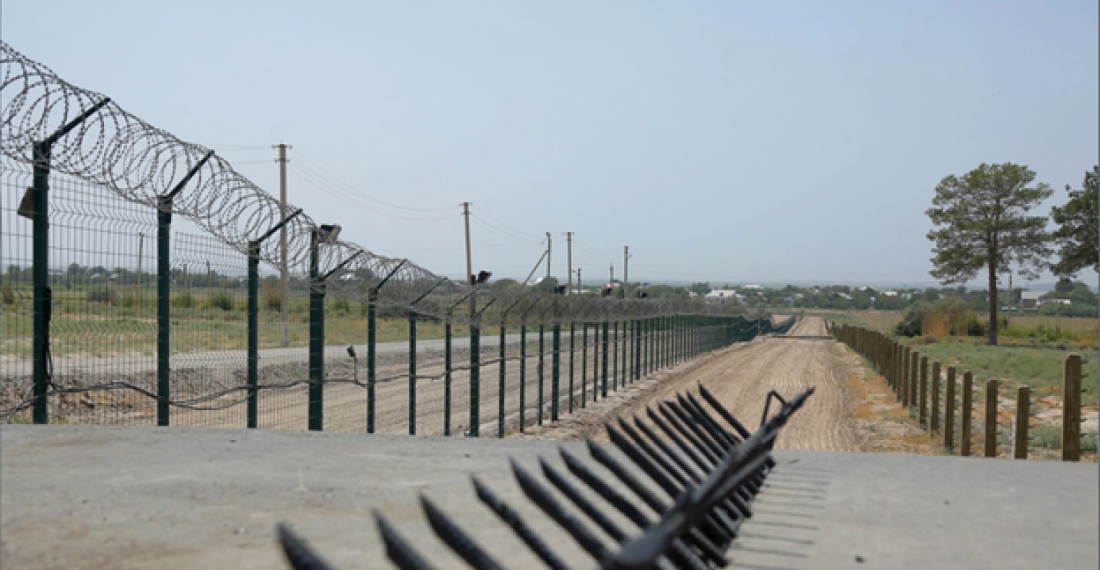
photo: The Uzbek-Afghan border



