


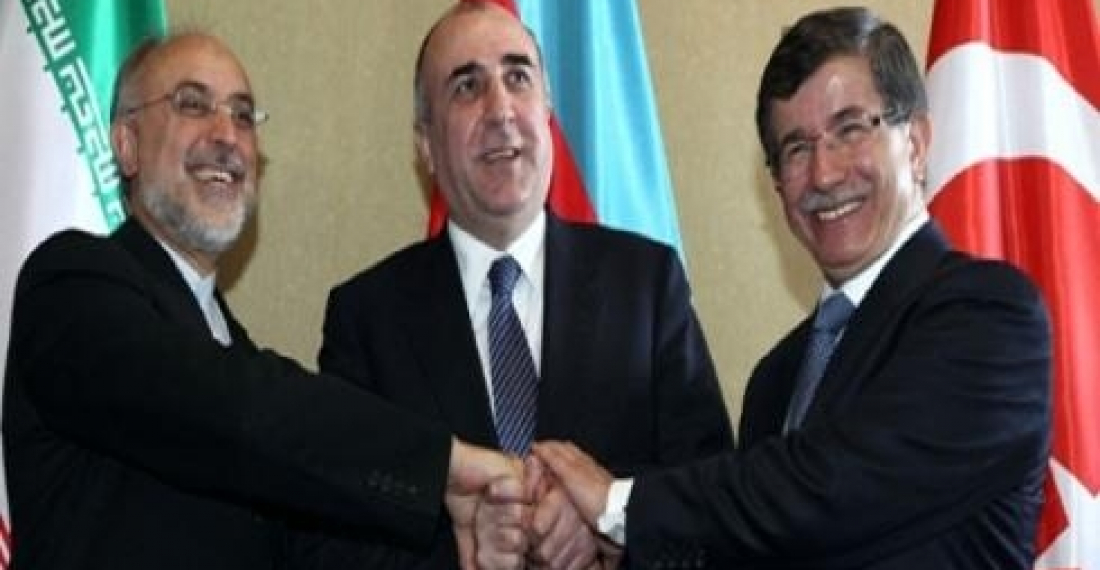
"Three bodies in one spirit". The trilateral meeting between Azerbaijan, Turkey and Iran has eased tensions between the three countries.

"We are three, countries, three bodies in one spirit." That is how Iranian Foreign Minister Ali Akber Salehi described relations between Azerbaijan, Iran and Turkey at the end of a meeting of the Foreign Ministers of the three countries held on Wednesday, 7 March 2012 in the Azerbaijani exclave of Nakhchivan. The meeting helped to defuse tensions, particularly between Azerbaijan and Iran, following a period when the two sides openly accused each other of working against each other's interests.

Azerbaijan Foreign Minister Elmar Mammadyarov said "It was a very good meeting, informative. We covered global issues and signed a trilateral declaration."

Indeed the three sides can take some comfort from the 15 point declaration signed at the end of the meeting. On Nagorno-Karabakh the three Ministers stated that "The Parties note the importance of the earliest resolution of Nagorno-Karabakh conflict on the basis of respect for the sovereignty, territorial integrity and internationally recognised borders of states and emphasize that strengthening the maintenance of peace and stability in the region through the promotion of regional cooperation will have a positive effect in the peaceful resolution of regional conflicts and will serve to their common interests."

On the other hand the declaration also states that "The Parties express their determination not to allow their territories to be used, under any circumstances, for any threat and activity against each other which may lead to hostilites", a particularly important point for Iran which has often accused Azerbaijan of being a base for espionage activity against it.

Turkey has been very keen to narrow the differences between Azerbaijan and Iran and its Foreign Minister Ahmet Davitoglu has been the main force behind the trilateral meetings. The next meeting of the three will now be held in the Van in six months time.

The full declaration in English by the three Foreign Ministers can be read here (Turkish Foreign Ministry Web site)

source: commonspace.eu.

picture: The Foreign Ministers of Iran, Azerbaijan and Turkey at the end of their meeting in Nakhchivan on 7 March 2012 (picture courtesy of the Turkish Foreign Ministry).
Related articles

Editor's choice
News
Borrell tells the European Parliament that the situation in Afghanistan was critical, but the EU will remain engaged

Borrell tells the European Parliament that the situation in Afghanistan was critical, but the EU will remain engaged

Borrell underlined that the European Union will make every effort to support the peace process and to remain a committed partner to the Afghan people. "Of course, we will have to take into account the evolving situation, but disengagement is not an option.  We are clear on that: there is no alternative to a negotiated political settlement, through inclusive peace talks.
Editor's choice
News
NATO Chief says war is on Europe's doorstep, and warns against complacency

NATO Chief says war is on Europe's doorstep, and warns against complacency

Russia could attack a Nato country within the next five years, the Secretary General of NATO, Mark Rutte, said in a stark new warning. "Nato's own defences can hold for now," Rutte warned in Berlin, but conflict was "next door" to Europe and he feared "too many are quietly complacent, and too many don't feel the urgency, too many believe that time is on our side. "Russia is already escalating its covert campaign against our societies," Rutte said in a speech in Germany. "We must be prepared for the scale of war our grandparents or great-grandparents endured." Earlier this month, Russia's President Vladimir Putin said his country was not planning to go to war with Europe, but it was ready "right now" if Europe wanted to - or started a war. But similar reassurances were given by Moscow in 2022, just before 200,000 Russian troops crossed the border and invaded Ukraine. Putin has accused European countries of hindering US efforts to bring peace in Ukraine - a reference to the role Ukraine's European allies have recently played in trying to change a US peace plan to end the war, whose initial draft was seen as favouring Russia. But Putin was not sincere, Nato's secretary-general said in the German capital, Berlin. Supporting Ukraine, he added, was a guarantee for European security. "Just imagine if Putin got his way; Ukraine under the boot of Russian occupation, his forces pressing against a longer border with Nato, and the significantly increased risk of an armed attack against us." Russia's economy has been on a war footing for more than three years now - its factories churn out ever more supplies of drones, missiles and artillery shells. According to a recent report by the Kiel Institute for the World Economy, Russia has been producing each month around 150 tanks, 550 infantry fighting vehicles, 120 Lancet drones and more than 50 artillery pieces. The UK, and most of its Western allies, are simply not anywhere near this point. Analysts say it would take years for Western Europe's factories to come close to matching Russia's mass-production of weapons. "Allied defence spending and production must rise rapidly, our armed forces must have what they need to keep us safe," the Nato chief said.

Popular

Editor's choice
News
NATO Chief says war is on Europe's doorstep, and warns against complacency

NATO Chief says war is on Europe's doorstep, and warns against complacency

Russia could attack a Nato country within the next five years, the Secretary General of NATO, Mark Rutte, said in a stark new warning. "Nato's own defences can hold for now," Rutte warned in Berlin, but conflict was "next door" to Europe and he feared "too many are quietly complacent, and too many don't feel the urgency, too many believe that time is on our side. "Russia is already escalating its covert campaign against our societies," Rutte said in a speech in Germany. "We must be prepared for the scale of war our grandparents or great-grandparents endured." Earlier this month, Russia's President Vladimir Putin said his country was not planning to go to war with Europe, but it was ready "right now" if Europe wanted to - or started a war. But similar reassurances were given by Moscow in 2022, just before 200,000 Russian troops crossed the border and invaded Ukraine. Putin has accused European countries of hindering US efforts to bring peace in Ukraine - a reference to the role Ukraine's European allies have recently played in trying to change a US peace plan to end the war, whose initial draft was seen as favouring Russia. But Putin was not sincere, Nato's secretary-general said in the German capital, Berlin. Supporting Ukraine, he added, was a guarantee for European security. "Just imagine if Putin got his way; Ukraine under the boot of Russian occupation, his forces pressing against a longer border with Nato, and the significantly increased risk of an armed attack against us." Russia's economy has been on a war footing for more than three years now - its factories churn out ever more supplies of drones, missiles and artillery shells. According to a recent report by the Kiel Institute for the World Economy, Russia has been producing each month around 150 tanks, 550 infantry fighting vehicles, 120 Lancet drones and more than 50 artillery pieces. The UK, and most of its Western allies, are simply not anywhere near this point. Analysts say it would take years for Western Europe's factories to come close to matching Russia's mass-production of weapons. "Allied defence spending and production must rise rapidly, our armed forces must have what they need to keep us safe," the Nato chief said.

