


The much heralded development programme for the North Caucasus, launched by the Presidential envoy Alexandr Khloponin when he was appointed two years ago, appears to be stagnating. Khloponin was this week in the Dagestani Capital Makhachkala where he met the leader of Dagestan Magomedsalam Magomedov and other local officials to discuss preparations for the forthcoming Russian parliamentary election and other issues. Despite appeals from Magomedov for Moscow to move ahead with the development programme Khloponin said that this had now been postponed until May 2012 as a minimum.
The Russian newspaper Nezavisimaya Gazeta commented that Khloponin's statement sounded strange, because as early as in July 2011 the Ministry of Regional Development drafted a programme for the development of the Northern Caucasus for the period ending in 2025, whose value was about 4,000 billion roubles, with 2,600 billion coming from the federal budget. The figures would not look so impressive, if they were compared with some 5,000 billion roubles, to be spent on the rearmament of troops of the Southern Military District.
The newspaper adds that sources in the government report that even the sum of 2,600 billion roubles, planned for the coming 14 years (less than 200 billion roubles a year) seemed to be too large for the Finance Ministry, although, according to the programme, the main social and economic indices of the Northern Caucasus will be lower than the average figures for the Russian Federation. For instance, the average nominal calculated wages in the Northern Caucasus are to grow from 10,000 roubles to 23,000 roubles. In other words, they will be smaller than the average wages in Russia today.
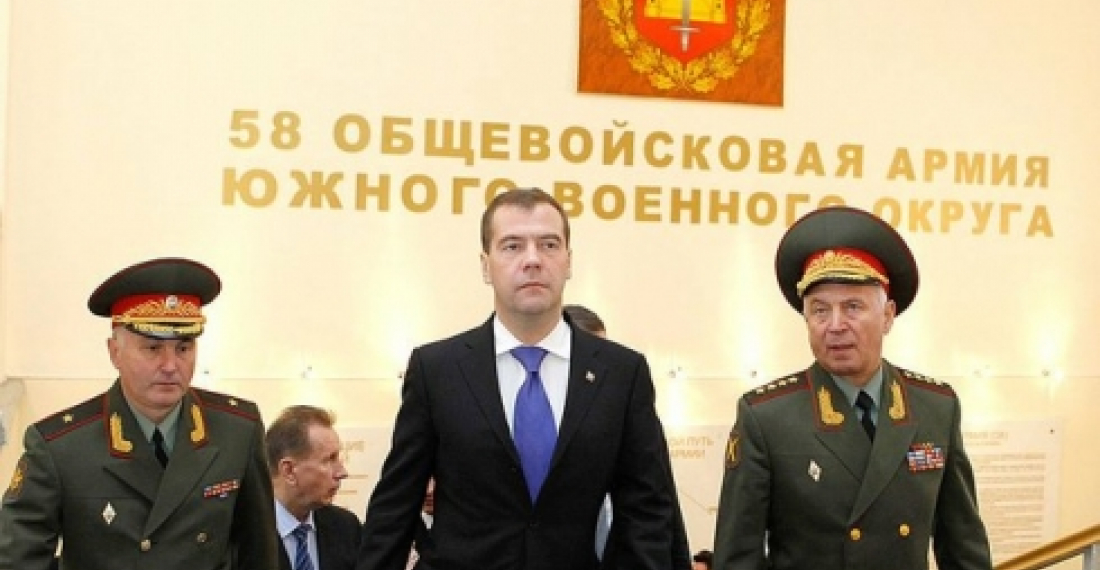
In contrast to this, the ambitious programme for the modernisation of Military and security forces in the North Caucasus was given a boost this week with the visit of President Dimitri Medvedev to the Southern Military District Command in Vladikavkaz. According to the Press Service of the Russian President the subjects discussed included new arms and equipment for the armed forces, higher service pay, and better service conditions. The European missile defence issue was also discussed. Earlier reports in the Russian media indicated that the process of modernisation of the Armed Forces was already very advanced in the North Caucasus when compared to other military regions.
For some time the Kremlin has been balancing a tough military and security posture in the North Caucasus with plans for a generous development programme aimed at addressing the root causes of the insurgency that has distabilised the region over the last decade. It seems now that it is abandoning, or at least much reducing its development programme, whilst generously supporting its military build up.
In Makhachkala Presidential envoy Khloponin also spoke about the need to boost civil society institutions and strenghten the judiciary. "The development of civil society institutions and an independent judicial system are the main instruments for counteracting corruption. These are two key factors that should significantly affect negative processes which are taking shape in the public", Regnum news agency quoted him as saying. However many consider that these are empty words unless they can be backed up with an ambitious economic development programme that can bring the region into the 21st century.
source: commonspace.eu with reporting from Nezavisimaya Gazeta, Regnum News Agency, Itar-Tass and kremlin.ru
photo: President Medvedev arriving for a meeting with officers of the Southern Military District at the 58th Army headquarters, with Army General Nikolai Makarov, the chief of the General Staff of the Russian Armed Forces (right) on Monday, 21 November 2011. (Picture courtesy of the Press Service of the president of Russia).



