


Commentary: Central Asia is safer together

Whilst it is often the case that the five Central Asian republics are lumped together and seen by outsiders as one group, in truth there are between them huge differences, a lot of competition, some rivalry, and every now and then, some conflict, writes the commonspace.eu editorial team.

The big two, Kazakhstan and Uzbekistan, are often perceived to be in competition with each other. The two have different strengths and weaknesses, which means that if they play their cards right they can turn this competition into a healthy collaborative relationship with a win-win situation.

This is what appears to be happening at the moment.

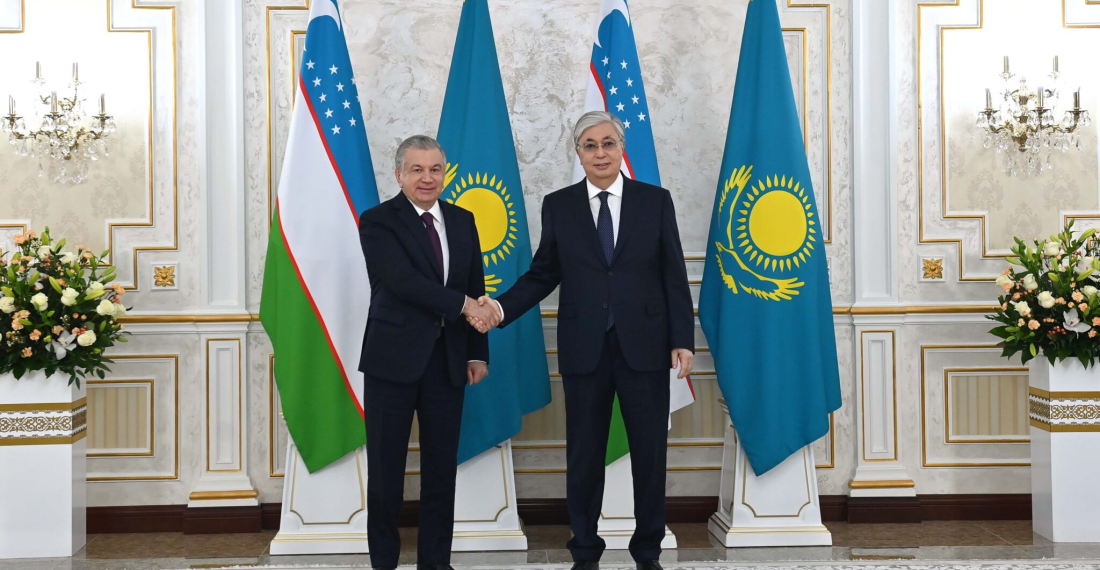
Kazakh President, Kassym-Jomart Tokayev, met his Uzbek counterpart Shavkat Mirziyoyev in Shymkent on 3 March to discuss “trade and prospects for strengthening allied relations between the two countries”. The Kazakh presidential administration described the meeting as “informal”.

The two leaders appear to have two priorities. The first is to co-ordinate positions in the face of what appears to be considerable pressure from Moscow for the two countries to tow the line and stay in the fold, at a time when the Kremlin feels embattled due to the ongoing war in Ukraine. 

The second priority of the two presidents seems to be a desire to ensure that the many documents on major areas of co-operation, including the treaty on allied relations and an agreement on border demarcation, which they signed during Tokayev’s state visit to Tashkent in December 2022, are realised and fulfilled.  The 40 agreements signed in December envisioned 40 economic initiatives worth $2.5 billion. 

The official statement at the end of the meeting said that: 

“in Shymkent, the presidents focused on trade and economic cooperation, including opportunities for strengthening mutual trade, attracting investments, and expanding collaboration in the industrial, energy, agricultural, transportation, and logistics sectors. They also exchanged views on regional issues.”

Both countries are very cautiously exploring political reforms, and more boldly, seeking economic reform. The two leaders are firmly entrenched, but are vulnerable to threats, including from their own elites. They appear to be developing strong personal bonds, which can be very useful, especially in times of crisis.

The meeting in Shymkent came immediately after the two leaders received in their respective capitals US Secretary of State, Antony Blinken. Making a point of going to both Astana and Tashkent, Blinken once more emphasised the importance of Kazakhstan and Uzbekistan in the region, and no doubt encouraged the two to increase the co-operation between them.
Image
a
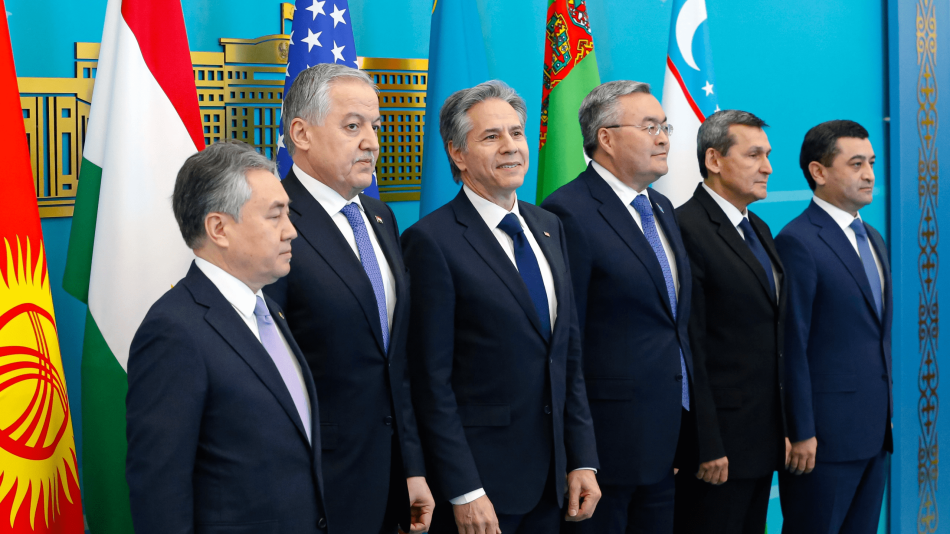
US Secretary of State Antony Blinken meets with Central Asian foreign ministers last week. westernslopenow.com

Blinken signals a firm but nuanced US approach to Central Asia

US Secretary of State Antony Blinken visited Central Asia last week, first going to Astana where he met President Tokayev and where he participated in the regular meeting of the C5+1 – a forum bringing together the five Central Asian nations with the United States. He then went on to Tashkent to meet President Mirziyoyev.

In the region Blinken took the opportunity to restate the US position towards the Central Asian republics namely, “enduring support for their sovereignty, for their independence, for their territorial integrity”, and US “determination that each be able to determine their own futures consistent with those principles.”

But Blinken was quick to also add the economic dimension of the US relationship with the region. He stated:

“a big part of the work that we’re doing here is to help the region diversify trade relationships, to build new partnerships and relationships with other countries, including with the United States, so they’re not dependent on any one country or any one source for trade and investment, and at the same time to increase trade and investment within Central Asia itself.  There’s a very strong potential market here, and the more connectivity we have among the countries of Central Asia, the more collaboration we have, the stronger that market’s going to be, the more investment it’s going to attract from outside of Central Asia.”

Blinken however made it clear that the US will move cautiously:

“Central Asia is in a complicated part of the world with longstanding relationships with different countries based on history, based on geography, and that’s something that we well understand. But I think we also see each of these countries looking to multiply and deepen their relationships and partnerships with other countries around the world.  And in that, the United States wants to be a steadfast partner and a partner that works with them to create new opportunities for people in this region and new opportunities for us to work together.”

The visit of the US Secretary of State to Central Asia was as timely as it was important. As the region works to break out of its Russian straightjacket, an intelligent and well calibrated US approach is hugely important.
Image
a
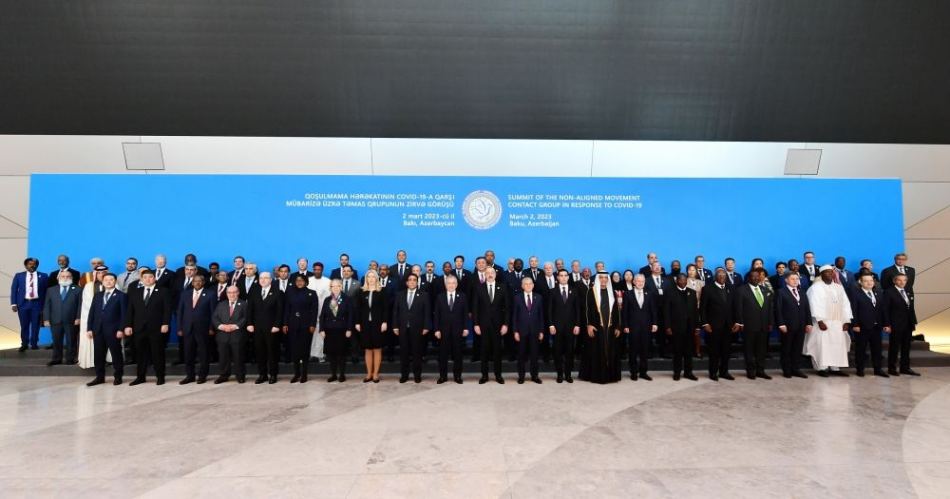
Non-Aligned Movement meeting on COVID-19 recovery on 2 March 2023 in Baku. APA.

 Guests of honour in Baku

On 2 March, Azerbaijan hosted a meeting of the contact group of the Non-Aligned Movement (NAM) focusing on the recovery from the Covid-19 pandemic. Azerbaijan currently holds the Chairmanship of the Movement, which has around 120 member states, mostly in the global south. Whilst most delegations were led by the vice-presidents, prime ministers or foreign ministers, Uzbekistan and Turkmenistan were represented by their presidents, and they were clearly the guests of honour at the event.

Baku has been seeking for some time to nurture relations with the Central Asian republics and it appears to be making progress. Azerbaijan is keen to consolidate connectivity links with Central Asia, and to provide the alternative corridor for the export of energy and other goods from the region to European markets. But there is also a political angle. Azerbaijan has generally been supported by Central Asian countries in its dispute with Armenia. It also sees the Central Asian republics as allies in its efforts to manage relations with Moscow. 

So the presence in Baku of the presidents of Uzbekistan and Turkmenistan was very well received by the Azerbaijani leadership, and reflects a broader sense of increased co-operation between Azerbaijan and the Central Asian region.
source: commonspace.eu editorial team
photo: Akorda press service
The views expressed in opinion pieces and commentaries do not necessarily reflect the position of commonspace.eu or its partners

Related articles

Editor's choice
News
Russia adds pressure on Armenia ahead of key elections; recalls Ambassador in Yerevan for consultations

Russia adds pressure on Armenia ahead of key elections; recalls Ambassador in Yerevan for consultations

Ahead of key parliamentary elections,scheduled to be held in Armenia on Sunday, 7 June, Russia continues to attempt to put pressure on the Armenian Government led by prime minister Nikol Pashinyan. On 30 May, Russia recalled its Ambassador to Yerevan for consultations. A terse statement, published on the website of the Russian Foreign Ministry, said, "The Ambassador of the Russian Federation to the Republic of Armenia , S.P. Kopyrkin, has been summoned to Moscow for consultations in connection with the steps taken by the Armenian leadership to move closer to the European Union, which are detrimental to cooperation within the EAEU." This followed a statement issued the day before, by the leaders of the Eurasian Economic Union (EAEU) that challenges the Armenian trajectory towards approximating to the European Union. Vladimir Putin is undertood to have personally pushed the other four EAEU leaders to issue the statement, which said: "Taking into account the significant risks to the economic security of the member states of the Eurasian Economic Union (hereinafter referred to as the Union) arising in connection with the preparation of the Republic of Armenia for accession to the European Union, as well as the need to prevent the associated damage to the member states of the Union: decided that the members of the Eurasian Intergovernmental Council from the Republic of Belarus, the Republic of Kazakhstan, the Kyrgyz Republic and the Russian Federation will report at the next meeting of the Supreme Eurasian Economic Council in December 2026 on the possible consequences of the suspension of the Treaty on the Eurasian Economic Union with respect to the Republic of Armenia. We share the position on the need to hold a national referendum in the Republic of Armenia as soon as possible on joining the European Union or continuing to be part of the Eurasian Economic Union."
Editor's choice
News
The leaders of the states of the Eurasian Economic Union issued a tough statement warning fellow-member state Armenia of the consequences of its desire to join the European Union.

The leaders of the states of the Eurasian Economic Union issued a tough statement warning fellow-member state Armenia of the consequences of its desire to join the European Union.

The leaders of the states of the Eurasian Economic Union (EEAS) issued a tough statement warning fellow-member state Armenia of the consequences of its desire to join the European Union. The stark, sharply worded,  warning, comes days before crucial parliamentary elections in Armenia, scheduled for 7 June. The full statement said, “We, the Presidents of the Republic of Belarus, the Republic of Kazakhstan, the Kyrgyz Republic and the Russian Federation, Taking into account the actions of the Republic of Armenia aimed at joining the European Union, including the approval in 2025 by the National Assembly of the Republic of Armenia and the signing by the President of the Republic of Armenia of the Law of the Republic of Armenia "On the Start of the Process of Accession of the Republic of Armenia to the European Union", as well as the confirmation by the European Union of the European aspirations of the Government of the Republic of Armenia, expressed in the joint declaration following the first Armenia-European Union summit, adopted on 5 May 2026, Taking into account the significant risks to the economic security of the member states of the Eurasian Economic Union (hereinafter referred to as the Union) arising in connection with the preparation of the Republic of Armenia for accession to the European Union, as well as the need to prevent the associated damage to the member states of the Union: decided that the members of the Eurasian Intergovernmental Council from the Republic of Belarus, the Republic of Kazakhstan, the Kyrgyz Republic and the Russian Federation will report at the next meeting of the Supreme Eurasian Economic Council in December 2026 on the possible consequences of the suspension of the Treaty on the Eurasian Economic Union with respect to the Republic of Armenia. We share the position on the need to hold a national referendum in the Republic of Armenia as soon as possible on joining the European Union or continuing to be part of the Eurasian Economic Union. Astana, May 29, 2026” A meeting of the Supreme Eurasian Economic Council was held in Astana, Kazakhstan, on May 29, 2026. The meeting of the Supreme Eurasian Economic Council in a restricted format was attended by Russian President Vladimir Putin, Belarusian President Alexander Lukashenko , Kazakh President Kassym-Jomart Tokayev , Kyrgyz President Sadyr Japarov , Armenian Deputy Prime Minister Mher Grigoryan, and Chairman of the Board of the Eurasian Economic Commission Bakytzhan Sagintayev. From the Russian side, the meeting was also attended by Deputy Prime Minister and member of the Council of the Eurasian Economic Commission Alexey Overchuk and Presidential Aide Yury Ushakov . The heads of delegations from EAEU observer states, including President of Uzbekistan Shavkat Mirziyoyev , Vice President of Cuba Salvador Valdés Mesa, Minister of Industry, Mines, and Trade of Iran Mohammad Atabak, and CIS Secretary General Sergei Lebedev, joined the expanded meeting . Following the meeting of the Supreme Eurasian Economic Council, a number of documents were signed .

Popular

Editor's choice
Interview
Thursday Interview: Murad Muradov

Thursday Interview: Murad Muradov

Today, commonspace.eu starts a new regular weekly series. THURSDAY INTERVIEW, conducted by Lauri Nikulainen, will host  persons who are thinkers, opinion shapers, and implementors in their countries and spheres. We start the series with an interview with Murad Muradov, a leading person in Azerbaijan's think tank community. He is also the first co-chair of the Action Committee for a new Armenian-Azerbaijani Dialogue. Last September he made history by being the first Azerbaijani civil society activist to visit Armenia after the 44 day war, and the start of the peace process. Speaking about this visit Murad Muradov said: "My experience was largely positive. My negative expectations luckily didn’t play out. The discussions were respectful, the panel format bringing together experts from Armenia, Azerbaijan, and Turkey was particularly valuable during the NATO Rose-Roth Seminar in Yerevan, and media coverage, while varied in tone, remained largely constructive. Some media outlets though attempted to represent me as more of a government mouthpiece than an independent expert, which was totally misleading.  Overall, I see these initiatives as important steps in rebuilding trust and normalising professional engagement. The fact that soon a larger Azerbaijani civil society visits to Armenia followed, reinforces the sense that this process is moving in the right direction." (click the image to read the interview in full)

