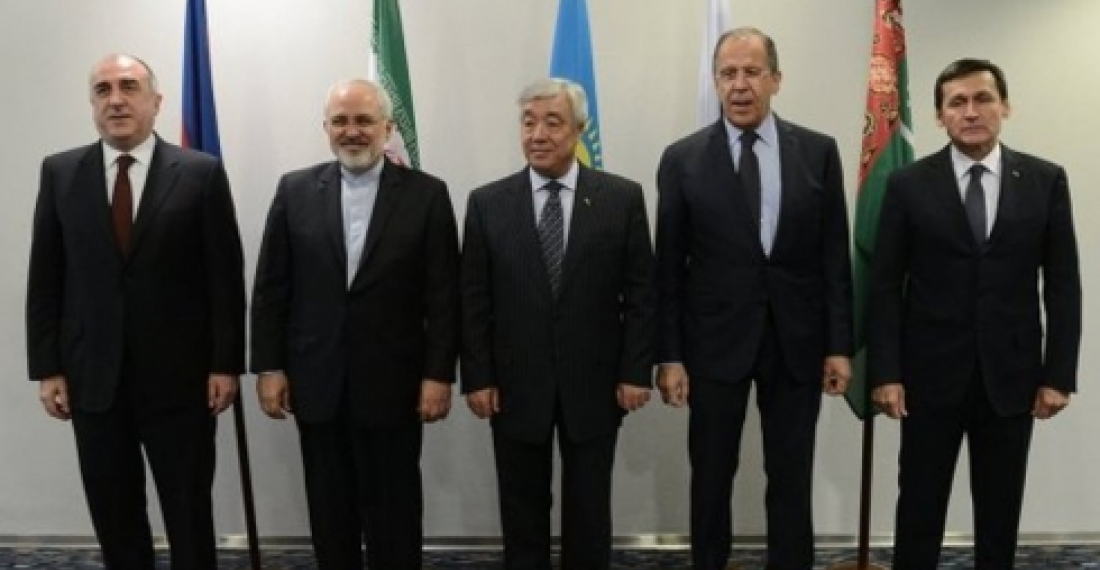
The Foreign Ministers of the five Caspian littoral countries met in Moscow yesterday to discuss issues related to the region and to prepare for the next summit of Caspian leaders which will be held in Astrakhan in the summer. The Presidents of Azerbaijan, Kazhakstan, Iran, Russia and Turkmenistan last met in Baku in 2010.
Comments made by the representatives of the five states after the Moscow meeting indicate that some tough negotiations are ongoing as each state tries to protect its interests. Russia and Iran are particularly keen to keep other countries apart from the littoral five out of the sea, both militarily and economically.
Iranian Foreign Minister Mohammad Javad Zarif stressed that the common goal of the Caspian states is to prevent a military buildup in the region and "to turn the Caspian Sea into a sea of peace, friendliness and stability, to refrain from an arms race, to give up the use of military force and to prevent the non-coastal states from deploying their troops These are the major conditions to secure peace and stability in the region," said Zarif.
The Russian Foreign Minister Sergei Lavrov said that Moscow sees a need for enhanced cooperation between the countries bordering the Caspian Sea to boost discussion on mutual issues. "It is obvious now that the shared trans-Caspian agenda necessitates the strengthening of further cooperation mechanisms and, possibly, the creation of new forums to ensure the effectiveness of efforts," the Russian News Agency RIA-Novosti quoted Lavrov as saying.
Both Russia and Iran have been keen to exclude and US or EU presence in the Caspian Sea and hope that they could enshrine provisions on this in a new Caspian Convention. However no agreement on such a convention has been reached yet, and it seems that at their meeting in Moscow the foreign ministers left all the hard decisions to be taken by their Presidents when they meet in September.
Turkmenistan and Azerbaijan have emerged as pivitol countries in defining the future of the Caspian. The two countries have some differences over the delineations of their respective zones in the Caspian Basin but Azerbaijani Foreign Minister Elmar Mammadyarov, speaking on his return to Baku, dismissed rumours of problems and was quite upbeat on the results of the meeting.The minister said that Azerbaijan plans to turn the Caspian Sea into a sea of cooperation and security, adding that in Moscow "the parties have made a big step in determining the status of the sea." Mammadyarov added that all five countries are interested in making progress on this issue and another meeting will be held in Tehran at the level of deputy ministers in June." The Minister said that if necessary the Foreign Ministers will meet again before the September Summit in Astrakhan.
Speaking in Baku at an international conference, Azerbaijani Energy Minister Natig Aliyev said that "an energy corridor is being created between the Caspian region and Europe, which begins in Azerbaijan and will extend up to Italy." The Minister said that more than $ 50 billion will be required to ensure the gas supply as part of the second phase of development of Azerbaijani offshore gas condensate Shah Deniz field to the European market. The Minister said that the proven oil reserves of the region were now estimated at between 3.5% - 4%, while the proven gas reserves were estimated at between 7%-11% of the proven world reserves. The Minister added that hydrocarbon reserves of the Caspian region will double by 2035 as a result of new findings.
source: commonspace.eu
photo: The Foreign Ministers of the five Caspian Sea states at their meeting in Moscow on 22 April 2014 (picture courtesy of RIA NovostI).